MSc Thesis Defence: Generating and Evaluating Exam Questions Using LLMs and HPC

On October 21, 2026, MSc candidate Sara Kovačević successfully defended her thesis entitled “Generation and Quality Evaluation of Exam Questions Using Large Language Models and HPC Infrastructure” within the Artificial Intelligence Master’s programme at the Faculty of Information Systems and Technologies, University of Donja Gorica (UDG). The thesis was supervised by Prof. Dr. Tomo Popović. The research was partially supported by NCC Montenegro within the EuroCC3 project, including access to HPC infrastructure and support for experimental work. The study demonstrates the potential of combining generative AI and high-performance computing to support the preparation and evaluation of educational materials, with particular attention to the Montenegrin language.
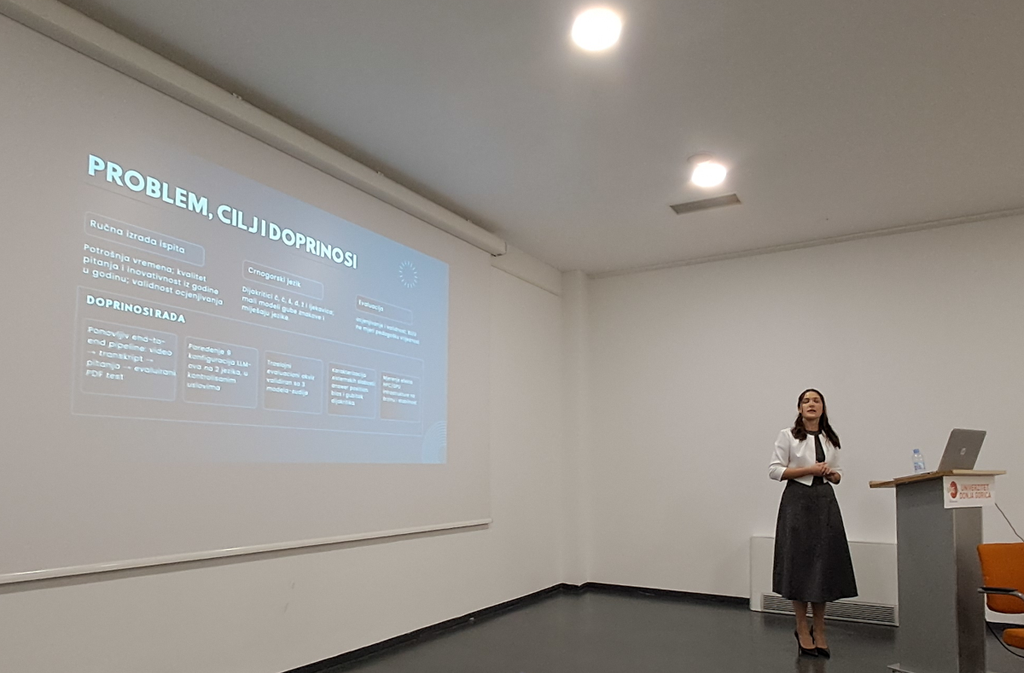
Ms Sara Kovacevic at her MSc thesis defence

ABSTRACT – This thesis presents the development and evaluation of an automated system for generating exam questions from video lectures using large language models (LLMs). The system integrates automatic transcription, extraction of key concepts, generation of multiple-choice and short-answer questions, and automated quality assessment. Nine LLM configurations were evaluated in English and Montenegrin, using local computing resources, the UDG HPC cluster, and API-based inference services.

The evaluation combined linguistic and structural metrics, Bloom’s taxonomy, and an LLM-as-Judge approach to assess the quality of generated questions. Experimental results highlighted challenges faced by smaller models when generating educational content in Montenegrin, while larger models achieved more consistent results. Experiments on the UDG HPC cluster demonstrated a 17.9× GPU speedup compared with CPU inference for the same model.

The research highlights the potential of AI and HPC technologies to assist educators in preparing assessment materials, while emphasizing the importance of human review and further pedagogical validation before practical deployment.
MSc Thesis Defence: Explainable AI for Type 2 Diabetes Risk Assessment

On October 21, 2026, MSc candidate Sanja Lazić successfully defended her thesis entitled “Interpretable Machine Learning and Deep Learning Models for Type 2 Diabetes Risk Prediction Based on Behavioural and Clinical Indicators” within the Artificial Intelligence Master’s programme at the University of Donja Gorica, Faculty for Information Systems and Technologies, under the mentorship of Prof. Dr. Tomo Popović.

The research and experimental work were partially supported by NCC Montenegro through HPC infrastructure and expertise within the EuroCC3 project, with additional research support from the AI-AGE project. Through its involvement in academic research, mentoring, and competence development, NCC Montenegro contributes to strengthening the application of advanced AI and HPC technologies in healthcare and other scientific domains.

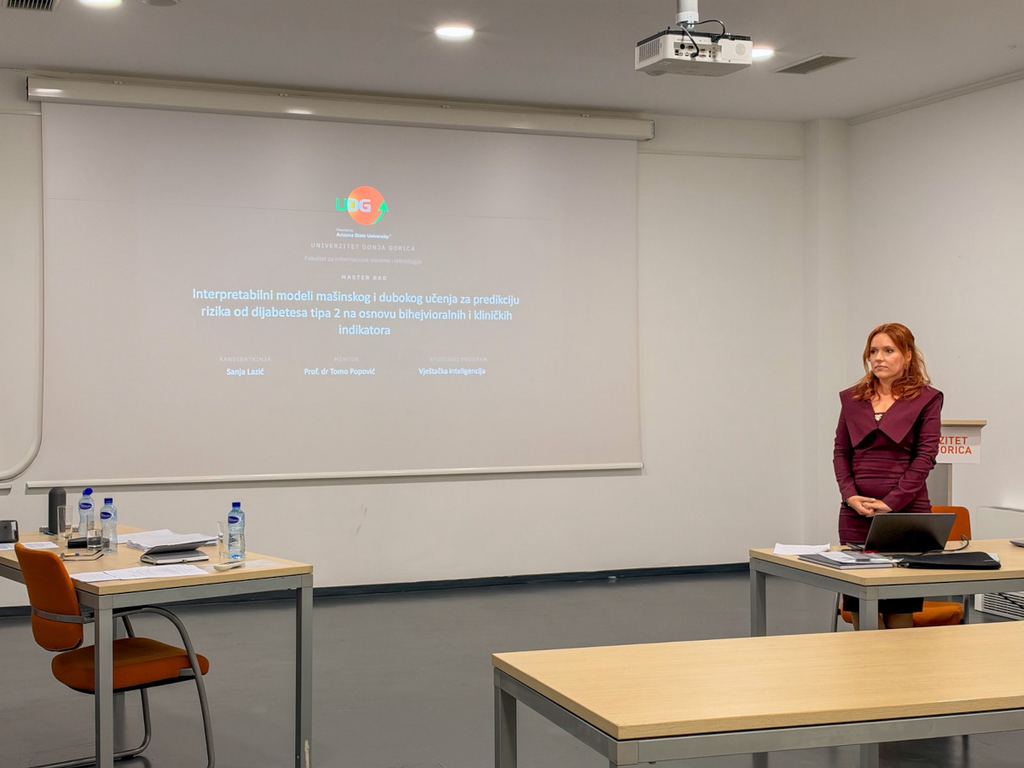
Ms Sanja Lazić during her MSc thesis defence

The thesis investigates the application of machine learning, deep learning, and explainable AI techniques to type 2 diabetes risk assessment, focusing on predictive performance, reliability, and interpretability. The research also demonstrates how AI models can support preventive healthcare through accessible, questionnaire-based risk assessment without requiring laboratory measurements.

ABSTRACT – This thesis presents the development and systematic evaluation of machine learning and deep learning models for type 2 diabetes risk assessment using behavioural, clinical, and demographic indicators. The study analysed 253,680 records and compared five models: Logistic Regression, Random Forest, XGBoost, LightGBM, and a deep neural network. Model performance was evaluated in terms of discrimination, probability calibration, and interpretability. While the deep neural network achieved the highest ROC-AUC (0.7728), LightGBM demonstrated the most balanced overall performance. Explainable AI methods, including TreeSHAP, Integrated Gradients, and DeepLIFT SHAP, were applied to identify factors contributing to model predictions. A prototype web application was developed to demonstrate how estimated risks and their explanations could be presented to users.

The results demonstrate the potential of explainable AI for supporting non-invasive risk assessment and preventive screening, while highlighting the importance of model reliability, transparency, and further validation before clinical application.

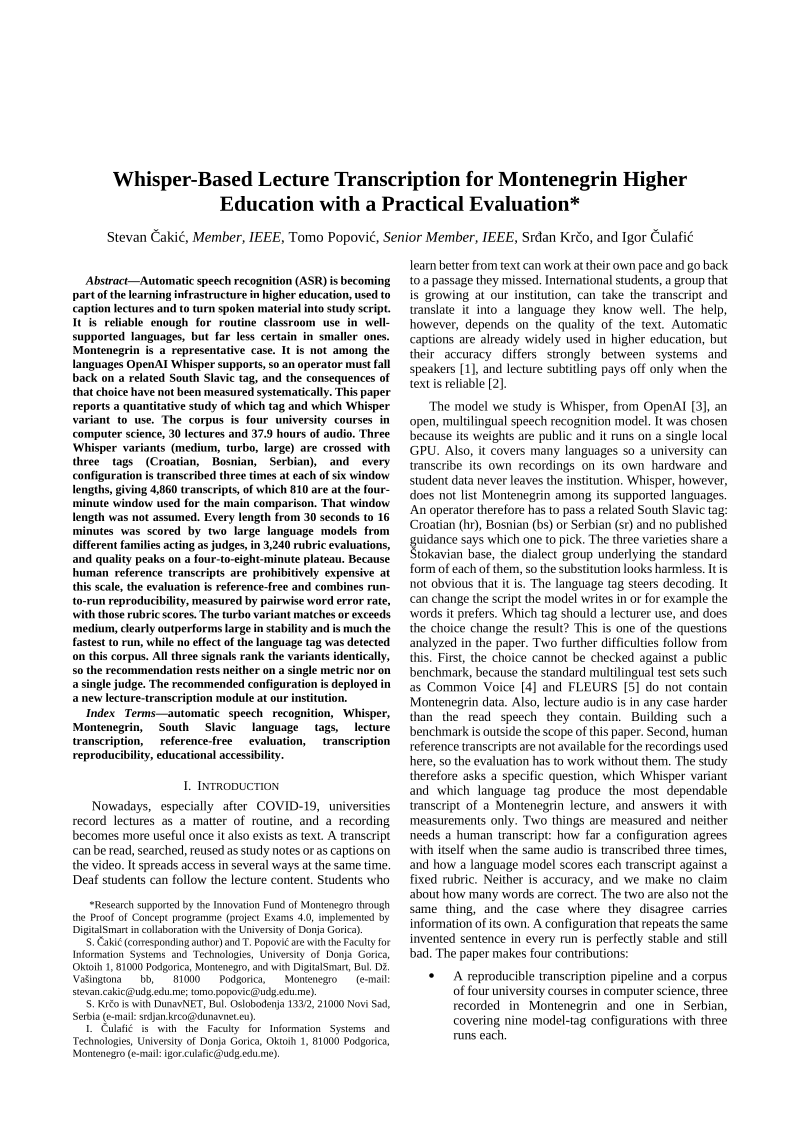
EuroHPC-Supported Research Advances AI-Based Lecture Transcription for Montenegrin

Results from the Exams 4.0 Proof of Concept project, supported by the Innovation Fund of Montenegro and EuroHPC computing resources, were presented at the international SAMYRAD 2026 conference in Seville, Spain.

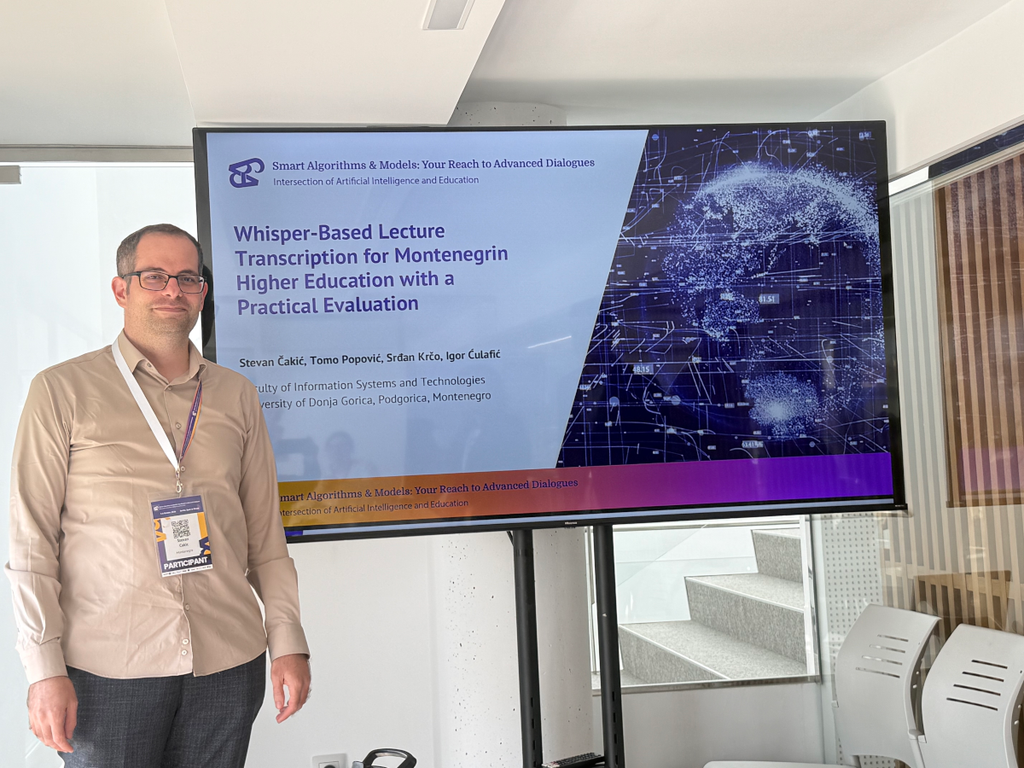
The paper “Whisper-Based Lecture Transcription for Montenegrin Higher Education with a Practical Evaluation” was presented at the Smart Algorithms & Models: Your Reach to Advanced Dialogues (SAMYRAD 2026) conference, held on 5–6 October 2026 in Seville, Spain.

Authored by Stevan Čakić, Tomo Popović, Srđan Krčo, and Igor Čulafić, the paper investigates the use of OpenAI Whisper models for automatic transcription of university lectures in Montenegrin, a language not directly supported by Whisper.

The study evaluated three Whisper model variants and three related South Slavic language settings using 30 university lectures covering nearly 38 hours of audio. The experimental work involved generating 4,860 transcripts, with large-scale processing performed on the LUMI EuroHPC supercomputer in Finland.

The results identified Whisper’s turbo variant as the most suitable among the tested models in terms of transcription consistency, evaluated text quality, and processing speed. The research also provided practical recommendations for processing lecture recordings in Montenegrin.

These findings have already been incorporated into a new lecture-transcription module developed within the Exams 4.0 platform, enabling lecturers to transform audio and video recordings into text that can support AI-assisted preparation of educational materials and examination questions.

This R&D effort was conducted as part of the Exams 4.0 Proof of Concept project, implemented by DigitalSmart in collaboration with the University of Donja Gorica and funded by the Innovation Fund of Montenegro.

HPC Montenegro (NCC Montenegro) supported the research team in securing access to EuroHPC computing resources through the EuroHPC JU Development Access programme (project ID: EHPC-DEV-2024D12-018). The computational experiments were performed on LUMI, hosted by CSC in Finland and the LUMI consortium.

This work demonstrates how access to European HPC infrastructure can support applied AI research, foster innovation in higher education, and contribute to the development of digital tools for smaller and underrepresented languages.