

On October 21, 2026, MSc candidate Sanja Lazić successfully defended her thesis entitled “Interpretable Machine Learning and Deep Learning Models for Type 2 Diabetes Risk Prediction Based on Behavioural and Clinical Indicators” within the Artificial Intelligence Master’s programme at the University of Donja Gorica, Faculty for Information Systems and Technologies, under the mentorship of Prof. Dr. Tomo Popović.
The research and experimental work were partially supported by NCC Montenegro through HPC infrastructure and expertise within the EuroCC3 project, with additional research support from the AI-AGE project. Through its involvement in academic research, mentoring, and competence development, NCC Montenegro contributes to strengthening the application of advanced AI and HPC technologies in healthcare and other scientific domains.
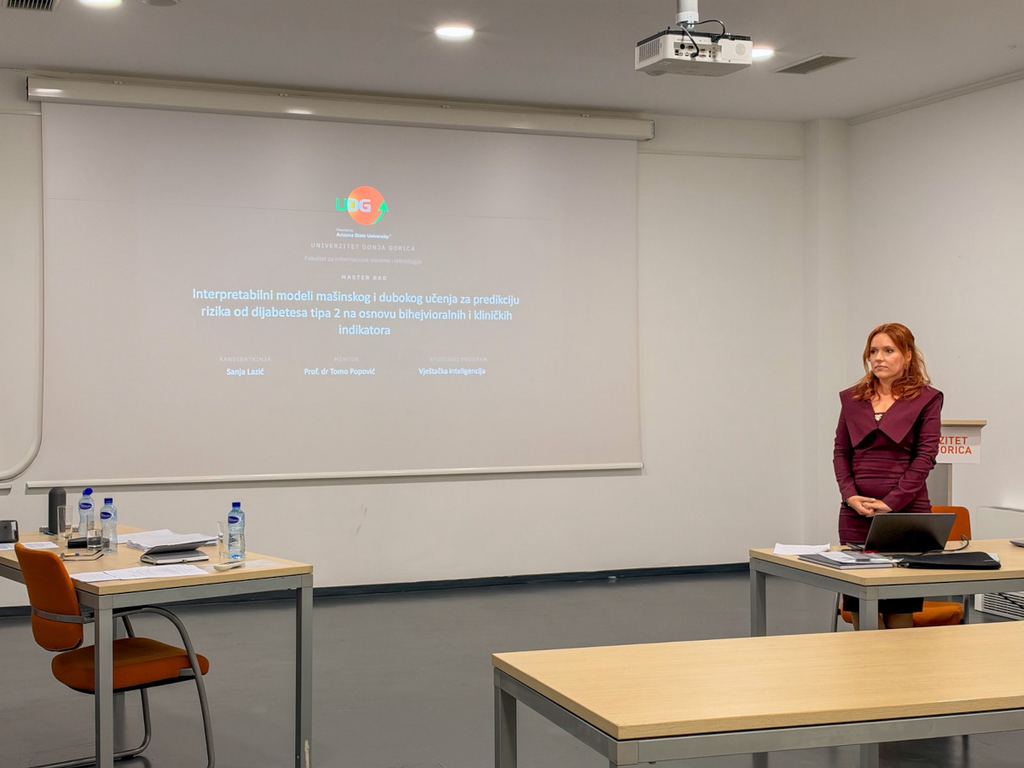
The thesis investigates the application of machine learning, deep learning, and explainable AI techniques to type 2 diabetes risk assessment, focusing on predictive performance, reliability, and interpretability. The research also demonstrates how AI models can support preventive healthcare through accessible, questionnaire-based risk assessment without requiring laboratory measurements.
ABSTRACT – This thesis presents the development and systematic evaluation of machine learning and deep learning models for type 2 diabetes risk assessment using behavioural, clinical, and demographic indicators. The study analysed 253,680 records and compared five models: Logistic Regression, Random Forest, XGBoost, LightGBM, and a deep neural network. Model performance was evaluated in terms of discrimination, probability calibration, and interpretability. While the deep neural network achieved the highest ROC-AUC (0.7728), LightGBM demonstrated the most balanced overall performance. Explainable AI methods, including TreeSHAP, Integrated Gradients, and DeepLIFT SHAP, were applied to identify factors contributing to model predictions. A prototype web application was developed to demonstrate how estimated risks and their explanations could be presented to users.
The results demonstrate the potential of explainable AI for supporting non-invasive risk assessment and preventive screening, while highlighting the importance of model reliability, transparency, and further validation before clinical application.