AIHeal: Using the LUMI Supercomputer to Develop Personalized AI Models for Every Patient

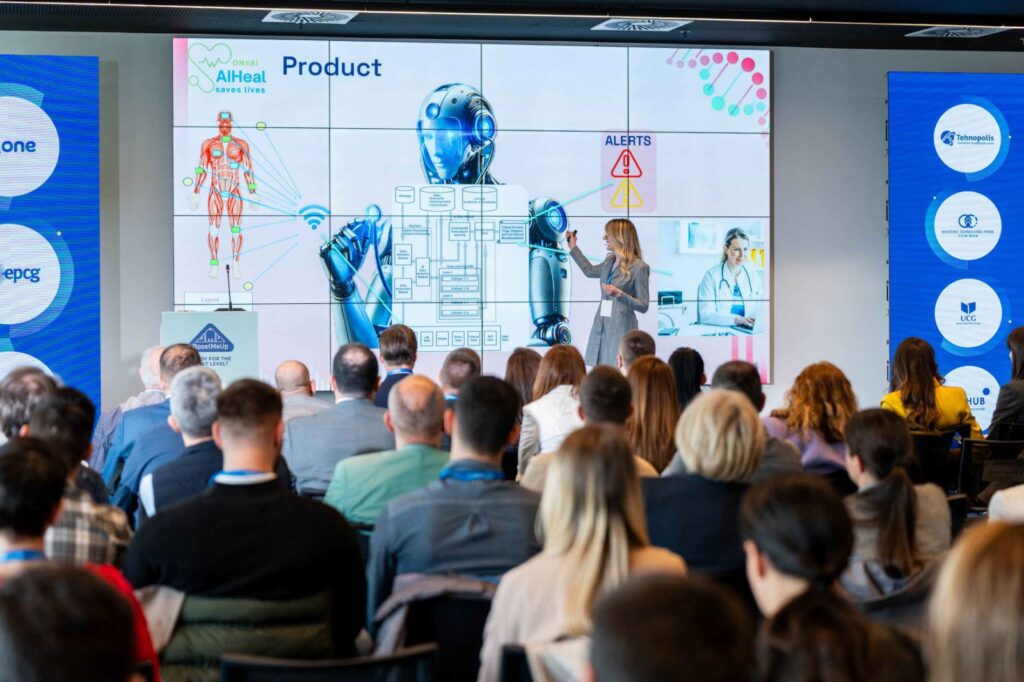
The Montenegrin company ONEAI has successfully carried out a project on the EuroHPC infrastructure, utilizing the LUMI-G supercomputer to develop advanced AI models in the field of ECG signal analysis. Following the successful completion of the previous cycle, the AIHeal project has been granted renewed access to computational resources for the upcoming period.

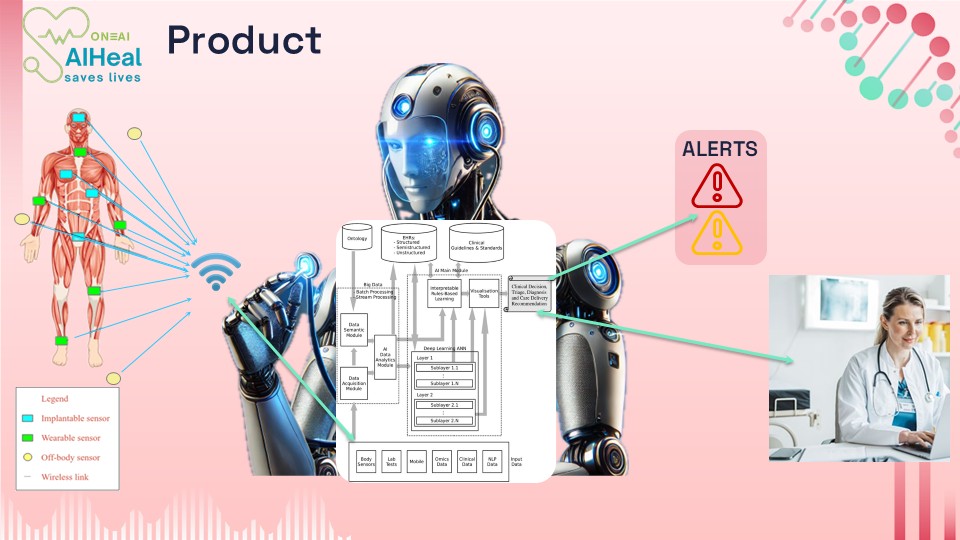
During the previous project, the team developed a dynamic HPC pipeline that enables training personalized models for each individual patient, with the capability for continuous retraining based on new data. The key innovation lies in establishing an integrated system that connects the existing infrastructure with the supercomputer:

  • data is automatically collected from the AIHeal system,
  • sent to the LUMI supercomputer for training,
  • after processing, the models are returned to the production environment and registered in the MLflow system.

This approach enables the creation of “digital twin” patient models, where each model is tailored to the specific characteristics of the individual, significantly improving anomaly detection accuracy compared to generic models.

By leveraging the LUMI infrastructure, the AIHeal team achieved significant acceleration in the model training process, particularly through parallelization across multiple GPU units and the execution of a large number of experiments simultaneously. This enabled faster identification of optimal models and improved the overall quality of the solution.

The project results confirm that HPC resources play a crucial role in the development of scalable and personalized AI systems in healthcare, especially in the context of real-time biomedical data analysis.

AIHeal

The newly approved access to EuroHPC resources will be used for further model improvement, performance optimization, and expansion of the system to cover a broader range of cardiovascular and other health-related indications.

IoT Day 2026: IoT, AI and HPC Shaping the Future of Digital Infrastructure

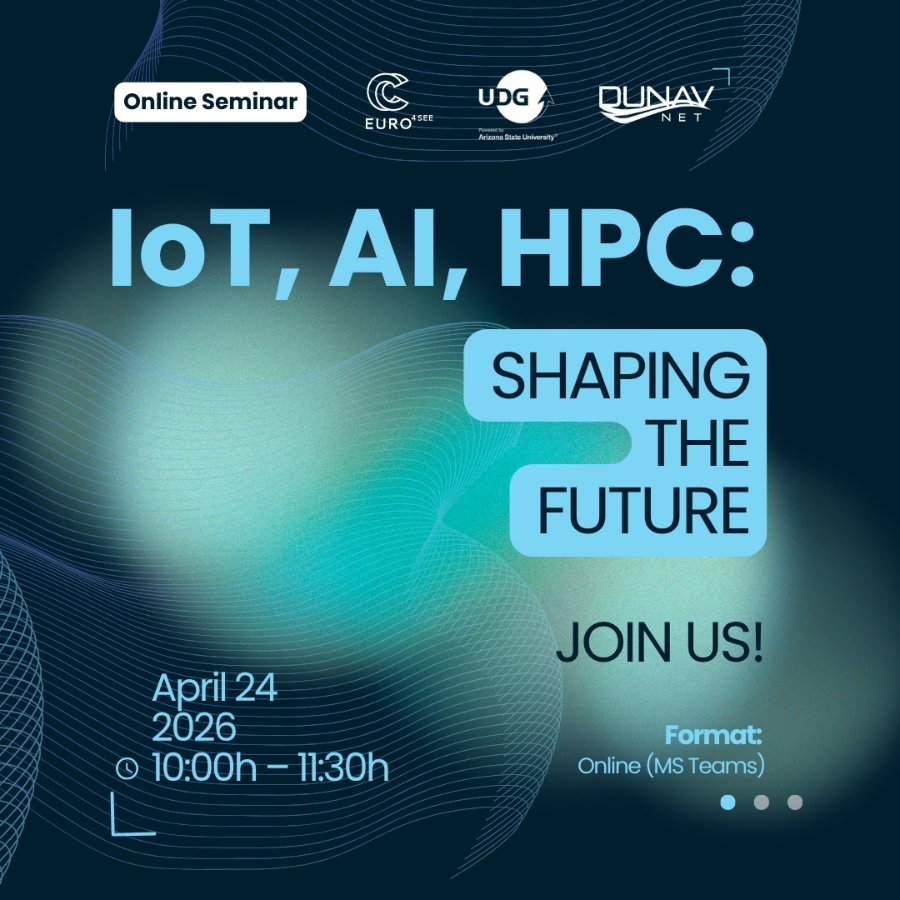
On the occasion of IoT Day 2026, an online seminar titled “IoT, AI, HPC: Shaping the Future” will bring together technologies that are redefining modern digital infrastructure. The event will focus on the practical application of Internet of Things (IoT), Artificial Intelligence (AI) and High-Performance Computing (HPC) in the development of modern digital systems.

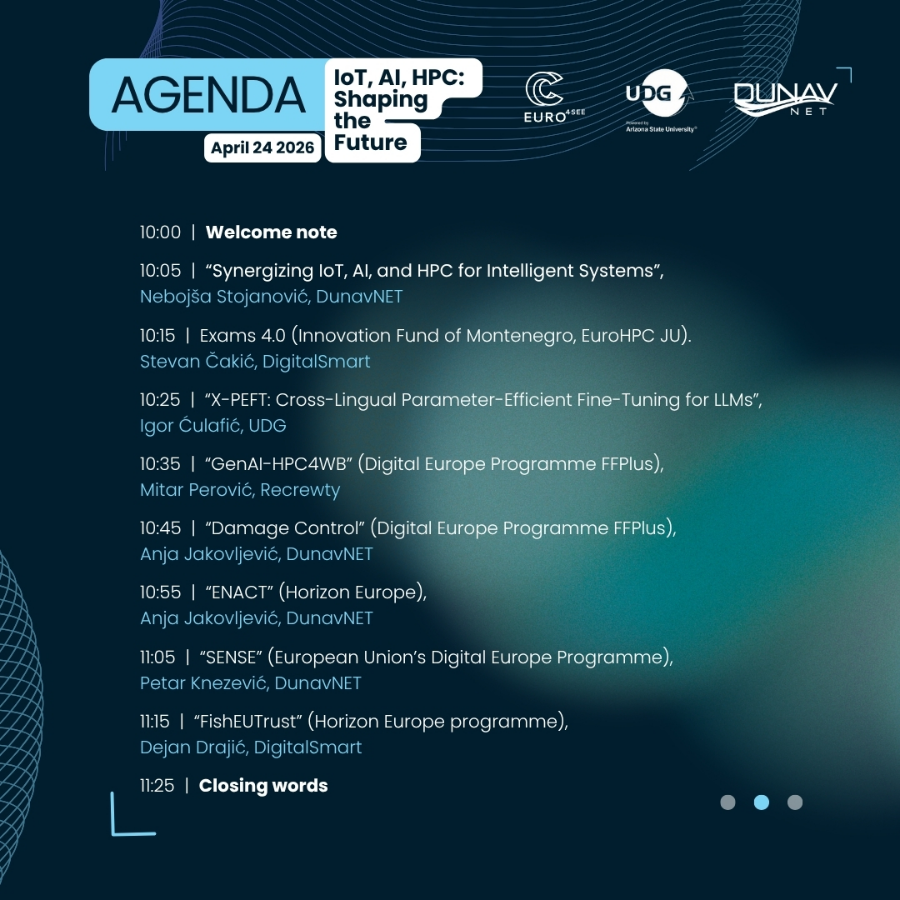
During the seminar, experts from DunavNET, DigitalSmart Montenegro, the University of Donja Gorica, and Recrewty will present the projects and solutions they are currently working on, with a special emphasis on real-world applications of these technologies and their importance for digital transformation.

The speakers include: Nebojša Stojanović, Petar Knežević, Dejan Drajić, Anja Jakovljević, Stevan Čakić, Igor Ćulafić, and Mitar Perović.

📅 April 24, 2026
🕙 10:00–11:30 AM
📍 Online seminar
Organized by: EuroCC 2 & EuroCC4SEE, University of Donja Gorica, and DunavNET

The event is open to researchers, engineers, developers, and everyone interested in current trends and practical applications of IoT, AI, and HPC.

Join via Microsoft Teams (open for everyone):
https://events.teams.microsoft.com/event/da701818-2b37-4111-97d8-dc277e81d88a@a3a630ac-fa20-4e00-baab-ceeede9da950

AI and HPC for Honey Authenticity: PollenTrace at IEEE IT2026

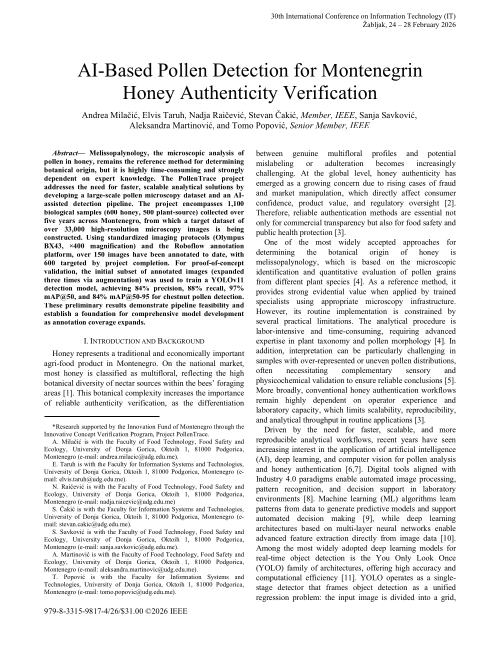
At the IEEE IT2026 conference in Žabljak, researchers from the University of Donja Gorica presented PollenTrace, an innovative project combining Artificial Intelligence and High Performance Computing (HPC) to enhance honey authenticity verification. Traditional pollen analysis (melissopalynology), while reliable, is time-consuming and dependent on expert knowledge. PollenTrace addresses this limitation by developing a large-scale microscopy dataset and an AI-driven detection pipeline capable of automatically identifying pollen grains in honey samples.

The project is building a dataset of over 33,000 high-resolution microscopy images derived from more than 1,100 biological samples collected across Montenegro, enabling the development of robust and scalable AI models. As a proof of concept, a deep learning model based on YOLOv11 was trained on annotated microscopy images, achieving 84% precision and 88% recall, demonstrating strong potential for automated pollen detection and future large-scale deployment.

HPC resources played a key role in enabling efficient model training and handling of high-resolution image datasets, highlighting the importance of national HPC infrastructure—such as that provided through NCC Montenegro -in supporting advanced AI applications in agri-food systems. This is also cross-project collaboration.

PollenTrace represents a step forward toward digital, scalable, and reproducible food authenticity verification, with strong potential to support laboratories, regulatory bodies, and industry in ensuring product quality and consumer trust. PollenTrace is supported as a PoC project by the Innovation Fund of Montenegro.

Researchers from the Faculty of Science and Mathematics published a journal paper on models tested on Leonardo HPC

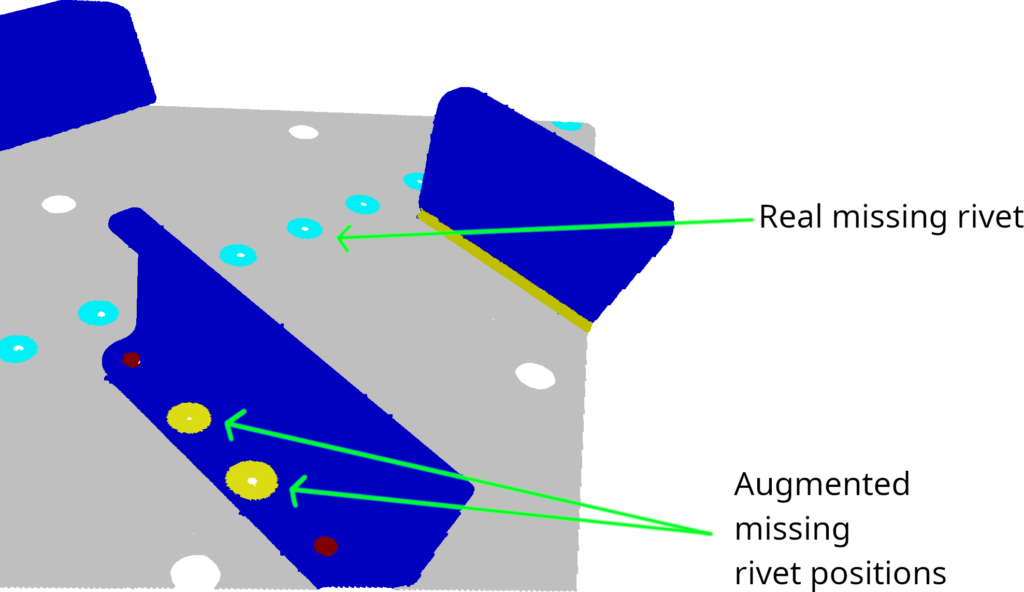
We are pleased to announce that the research team from the Faculty of Science and Mathematics has published a scientific paper titled “Data augmentation for fuselage panel inspection via 3D point cloud segmentation” in the Journal of Electronic Imaging. The paper presents advanced data augmentation methods to improve fuselage panel inspection using 3D point cloud segmentation, contributing to more accurate and reliable AI-based inspection systems. The research was enabled by access to the Leonardo HPC supercomputing resources, granted through the EuroCC2 project, which allowed the team to process large datasets and develop high-performance models efficiently. More info at: https://doi.org/10.1117/1.JEI.35.3.031202

Click on image to open DOI link

PAID MNE Showcased in the EuroCC2/EuroCC4SEE Success Stories Booklet — Powering Smarter Trading with Supercomputing

We are proud to highlight PAID MNE as a featured success story in the EuroCC2 & EuroCC4SEE Booklet — demonstrating how HPC is transforming financial analytics and algorithmic trading.

EuroCC2 & EuroCC4SEE Booklet

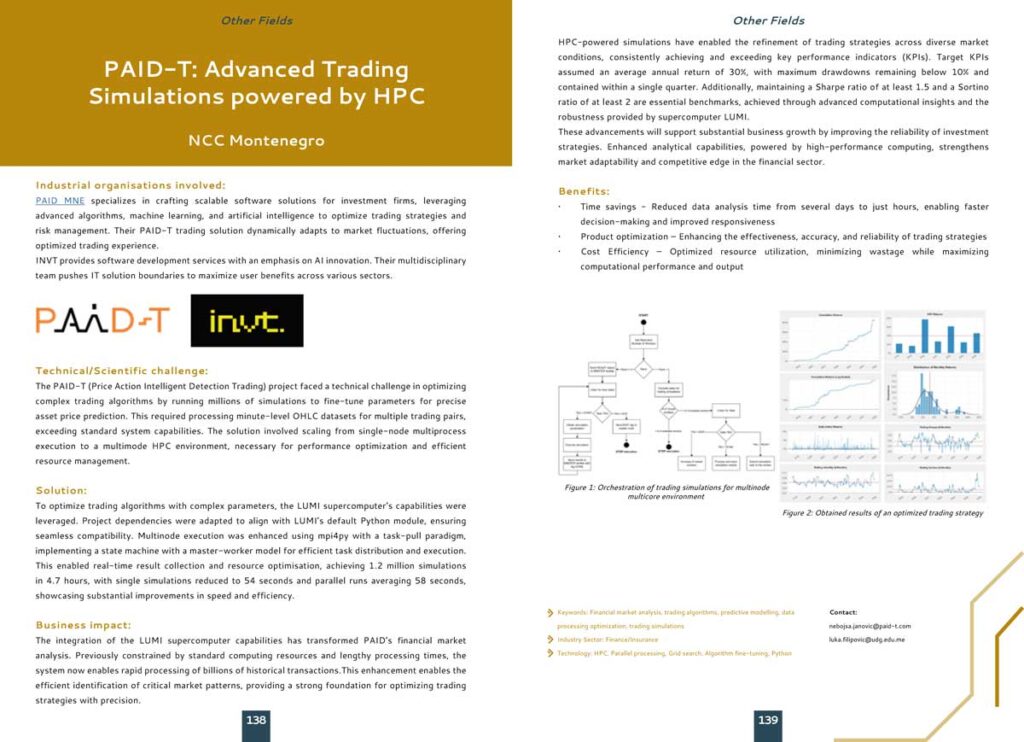
At the heart of PAID MNE innovations lies PAID-T (Price Action Intelligent Detection Trading) — a smart trading platform that leverages advanced algorithms and AI/ML to dynamically adapt to market movements, optimise investment strategies, and manage risk with higher precision. Traditional computing systems quickly reached their limits. To unlock the required performance, the team scaled their solution to the LUMI supercomputer, one of Europe’s most powerful HPC infrastructures. By enabling multinode execution and real-time task distribution, PAID MNE achieved over 1.2 million simulations in under 5 hours — a process that previously would have taken days. This acceleration enables processing billions of historical transactions in hours instead of days, rapid identification of critical market patterns and data-driven optimisation/ increased accuracy of trading strategies.

PAID MNE success story

This achievement, showcased through the EuroCC2/EuroCC4SEE project, demonstrates how supercomputing is becoming a powerful enabler of business innovation. PAID MNE’s journey is a clear example of how HPC and AI together can transform complex, critical data into faster, more profitable decisions.

“Generative AI Intelligent Process Automation Platform” project on Leonardo HPC

Uhura Solutions is developing AI platform for document-driven process automation in financial services. The “Generative AI Intelligent Process Automation Platform – GAIPAP” project is a transformative initiative aimed at revolutionizing the financial industry through the integration of advanced AI-driven automation solutions that combine capabilities of Large Language Model (LLM), low-code development, and process automation workflows. This unique fusion of technologies holds the potential to significantly enhance operational efficiency, cost reduction, and customer experience within the financial sector.

An exceptional aspect of the platform is the incorporation of fine-tuned Large language models (LLMs), which sets it apart from generic AI solutions. These LLMs, refined for the financial industry’s unique language, context, and patterns, promise to deliver more precise and relevant insights. The platform’s value proposition is further strengthened by its ability to streamline workflows, offer scalability, real-time data insights, and elevate customer experiences. The integration of a low-code development framework and process automation workflows enables swift prototyping and deployment of AI-driven models, thereby accelerating time-to-market and capitalizing on market opportunities effectively.

The project involves the use of open-source Python libraries and pre-trained Large language models which are fine-tuned on a custom-made private dataset created by the team, allowing for specialized tasks within the financial sector. Leonardo supercomputer enabled us to make a leap with GPU training experiments from 1B to 7B and higher Large language models. We are focusing on various LLM research and optimization methods in this phase of the project, which include hyperparameter tuning, model quantization and pruning, and parameter efficient fine-tuning (PEFT). Special attention is put on dataset preprocessing including quality filtering, deduplication and privacy redacting.

This project, developed and managed by Uhura Solutions, was awarded with 4,500 node hours of GPU resources (8x64GB) on the Leonardo Buster HPC for a duration of 12 months.

EuroCC success story booklet 2024

The new Success Story Booklet for EuroCC 2024, created in collaboration by CASTIEL and the National Competence Centres (NCCs), is now available online!

The success stories in the EuroCC 2024 booklet span a diverse range of sectors, including:

  • IT and Software
  • Natural Sciences and Aeronautics
  • Environment, Energy, and Agriculture
  • Pharmacy and Medicine
  • Manufacturing and Engineering
  • Finance and Mobility
  • Public and Communication

These stories showcase achievements and innovations across multiple industries, highlighting the wide-reaching impact of EuroCC initiatives.

One of the featured success stories highlights the collaboration between NCC Montenegro and the Montenegrin company Fleka, showcased through the project “Personalized Banking Software Solutions.” This partnership shows how local innovation can create custom ML predictions for the banking sector and personalized financial-tech sector.

Discover inspiring success stories that highlight innovative achievements across Europe.