AI-AGE Research Demonstrates the Potential of Retinal AI for Colorectal Cancer Detection

A new scientific paper developed within the AI-AGE research project, implemented by the University of Donja Gorica (UDG) and the University of Montenegro, has been published in the international journal Current Medical Imaging. The study, titled “Deep Learning Discrimination of Colorectal Cancer using Retinal Fundus Photographs: UK Biobank Case-Control Study,” explores the potential of artificial intelligence (AI) to identify retinal imaging patterns associated with colorectal cancer.

Using 1,600 retinal fundus images from the UK Biobank dataset, the researchers developed a deep learning model based on EfficientNet-B3, achieving an AUROC of 0.945 on an independent participant-level test set. The findings suggest that retinal images may contain valuable information about systemic diseases beyond the eye, opening possibilities for future non-invasive screening and risk assessment approaches. However, further clinical validation is required before such methods can be considered for practical healthcare applications.
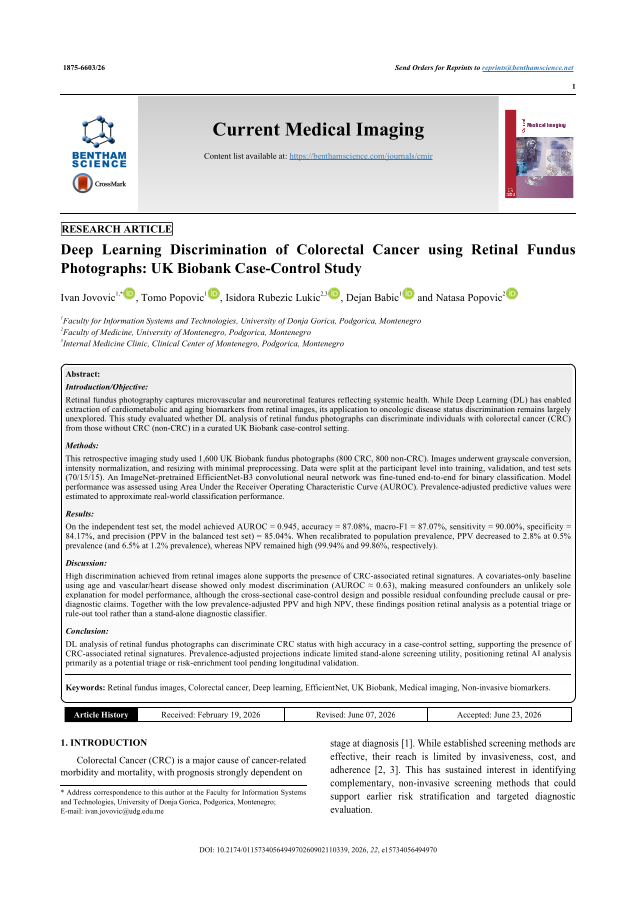
Click on image to open

The research represents an important achievement for the AI-AGE project and demonstrates the growing potential of advanced AI methods in biomedical research in Montenegro. The project benefits from synergies with HPC Montenegro (NCC Montenegro) and the EuroCC initiatives, which support the development of national competencies in High-Performance Computing (HPC), data analytics, and artificial intelligence. This collaboration contributes to strengthening the research infrastructure and expertise needed for computationally demanding medical AI applications.

The AI-AGE project is implemented by the Faculty for Information Systems and Technologies at UDG and the Faculty of Medicine at the University of Montenegro, with funding from the Ministry of Education, Science and Innovation of Montenegro.

Read more:
Artificial Intelligence in Tourism: Meeting Between NCC Montenegro and Korsakov Group

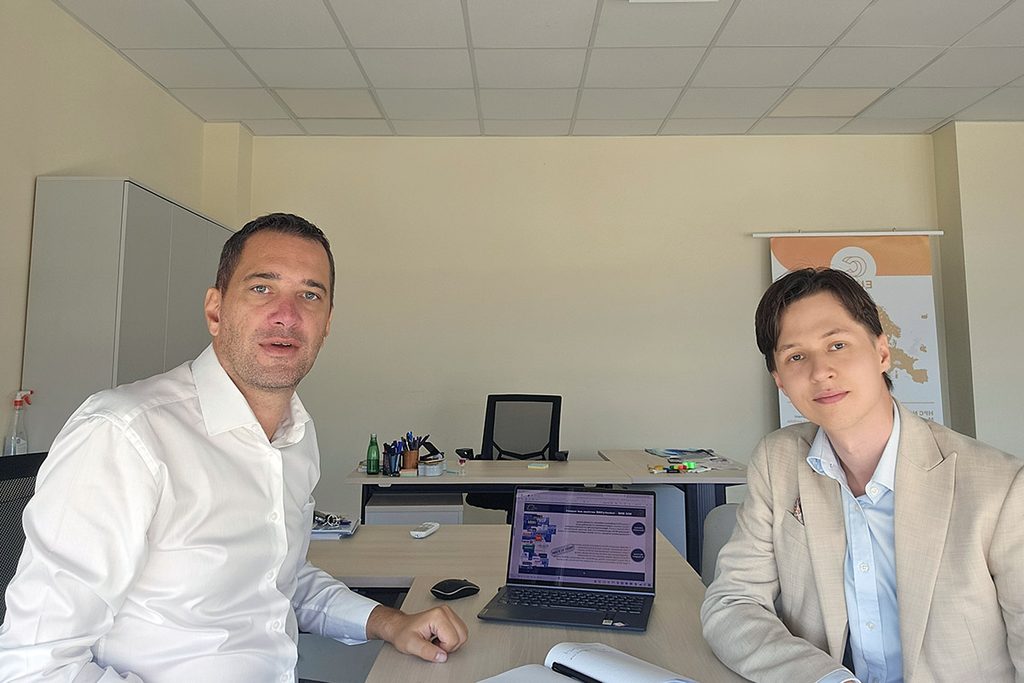
NCC HPC Montenegro welcomed a representative of Korsakov Group in mid-September for talks on cooperation and the use of advanced technologies in tourism. The activities of NCC HPC Montenegro were presented, European EuroCC3 initiative, developing the HPC/AI ecosystem, strengthening digital skills, and supporting industry. The services offered by the center free of charge were also presented — from consultations and HPC/AI maturity assessments to proof-of-concept development and access to European supercomputers.

Particular focus was placed on the application of artificial intelligence in tourism, as one of the strategic sectors of the Montenegrin economy. The participants exchanged ideas on concrete directions for cooperation and joint activities that would put HPC and AI technologies to work in developing tourism services.

FFplus Success Story Highlights HPC-Driven HR Innovation from Montenegro

The FFplus project has published its first Business Experiment Success Stories, presenting how European SMEs and start-ups are using High-Performance Computing (HPC) to address real business challenges and develop new products and services.

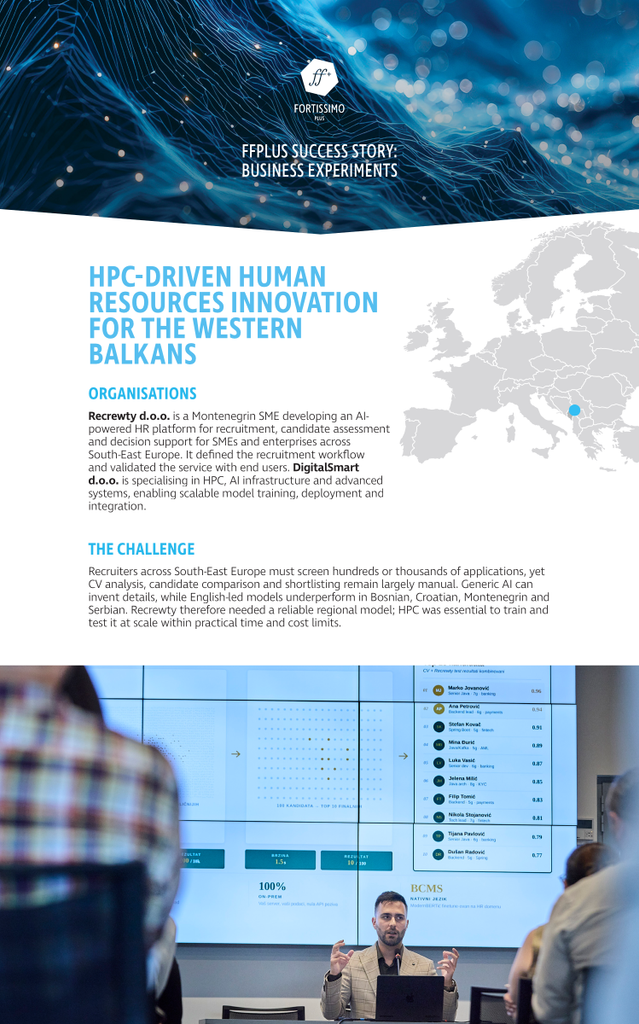
Among the featured examples is GenAI-HPC4WB – Transforming Business Culture and Hiring Through High-Performance Computing, implemented by Recrewty and DigitalSmart. The project used AI, machine learning and HPC to develop language technologies and HR tools adapted to the Western Balkans, with particular focus on Montenegrin, Serbian, Bosnian and Croatian.

Click on image to open.

A key part of the experiment involved training and evaluating advanced language models using the LEONARDO EuroHPC supercomputer at CINECA in Italy. The resulting solutions support tasks such as CV analysis, candidate matching, interview processing and psychometric assessment, while keeping human experts involved in final recruitment decisions.

The published FFplus Success Story highlights the practical business impact of the experiment, including significant reductions in recruitment screening time and the cost of AI-based candidate search.

For NCC Montenegro, this is also an important example of how local companies can benefit from the European HPC ecosystem. Through NCC support, companies can identify relevant funding opportunities, prepare HPC and AI use cases, and access European supercomputing resources for experimentation and development.

Read the full FFplus Success Story: HPC-Driven Human Resources Innovation for the Western Balkans:
https://www.ffplus-project.eu/en/success-stories/hpc-driven-human-resources-innovation-for-the-western-balkans/

Acknowledgements

The GenAI-HPC4WB Business Experiment received funding from the European High-Performance Computing Joint Undertaking (EuroHPC JU) under grant agreement No. 101163317. The JU receives support from the Digital Europe Programme.

We acknowledge the EuroHPC Joint Undertaking for awarding the project access to the LEONARDO EuroHPC supercomputer, hosted by CINECA, Italy, through a EuroHPC Development Access call.