NCC Montenegro Announces Short Course: 3D Printing, Generative AI & HPC-Enabled Design

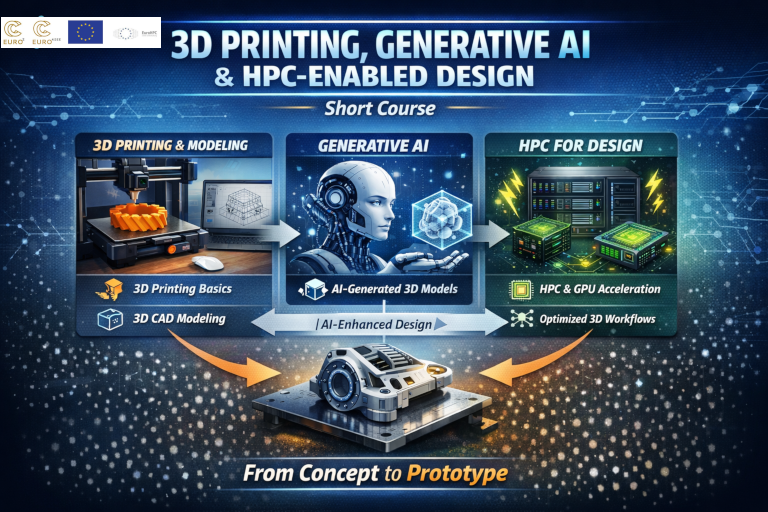
The National Competence Center for High Performance Computing (NCC Montenegro) is launching a short course dedicated to the emerging intersection of 3D printing, generative artificial intelligence, and high-performance computing (HPC). The course is designed to provide participants with practical insight into the full digital fabrication pipeline — from concept and model creation to the production of a physical prototype.

During the two-day program, participants will learn the fundamentals of 3D printing technologies, CAD-based modeling, and model preparation for printing, while also exploring how Generative AI tools can automatically generate and enhance 3D models. A special segment of the course will focus on the role of HPC infrastructure in enabling advanced generative design workflows, including the training and deployment of AI models for complex design generation and optimization.

Designed for students, researchers, and professionals

The course combines theoretical lectures with hands-on sessions, allowing participants to experiment with AI-assisted model generation and prepare designs for 3D printing. The program culminates in a final project where participants implement the complete workflow — from AI-generated concept to printed prototype.

The course is intended for students, researchers, engineers, makers, and professionals interested in digital fabrication, AI-assisted design, and advanced computational technologies. The course will take place on March 26th and March 30th.

Link for registration: https://forms.gle/c1vhhJZRcoXe2Br87

PhD Defence at UDG: Advancing AI and HPC in Precision Agriculture

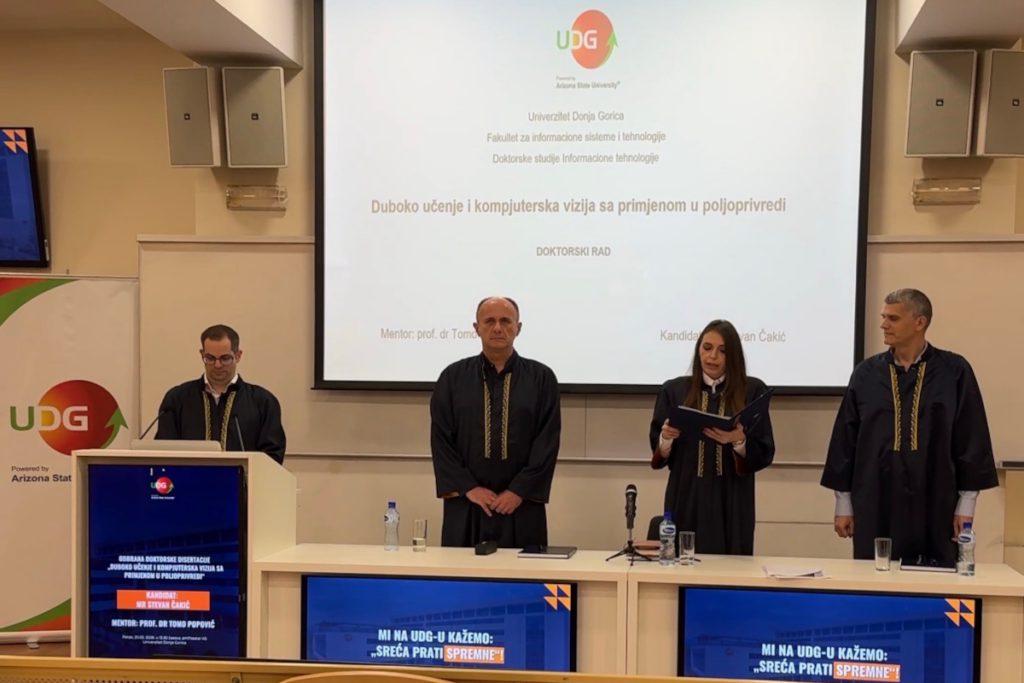
The University of Donja Gorica, through the Faculty for Information Systems and Technologies, proudly announces the successful PhD defence of Mr. Stevan Čakić, focused on the application of Artificial Intelligence and High-Performance Computing in precision agriculture.

The research addresses key challenges in modern agriculture, particularly in poultry farming, by leveraging deep learning and computer vision models for real-time monitoring, early disease detection, and improved farm management. The models were developed and trained using HPC resources, enabling efficient experimentation and achieving high prediction accuracy exceeding 92% . A significant contribution of this work lies in the integration of HPC-based model development with deployment on edge devices in real farm environments, demonstrating a complete AI-to-industry pipeline. The research also explores the use of generative AI and synthetic data to reduce dependency on large annotated datasets, accelerating innovation cycles.

mr Stevan Cakic presenting his PhD Thesis on AI/HPC in precision agriculture

Importantly, part of this research was conducted in synergy with the FFplus experiment and in direct collaboration with industry partners, highlighting the role of HPC in enabling real-world, industry-driven AI applications. This achievement further demonstrates the impact of the NCC Montenegro and EuroCC2 & EuroCC4SEE initiatives in supporting advanced research, fostering academia-industry collaboration, and promoting the adoption of HPC technologies in strategic sectors such as agriculture.

Enhancing BSc Education through AI and HPC: Implementation of the Artificial Intelligence Course

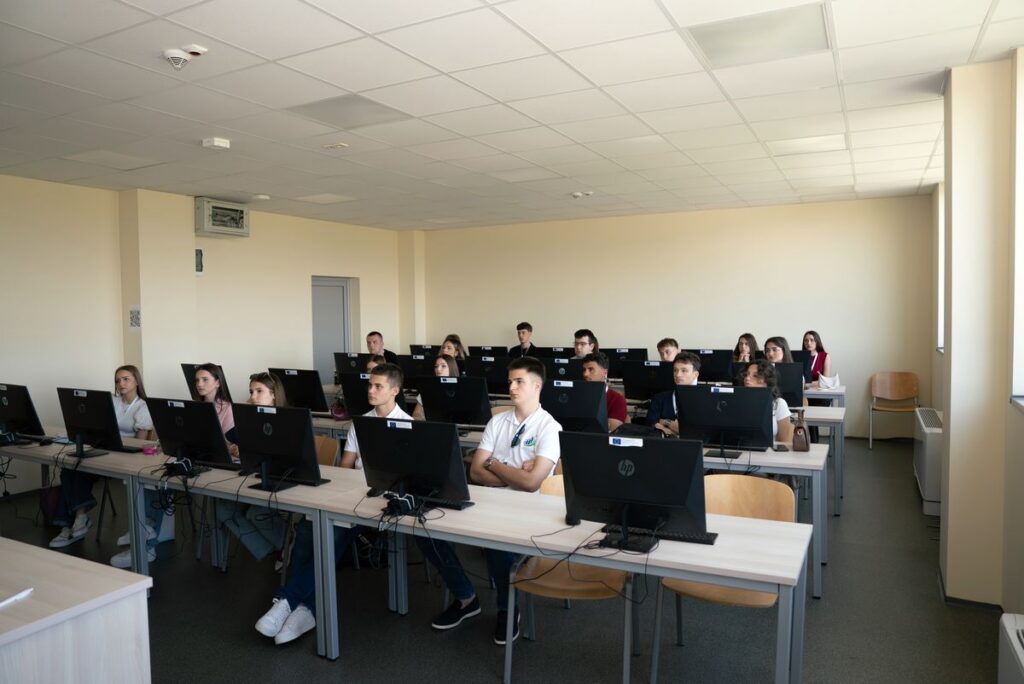
As part of the ongoing activities of the National Competence Centre for High-Performance Computing and Artificial Intelligence in Montenegro (HPC NCC Montenegro), a new undergraduate course entitled Artificial Intelligence has been successfully implemented during the current academic year. The course was delivered to students of the Faculty for Information Systems and Technologies (FIST) as well as the Faculty of Applied Sciences – Electrical Engineering and Computer Science programme, further strengthening the AI and HPC components within undergraduate curricula.

AI Education Bridging Academia and Industry

The course was designed as an introductory yet comprehensive overview of fundamental concepts, methods, and applications of artificial intelligence, aiming to provide students with a solid theoretical foundation alongside essential practical skills. The focus was placed on machine learning, data analysis and processing, decision-making algorithms, and the role of AI in digital transformation and real-world problem solving. In addition, ethical challenges and societal implications of AI technologies were explicitly addressed. The course content and learning outcomes were aligned with contemporary academic and industry standards, including hands-on use of tools recommended by the industry experts.

A distinctive feature of the course was its close collaboration with industry partners, fully aligned with the objectives of the EuroCC-2 and EuroCC4SEE projects, which promote strong links between academia, industry, and the HPC ecosystem. Representatives from Alicorn, BixBit, Inovativa, and DigitalSmart actively participated in the course delivery, contributing through guest lectures and weekly discussions with students. This collaboration allowed students to gain first-hand insights into how AI and HPC technologies are applied in real industrial environments.

Through direct interaction with industry professionals, students discussed concrete use cases of artificial intelligence in areas such as data-driven decision making, process automation, intelligent systems development, and scalable AI solutions supported by HPC infrastructures. These exchanges significantly enriched the learning experience, fostering critical thinking, practical understanding of market needs, and awareness of real-world constraints and opportunities.

The implementation of the Artificial Intelligence course represents a concrete example of how EuroCC initiatives contribute to the systematic enhancement of undergraduate curricula with AI and HPC content, while simultaneously strengthening cooperation with industry. In this way, students are not only equipped with fundamental technical knowledge but are also introduced to the broader European HPC and AI ecosystem, gaining a clear perspective on the role of AI and high-performance computing in modern research, innovation, and industry.

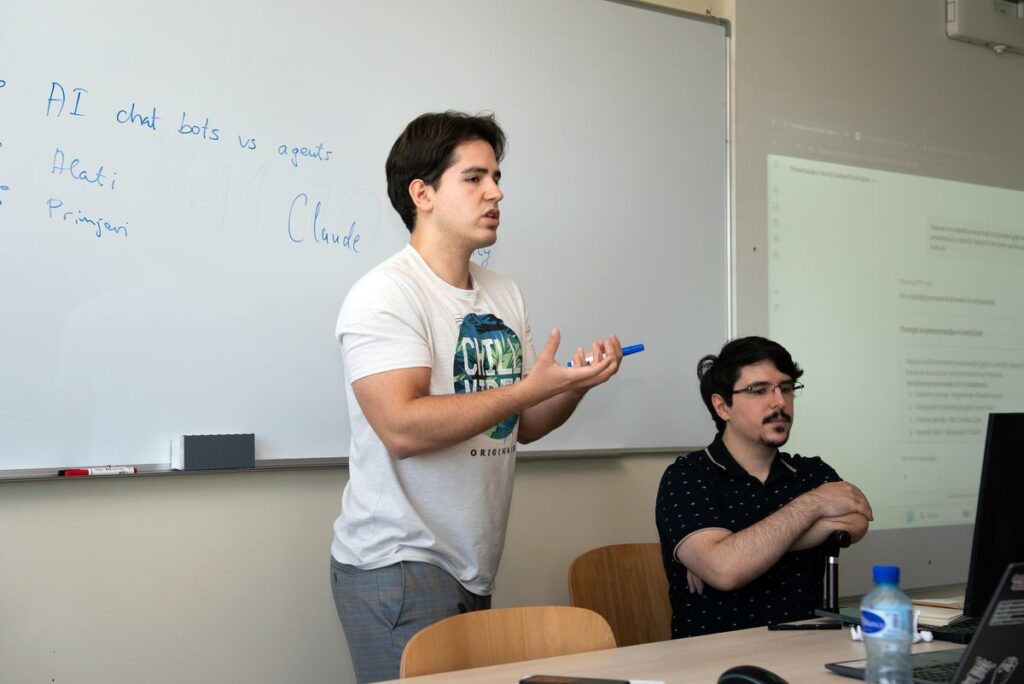
Short course: Modern Conversational AI — From Classic NLU to LLMs

This short course covers the foundations of conversational systems—classic NLU (intents, entities, slot filling, dialogue design) and modern LLM workflows (prompt engineering, function calling, RAG). Participants build a practical chatbot grounded in their own documents, evaluate quality and safety, and deploy a lightweight interface. An HPC module is included for large-scale embeddings and offline evaluation/load testing.

  • Date: 21.11.2025 at 11:45
  • Venue: PS, UDG
  • Registration required: https://forms.gle/SRW6GYiRAbi8pFBe8
  • Designed for: students, researchers, and professionals with basic Python and web/API skills.
Short course on NLP and LLMs

Course content overview

Session 1 (90 min) – theoretical framework

  • From classic NLU (intents/entities/slots) to LLM “agents”
  • Dialogue design: state machines vs. tools/functions
  • RAG essentials: indexing, chunking, hybrid search, source citations
  • Evaluation & safety: relevance/groundedness, moderation, PII
  • HPC view: when batch embeddings and batch evaluation matter

Session 2 (90 min)- hands-on lab

  • Project setup and starter RAG pipeline
  • Document import/index, prompt + function calling
  • Quick evaluation and guardrails
  • Deploy a web chat

Learning outcomes

  • Contrast intent-based vs. LLM-based chatbots.
  • Design dialogue and implement a grounded RAG pipeline with citations.
  • Ship a lightweight production chatbot with evaluation and safety.
  • Apply HPC techniques to scale embeddings and offline performance testing.

Deep Learning Course with HPC

The Deep Learning with High Performance Computing (HPC) course provides a comprehensive introduction to both the fundamental and advanced concepts of Deep Learning, with a special focus on applications in High Performance Computing environments.

Participants will explore neural networks, loss optimization, convolutional and transformer architectures, as well as unsupervised and generative models. Through a combination of lectures and practical sessions, attendees will gain both theoretical understanding and hands-on experience in efficiently training and deploying deep learning models on HPC systems.

The course is intended for students and researchers with prior knowledge of machine learning concepts, programming in any language, and a basic understanding of mathematics (functions, derivatives, linear algebra, and statistics).
The course is organized within the EuroCC project at the University of Donja Gorica, in collaboration with the Center for High Performance Computing and the Artificial Intelligence research team. All classes will be organized at the University of Donja Gorica, starting from 31st October, 2025, from 17:15h, in classroom S33 or S23 (3 floor).

Link for registration: https://forms.gle/dKH5WMc6egcikaF99

Schedule

MSc Thesis on Cross-Lingual Transfer Learning in Large Language Models

Mr. Igor Ćulafić successfully defended his master’s thesis titled “Cross-lingual Transfer Learning in Large Language Models: Scaling Laws and Parameter-Efficient Fine-Tuning for Multilingual Applications.” His research provides a comprehensive study of cross-lingual transfer for the Montenegrin language, combining a custom V-shaped semi-automated book scanner, a YOLOv11 + Tesseract OCR pipeline, and the creation of 46,661 parallel paragraph pairs. Using LoRA fine-tuning on Qwen2.5-7B and Qwen3-30B—executed on the Leonardo EuroHPC supercomputer—the work demonstrates parameter-efficient adaptation (only 1.05% trainable parameters) and offers insights into model behavior in cultural understanding, script mixing, and analytical reasoning. This research was supported by NCC Montenegro team and made use of the HPC cluster and EuroHPC JU computational resources.

V-shaped book scanner prototype used to create datasets

ABSTRACT – This thesis presents a comprehensive study of Cross-lingual transfer learning in Large Language Models with a focus on parameter-efficient fine-tuning for the Montenegrinlanguage. The research integrates the development of a custom semi-automated book scanner with V-shaped design and a computer vision pipeline using YOLO v11 models and Tesseract OCR to digitize 5000 on Montenegrin and 40000 on English language, from public domain books, resulting in 46661 parallel paragraph pairs. Implementation of LoRA fine-tuning on Qwen2.5-7B and Qwen3-30B models was conducted on Leonardo HPC supercomputer, achieving memory efficiency with only 1.05% trainable parameters. Comparative analysis through a structured benchmark of ten progressively complex questions reveals limited but positive effects of fine-tuning, where larger models show better performance in cultural understanding and analytical tasks, while systematic analysis identifies specific problems such as script mixing and cultural inaccuracies that require specialized approaches.

Master thesis: Application of Explainable Artificial Intelligence in Medicine

Ms. Ivana Lalatović successfully defended her master’s thesis titled “Application of Explainable Artificial Intelligence in Medicine” at the Faculty of Information Systems and Technologies, University of Donja Gorica.

The defence took place in October 2025, and the thesis explored how modern XAI techniques—such as SHAP and LIME—can improve transparency and trust in AI models used for analysing the performance and reliability of medical respirators. The development, training, and testing of the machine learning and XAI workflows were supported by the high-performance computing (HPC) resources provided through the EuroCC initiative in Montenegro, enabling scalable data processing, faster experimentation, and reproducible analysis required for medical AI applications. Her work demonstrates how HPC-enabled explainability can strengthen the safety, reliability, and ethical use of AI in healthcare environments, contributing to the growing ecosystem of advanced AI research supported by NCC Montenegro.

SHAP utilisation

ABSTRACT – The need for explainable intelligent systems is growing along with the increase in artificial intelligence products used in everyday life. Explainable artificial intelligence (XAI) has experienced significant growth in the last few years. The reason for this is the wide application of machine learning, as well as deep learning techniques, which have led to the development of highly accurate models. However, they lack explainability and interpretability. This study explores the application of XAI methods in medical applications, with a particular focus on interpreting model decisions. SHAP and LIME methods were applied to interpret the model’s predictions, enabling the identification of key features that have the greatest influence on the model’s decisions. The results of this research confirm the importance of explainable artificial intelligence in critical domains such as medicine, where trust in AI systems must be based on understanding and verifiability of their decisions.