Master Thesis Defense: Development of Edge/AI Applications with HPC Support

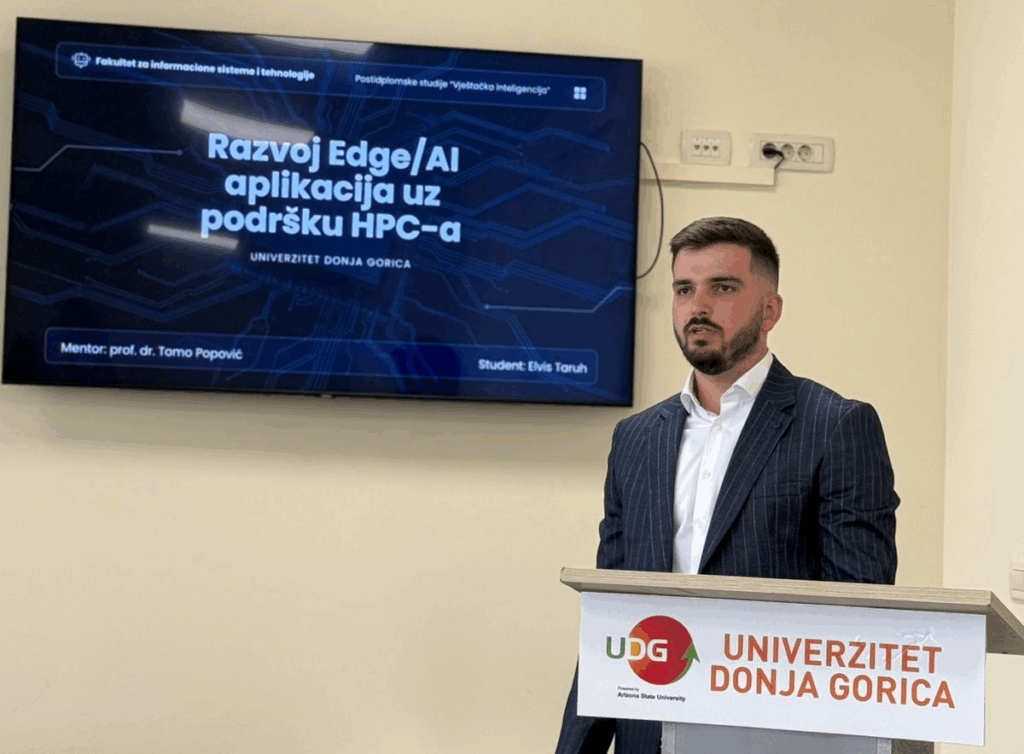
Mr. Elvis Taruh successfully defended his master’s thesis titled “Development of Edge/AI Applications with HPC” at the Faculty of Information Systems and Technologies, University of Donja Gorica.

Mr Elvis Taruh

ABSTRACT – The efficiency of training artificial intelligence (AI) models has become a crucial factor in modern research, especially when dealing with complex systems that require substanial computational power. This study explores how the application of high-performance computing (HPC) and Edge devices can optimize the AI model training process, reducing processing time and improving efficiency. Through an experimental approach, AI model training was analyzed across three different platforms. Local computer, Google Colab and the HPC cluster at the University of Donja Gorica. As a practical example, livestock detection was used. By comparing the training time, memory consumption, and model accuracy, the research demonstrates that HPC clusters significantly accelerate the training process compared to traditional methods, while Edge devices enable faster real-time data analysis.

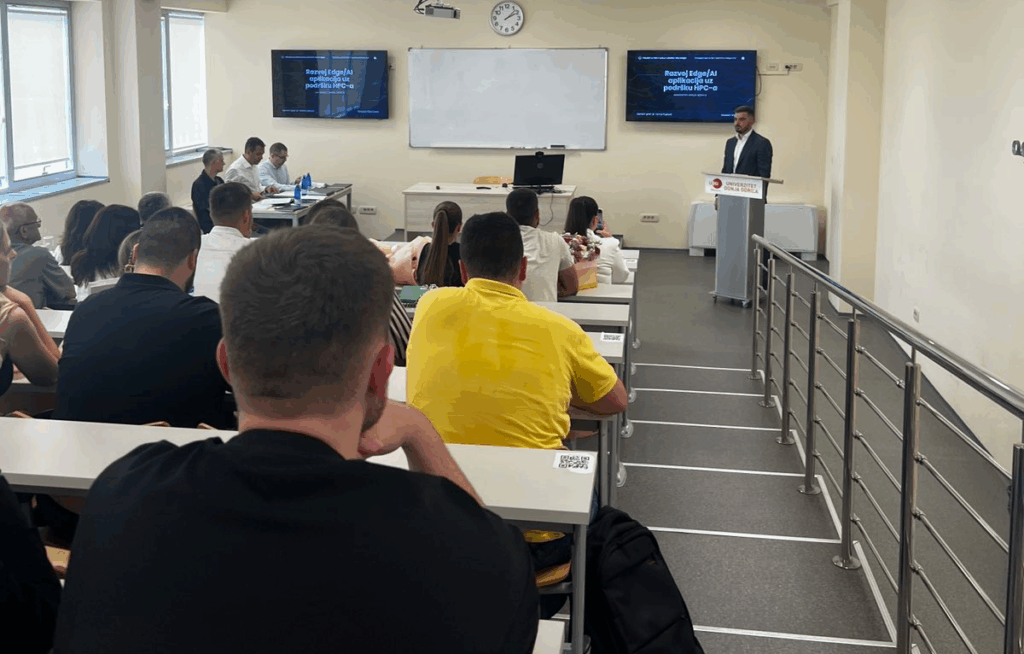
There was around 30 people attending. This was a small celebration for EuroCC2 and EuroCC4SEE projects

Master Thesis Defense: AI Tutors with LLMs and HPC

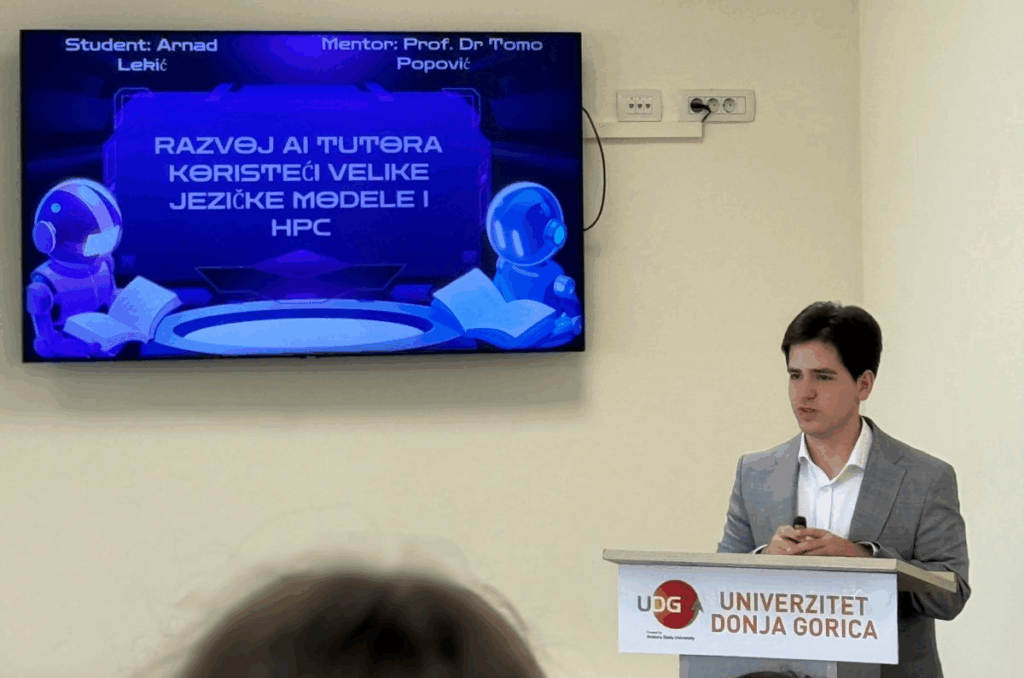
Mr. Arnad Lekić successfully defended his master’s thesis titled “Development of an AI Tutor Using Large Language Models and HPC” at the Faculty of Information Systems and Technologies, University of Donja Gorica.

Mr Arnad Lekic

ABSTRACT – This thesis explores the development of a personalized AI tutor using large language models (LLMs), with a specific focus on the LLaMA architecture and the application of High-Performance Computing (HPC) resources. The research involves the acquisition, setup, and evaluation of an open-source LLaMA model, with the goal of building a system capable of automated test grading. Special emphasis is placed on the training efficiency and feasibility of running the model locally using the available computing nodes, compared to cloud-based solutions like Google Colab. Beyond the technical implementation, the study also addresses the ethical challenges of using generative AI in education. Through experimental analysis, the research demonstrates that open models can be effectively adapted for educational purposes, with the potential to expand to grading diverse exam formats and generating educational content. The work provides directions for future development of systems leveraging advanced multimodal models for more complex tasks.

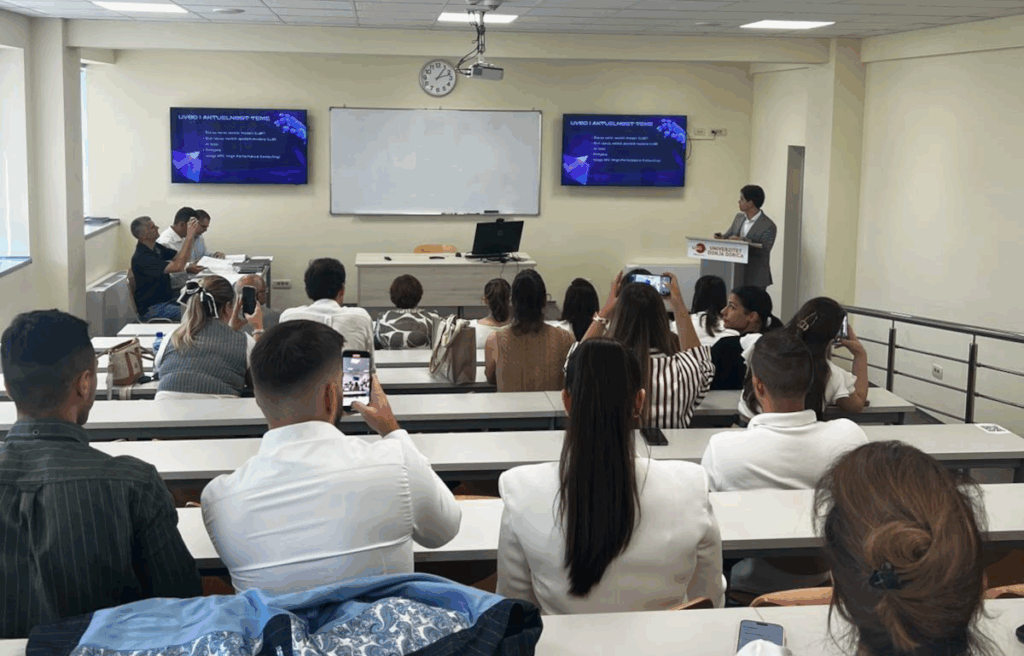
The defence was attended by over 30 people. We had three candidates that day, all in the context of EuroCC2 and EuroCC4SEE

Master Thesis Defense: HPC and AI for Education Enhancement

Ms. Enisa Trubljanin successfully defended her master’s thesis titled “Deep Learning with Application in Education” at the Faculty of Information Systems and Technologies, University of Donja Gorica. The development and testing of these solutions were supported by high-performance computing (HPC) resources provided through the EuroCC initiative in Montenegro.

Ms. Enisa Trubljanin

ABSTRACT – This master’s thesis explores the potential application of deep learning in education through the development and evaluation of two concrete solutions: an intelligent chatbot for solving matrix problems and a model for detecting cheating during online exams by analyzing eye movement. The first part of the thesis provides a theoretical foundation of deep learning, with a focus on neural networks, their architectures, transfer learning, and evaluation metrics. The practical part presents the development of a chatbot based on advanced language and mathematical models, implemented using high-performance computing cluster resources, enabling students to engage in interactive mathematics learning. Additionally, a model for detecting cheating through gaze analysis was developed, trained on the Columbia Gaze Dataset, and integrated into an online exam proctoring system. Evaluation results demonstrate a high level of accuracy and user satisfaction for both solutions. Beyond the technical aspects, the thesis also addresses ethical issues and privacy concerns related to the use of artificial intelligence in educational settings. Based on the findings, the study highlights the broad range of potential applications of deep learning in modern educational systems.

There was three great candidates on the same day!

FIST at UDG Wins EuroHPC JU Grant for HPC-Powered Research Development

The Faculty for Information Systems and Technologies (FIST) at the University of Donja Gorica (UDG) has been awarded a prestigious grant through the EuroHPC Joint Undertaking Open Call, marking a significant milestone for Montenegrin academic engagement with cutting-edge high-performance computing (HPC) resources.

As part of this grant, FIST has secured access to the Leonardo Booster partition at CINECA, one of the most powerful supercomputers in Europe. This will enable FIST researchers to perform large-scale experiments that are otherwise infeasible with standard computing infrastructure.

FIST at UDG gained access to Leonardo BOOSTER via EuroHPC JU open calls

The awarded project focuses on cross-lingual transfer learning in large language models (LLMs), aiming to systematically evaluate how model architecture and scale influence multilingual performance. By fine-tuning major LLM families (LLaMA, Mistral, DeepSeek) across model sizes from 1B to 70B parameters, the research will generate insights into optimal model selection under real-world resource constraints—critical for European institutions working with diverse languages and limited compute budgets. This is a development project with HPC resources available for 12 months.

The research focuses on cross-lingual transfer learning in large language models (LLMs)

This achievement underscores the growing capacity of UDG and FIST to contribute to frontier AI research, while reinforcing the mission of the National Competence Center in HPC (NCC Montenegro) to support HPC adoption across academia and industry in the region.

We congratulate the FIST team on this major success and look forward to sharing results from their HPC-powered investigations.

NCC Montenegro presented at EuroCC4SEE Seminar “5 Beats of Intelligence”

Successful presentation and from Dejan Babic from University of Donja Gorica at the EuroCC4SEE Seminar organized by NCC Turkiye. This was a part of the EuroCC4SEE project, five countries – Türkiye, Serbia, Montenegro, North Macedonia, and Bosnia and Herzegovina – have joined forces to present an engaging online seminar series titled: “5 Beats of Intelligence: AI Meets Diverse Domains”.

More details on schedule of seminar presentations and and registrations can be accessed at NCC Turkiye website at the foillowing link.

Successful presentation at the Seminar series, around 25 attendees
The presentation covered use cases from the AI-AGE project implemented at UDG with NCC support

Successful Delivery of Short Course: Introduction to SLURM on Computing Cluster

On May 27, 2025, the National Competence Center for HPC in Montenegro organized a one-day short course titled “Introduction to SLURM on Computing Cluster.” This training session was designed to introduce participants to the basics of SLURM, the most widely used workload manager for high-performance computing environments.

dr Luka Filipovic gave an introduction to UDG computiong cluster, SLURM comands

The course gathered 13 attendees, including postgraduate students, academic researchers, and a few representatives from industry. The participants had the opportunity to learn how to submit, manage, and monitor jobs on an HPC system using SLURM through a mix of theoretical overview and hands-on examples.

ms Enisa Trubljanin presented her research, activity of UDG AI Club

The short course started with a presentation from ms Enisa Trubljanin, where she discussed the use of AI and HPC in education. She was focused on developing prediction models for computer vision. Then, dr Luka Filipovic gave a presentation on SLURM with practical examples and demonstrations on UDG cluster. The course was wrapped up with presentation by mr Dejan Babic, who described Conda and demonstrated how it can be used for creation of virtual environments for different HPC experiments. Finally, Luka and Dejan discussed the Jupyter notbook setup on UDG cluster, its configuration and access.

mr Dejan Babic gave a presentation of Conda and its use on UDG cluster

With a focus on practical knowledge and real-world usage scenarios, the training aimed to support users in better utilizing HPC resources for data processing, simulations, and advanced research tasks.

The course gathered 13 attendees: students, academic researchers, and representatives from industry.

Profiling AI Software Bootcamp

Together with NVIDIA and OpenACC organization, EuroCC2 will host a virtual Profiling AI Software Bootcamp on July 9-10, 2025.

The Profiling AI Software Bootcamp covers the process and tools needed to profile AI and machine learning applications to fully utilize high-performance systems. Attendees will learn to profile applications using NVIDIA Nsight™ Systems, a system-wide performance analysis tool; analyze and identify optimization opportunities; and improve performance of applications to scale efficiently across systems of any quantity or size of CPUs and GPUs. Additionally, this bootcamp will walk through the system topology to learn the dynamics of multi-GPU and multi-node connections and architecture.

People who complete the bootcamp are encouraged to apply to participate in the upcoming EuroCC AI Hackathon, which will be open for applications shortly.

Due to EuroCC2 regulations, generic or private email addresses cannot be accepted. Please use your official university or company email address to prove your affiliation when applying.

Application Deadline: 16th June 2025

Prerequisites: Basic experience with Python programming and PyTorch distributed training. 

Event format: This bootcamp will be hosted online in Central European Summer Time (CEST). All communication will be through Zoom, Slack and email.

Compute Resources: Attendees will be given access to a GPU cluster for the duration of the bootcamp. 

More info, registration and agenda are available at https://www.openhackathons.org/s/siteevent/a0CUP00001YljuY2AR/se000402