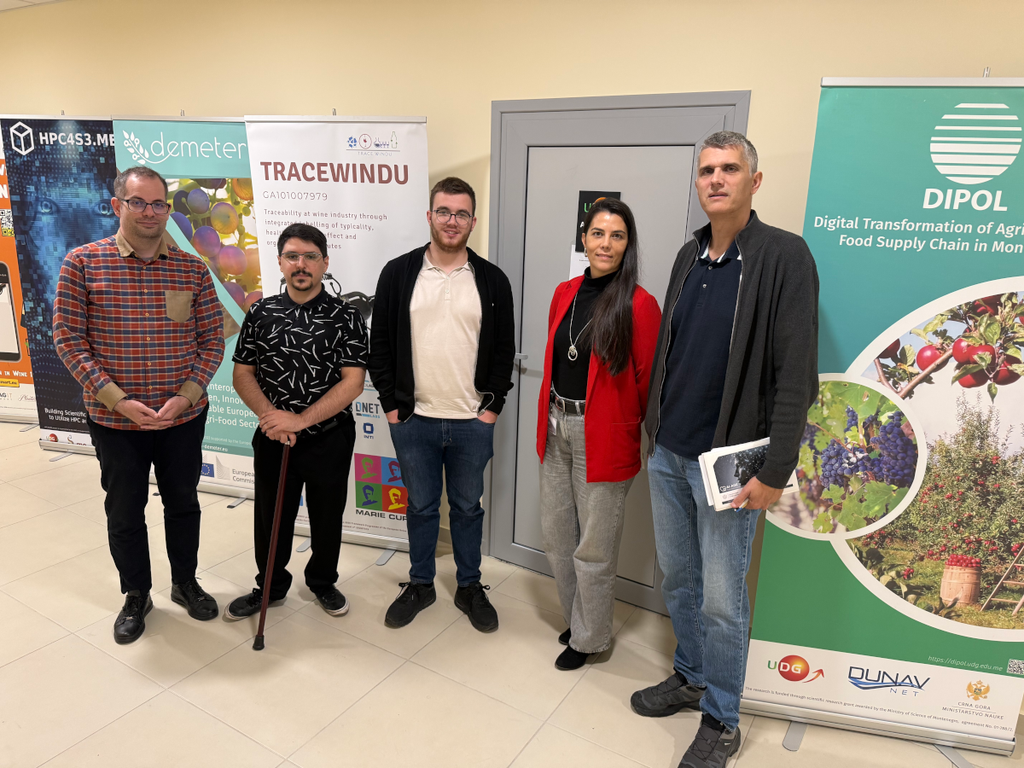
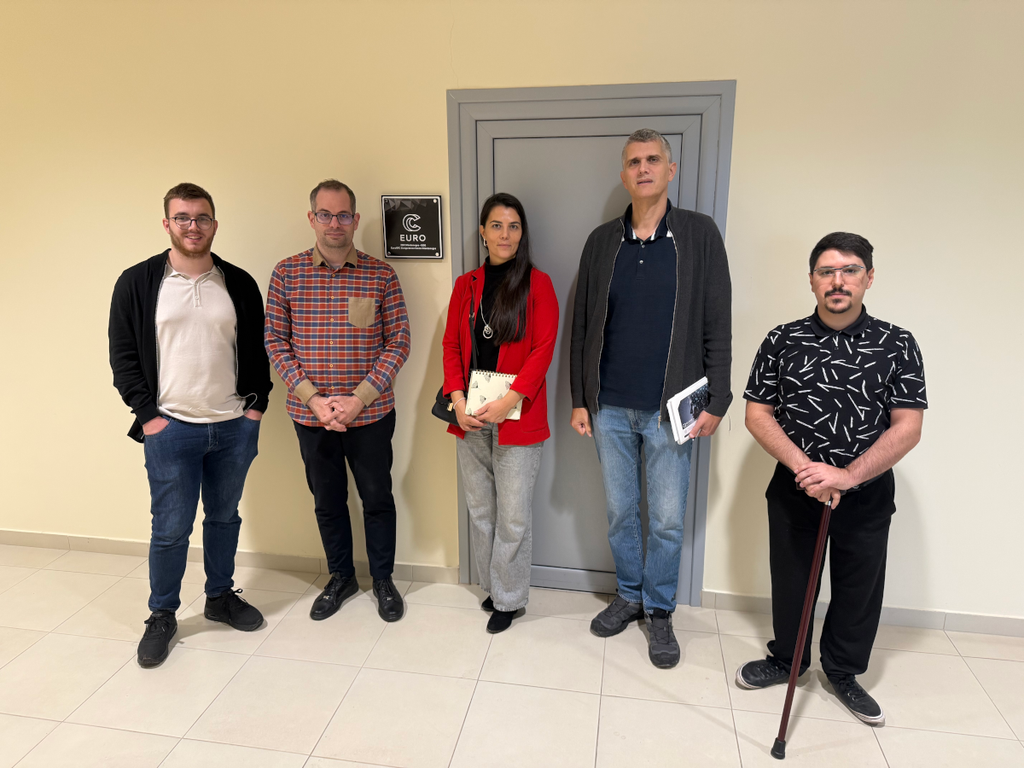
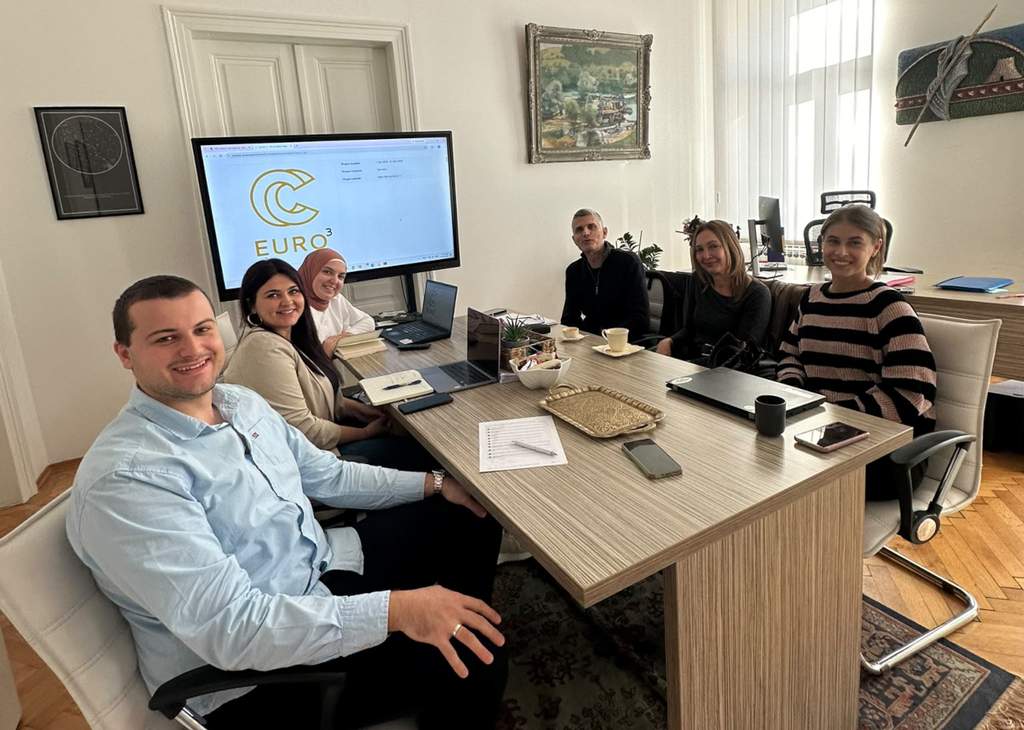
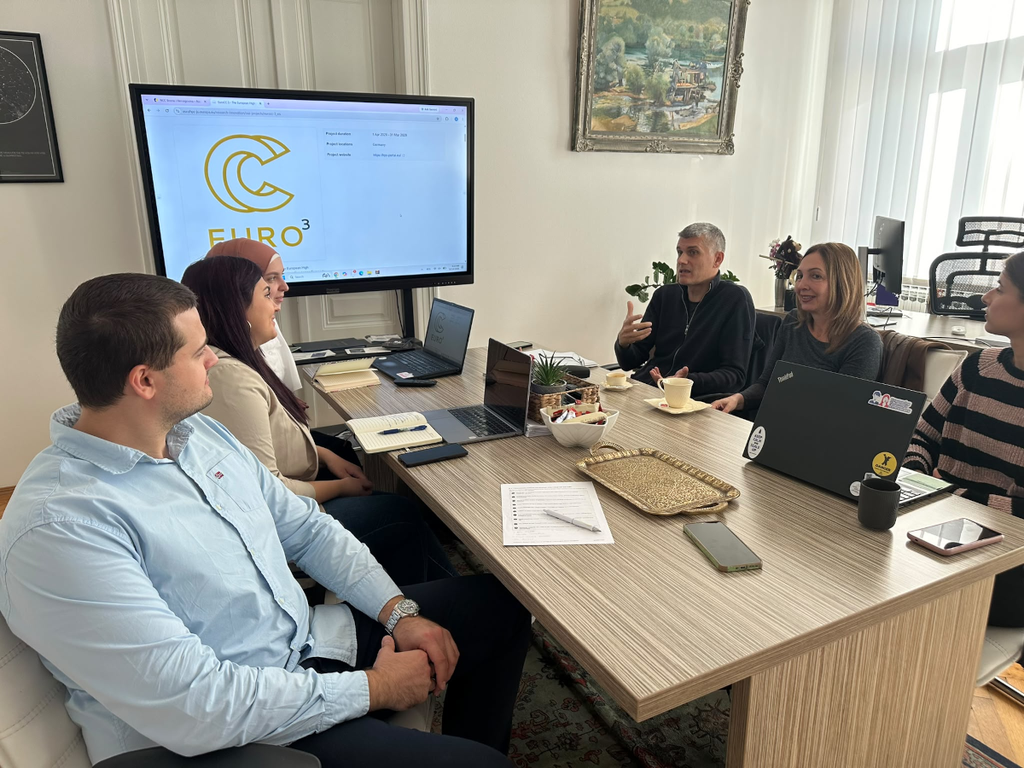
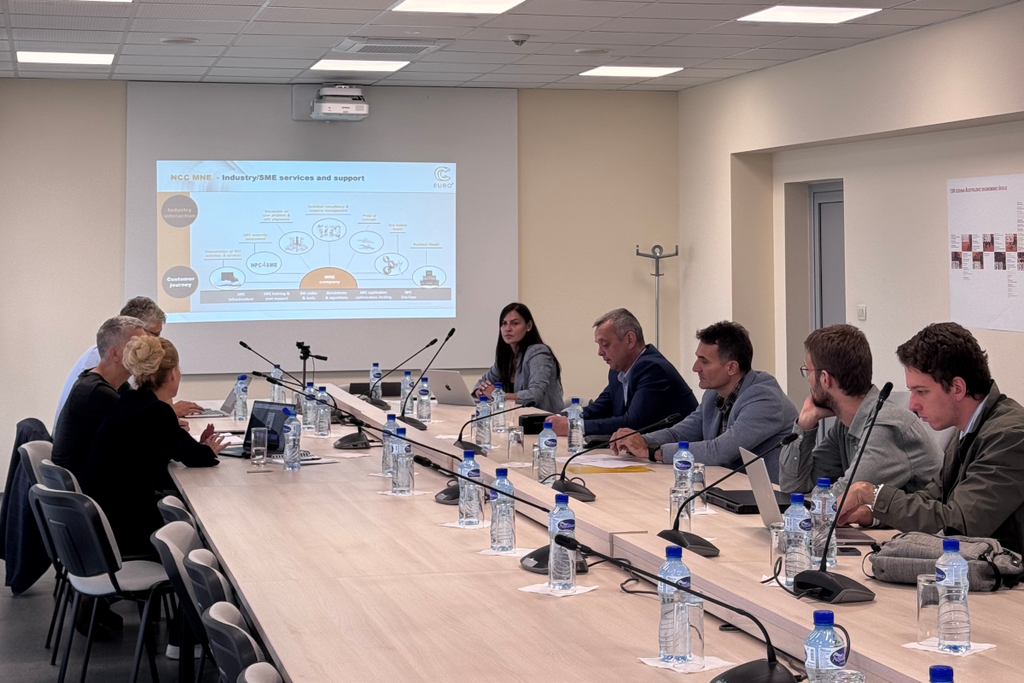
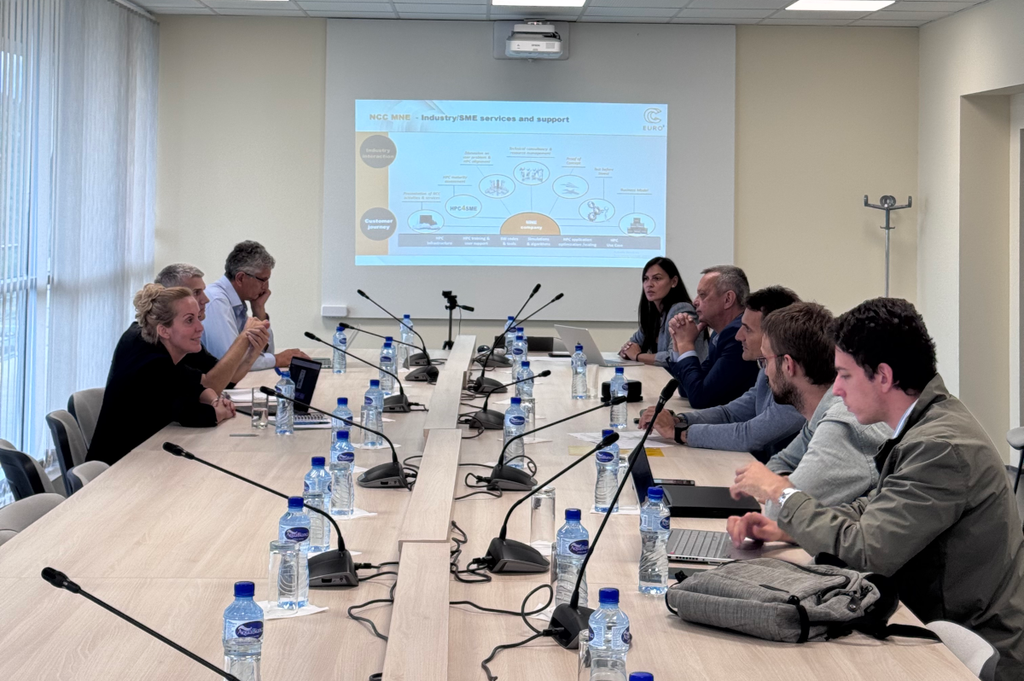
The University of Donja Gorica (UDG) hosted representatives of FiveG (Five Group) to discuss new opportunities for collaboration in augmented and virtual reality (AR/VR), generative artificial intelligence (AI), and high-performance computing (HPC).
FiveG has already successfully accessed EuroHPC resources with the support of NCC Montenegro through both Benchmark and Development calls for its Wasco AI project, utilizing the Leonardo Booster supercomputer. The meeting also addressed opportunities for further EuroHPC access applications to support the company’s ongoing AI development activities.
UDG hosted FiveG representatives to discuss further cooperation in AI, AR/VR and HPC
Building on an earlier initiative for cooperation between UDG and FiveG on establishing an AR/VR and AI laboratory, participants discussed the possibility of developing a demonstration setup for academia and industry. The proposed activities would showcase AR/VR applications and explore how generative AI and HPC resources could support the development of immersive digital content.
The meeting reaffirmed the shared interest in connecting academic research, education, and industry innovation through practical applications of emerging technologies.
Exploring new opportunities for AR/VR demonstrations, generative AI and EuroHPC resources
Initial consultations under EuroCC 3 strengthen engagement with major public enterprises and potential large-scale users of advanced computing technologies.
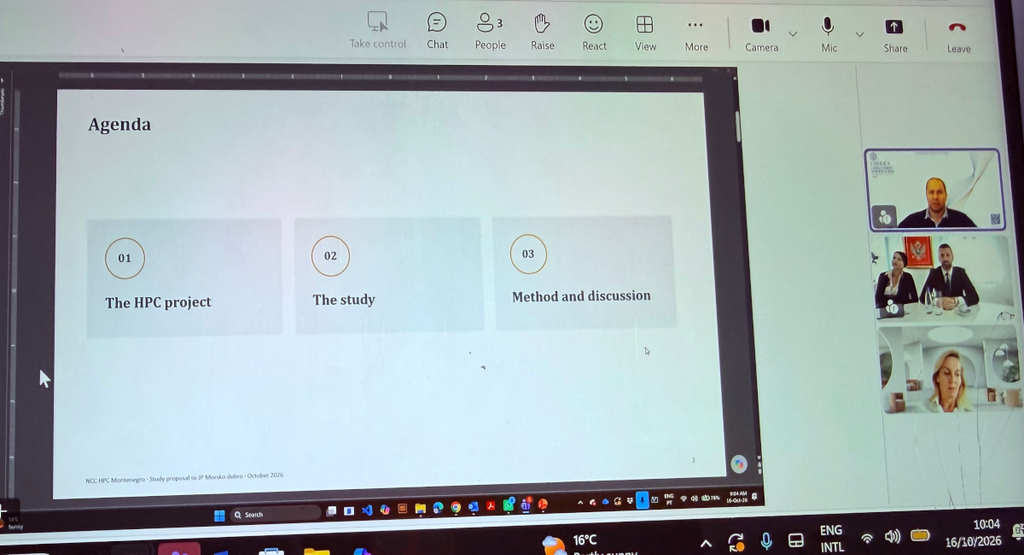
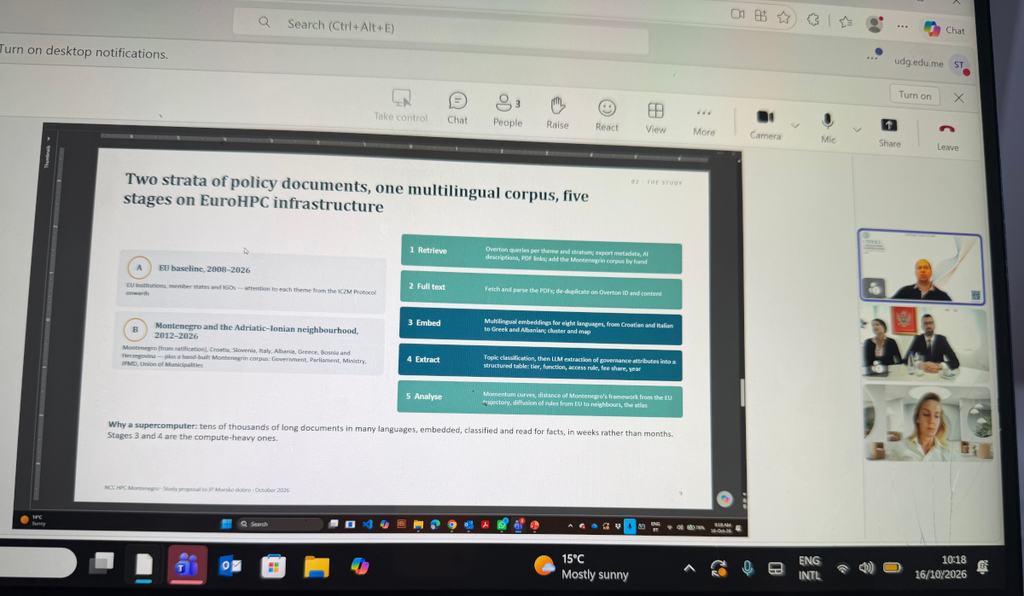
As part of its ongoing activities to engage large organizations and public-sector institutions, HPC Montenegro (NCC Montenegro) held an initial online meeting with representatives of the Public Enterprise for Coastal Zone Management of Montenegro (Morsko dobro) to explore opportunities for cooperation and the potential application of High-Performance Computing (HPC) and Artificial Intelligence (AI).
Online meeting between HPC Montenegro and Morsko dobro
During the meeting, the activities, services, and support opportunities offered by HPC Montenegro within the EuroCC 3 project were presented. The discussion focused on the potential benefits of advanced computing technologies for public enterprises managing complex operations, infrastructure, and significant amounts of data.
Given the responsibilities of Morsko dobro, possible areas for future cooperation include advanced data analysis, coastal and marine environmental monitoring, spatial data processing, and decision-support systems for sustainable coastal management. These opportunities could provide a basis for identifying concrete use cases and further technical consultations.
Possible areas for future cooperation were discussed in order to identify concrete use cases
This initial meeting represents another step in HPC Montenegro’s efforts to engage major public-sector organizations, promote the adoption of HPC and AI technologies, and facilitate access to European supercomputing resources and expertise through the EuroHPC ecosystem.
Continued collaboration under EuroCC 3 focuses on industry and public sector engagement, healthcare applications, and sharing HPC expertise and resources
On October 14, 2026, representatives of HPC Montenegro (NCC Montenegro) met with colleagues from NCC Bosnia and Herzegovina at the Verlab Institute in Sarajevo to discuss the continuation and expansion of their cooperation within the EuroCC 3 project.
Representatives of NCC Montenegro and NCC Bosnia and Herzegovina during their meeting at the Verlab Institute
Building on collaboration established through the previous EuroCC4SEE project, including a joint workshop on AI and HPC applications in healthcare organized at the Faculty of Medicine in Montenegro and recent collaborative research supporting the pharmaceutical industry, the meeting focused on new opportunities for joint initiatives and broader stakeholder engagement.
The participants discussed several HPC and AI use cases, particularly in healthcare and medical research, where both NCCs have relevant experience. Special attention was given to sharing expertise, human resources, HPC infrastructure, and experiences in engaging and supporting industry partners and public sector institutions. The discussion also addressed the promotion of results achieved through previous cooperation and opportunities to jointly assist companies in accessing European supercomputing resources through EuroHPC Joint Undertaking (EuroHPC JU) access calls.
Discussion was focused on joint efforts and experience sharing aimed at industry engagement
The Verlab Institute also expressed its willingness to support research activities in Montenegro by facilitating connections with healthcare industry partners and exploring opportunities for access to relevant datasets.
The meeting reaffirmed the commitment of both NCCs to strengthening regional collaboration under EuroCC 3, sharing knowledge and resources, and supporting the wider adoption of HPC and AI technologies in academia, industry, and the public sector.
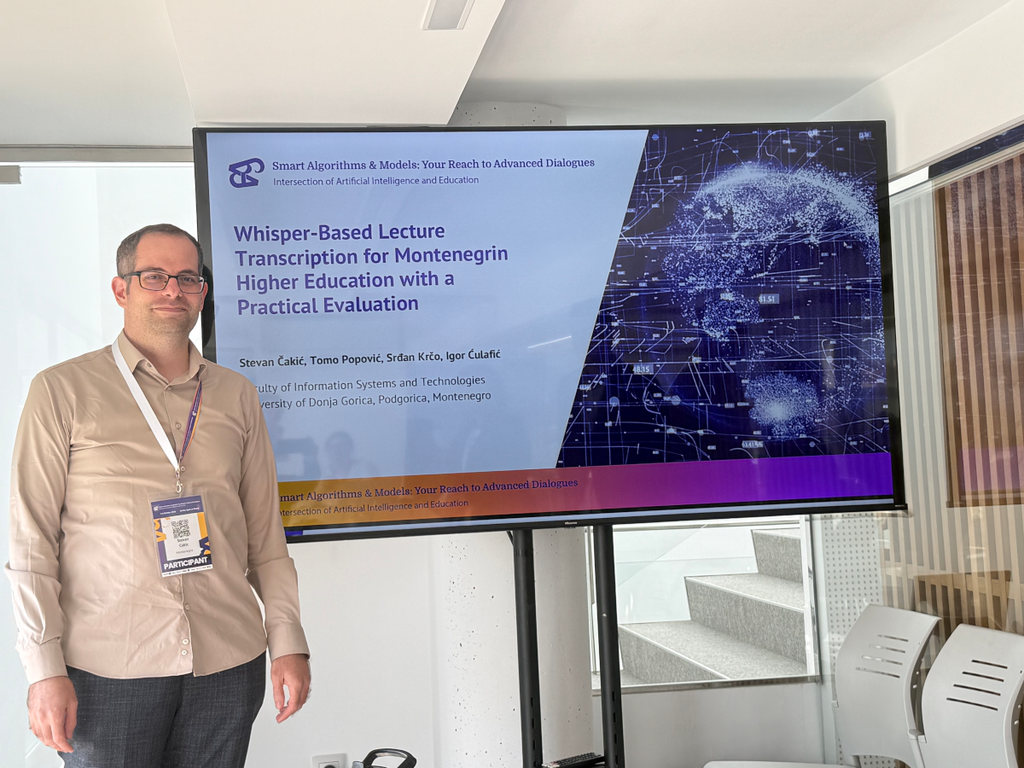
Results from the Exams 4.0 Proof of Concept project, supported by the Innovation Fund of Montenegro and EuroHPC computing resources, were presented at the international SAMYRAD 2026 conference in Seville, Spain.
The paper “Whisper-Based Lecture Transcription for Montenegrin Higher Education with a Practical Evaluation” was presented at the Smart Algorithms & Models: Your Reach to Advanced Dialogues (SAMYRAD 2026) conference, held on 5–6 October 2026 in Seville, Spain.
Authored by Stevan Čakić, Tomo Popović, Srđan Krčo, and Igor Čulafić, the paper investigates the use of OpenAI Whisper models for automatic transcription of university lectures in Montenegrin, a language not directly supported by Whisper.
The study evaluated three Whisper model variants and three related South Slavic language settings using 30 university lectures covering nearly 38 hours of audio. The experimental work involved generating 4,860 transcripts, with large-scale processing performed on the LUMI EuroHPC supercomputer in Finland.
The results identified Whisper’s turbo variant as the most suitable among the tested models in terms of transcription consistency, evaluated text quality, and processing speed. The research also provided practical recommendations for processing lecture recordings in Montenegrin.
These findings have already been incorporated into a new lecture-transcription module developed within the Exams 4.0 platform, enabling lecturers to transform audio and video recordings into text that can support AI-assisted preparation of educational materials and examination questions.
This R&D effort was conducted as part of the Exams 4.0 Proof of Concept project, implemented by DigitalSmart in collaboration with the University of Donja Gorica and funded by the Innovation Fund of Montenegro.
HPC Montenegro (NCC Montenegro) supported the research team in securing access to EuroHPC computing resources through the EuroHPC JU Development Access programme (project ID: EHPC-DEV-2024D12-018). The computational experiments were performed on LUMI, hosted by CSC in Finland and the LUMI consortium.
This work demonstrates how access to European HPC infrastructure can support applied AI research, foster innovation in higher education, and contribute to the development of digital tools for smaller and underrepresented languages.
A new scientific paper titled “Premium Domain Name Recommendation via Semantic Retrieval and Reranking of Fixed Aftermarket Inventories” has been published in the international journal IEEE Access. The research was conducted by Milutin Pavićević, Tomo Popović, Srđan Krčo, and Miodrag Vujković from the University of Donja Gorica (UDG) and DunavNET.
The study addresses the challenge of recommending relevant premium domain names from large collections of domains already available for resale. The researchers developed and evaluated an approach combining large language models (LLMs), semantic embeddings, vector search using FAISS, and different reranking strategies. Experiments were conducted on 30,000 domain names sampled from a collection of nearly 700,000 premium domains, with evaluations involving 22 industry experts and 180 students. The results demonstrated the potential of semantic retrieval to improve domain name recommendations while balancing relevance, diversity, and computational cost.
Click on image to open
The research also has clear potential for industrial application. Alicorn, a Montenegro-based software company specializing in solutions for the domain name industry, is already developing AI-powered domain name recommendation technologies, including its Name Sentinel platform. The methods investigated in this study could contribute to further improving such solutions, particularly through more effective semantic search and recommendation of premium domains.
The research represents another example of research and innovation supported by European initiatives and connected with the activities of HPC Montenegro (NCC Montenegro), contributing to the development of AI expertise and stronger links between academia and industry.
The National Competence Centre for High-Performance Computing (HPC Montenegro) held an initial consultation meeting with representatives of Elektroprivreda Crne Gore (EPCG), one of Montenegro’s largest enterprises and a key player in the national energy sector, to explore opportunities for applying advanced computing and artificial intelligence technologies in the power industry.
During the meeting, HPC Montenegro presented its activities within the EuroCC3 project, available services, access to HPC infrastructure, expert support, and training opportunities. EPCG representatives outlined their digital transformation plans, including the development of integrated data infrastructure where HPC and AI technologies could play an important role.
The discussion explored potential applications of advanced analytics and AI/ML technologies, including solar energy data analysis, satellite and thermal image processing, and predictive modelling of electricity generation and consumption. Opportunities for collaboration through European research and innovation projects were also discussed.
As a next step, EPCG will assess priority areas and the availability of data for potential pilot activities, while HPC Montenegro will share relevant success stories and proposals for further cooperation. Specific use cases and follow-up activities will be discussed in future consultations.
The meeting was attended by EPCG representatives Jovan Kasalica, Anton Radonić and Vuk Kasalica, together with representatives of HPC Montenegro: Sandra Tinaj, Tomo Popović, and Bojana Mališić from the University of Donja Gorica (UDG), and Božo Krstajić and Lazar Šćekić from the Faculty of Electrical Engineering at the University of Montenegro (UCG).
This engagement represents an important step in HPC Montenegro’s efforts to strengthen cooperation with large industrial users in Montenegro and promote the adoption of advanced computing technologies in strategically important economic sectors.
As part of its ongoing efforts to strengthen the engagement of public enterprises and institutions in the use of advanced computing technologies, HPC Montenegro held a working meeting with representatives of the Port of Bar to explore opportunities for cooperation and the application of High-Performance Computing (HPC) in areas of strategic importance.
During the meeting, a presentation was delivered highlighting the capacities, services, and opportunities offered by HPC Montenegro, with a particular focus on the potential of advanced computing resources to support complex data analysis, evidence-based decision-making, and the development of innovative solutions in the public sector.
Port of Bar (source: lukabar.me)
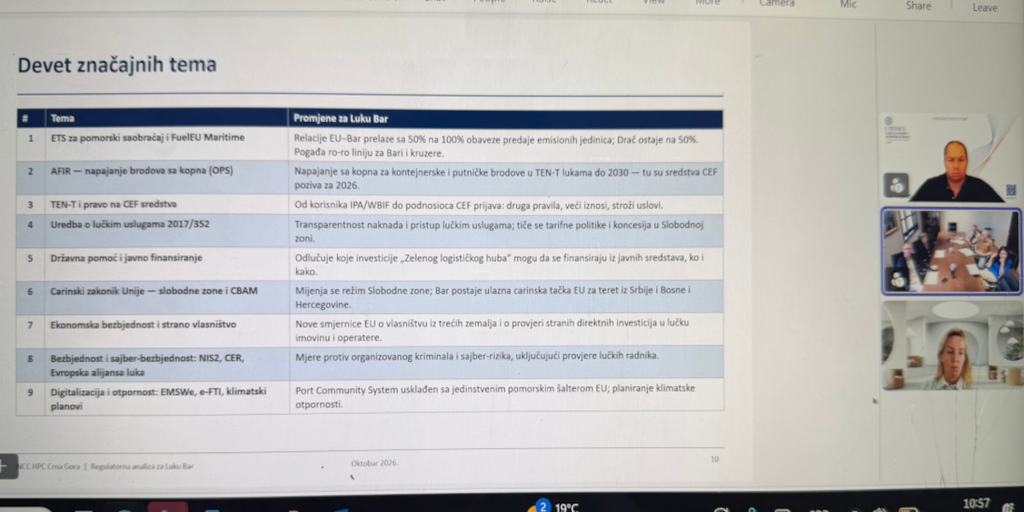
Special attention was given to the potential application of HPC technologies in the analysis of European Union policies, regulatory frameworks, and strategic development priorities. The discussion highlighted how advanced computing and data-driven approaches could support more effective policy analysis, strategic planning, and informed decision-making, particularly in areas relevant to the maritime and transport sectors.
The meeting resulted in an agreement to establish cooperation with HPC Montenegro in the coming period, with both sides expressing their commitment to identifying priority areas and defining concrete activities where HPC technologies could contribute to the Port of Bar’s operational and strategic development.
HPC Montenegro and Port of Bar online meeting.
The meeting was attended by Sandra Tinaj and Božidar Vlačić and provided an opportunity for a constructive exchange of ideas, experiences, and perspectives on future collaboration.
Following the alignment of cooperation priorities and the identification of specific joint activities, the next working meeting is planned for November, when further steps and opportunities for implementing joint initiatives will be discussed.
This initiative represents another important step in HPC Montenegro’s mission to bring High-Performance Computing closer to public enterprises and institutions in Montenegro, promoting its wider adoption as a driver of digital transformation, innovation, and data-driven strategic development.