Cross-NCCs training event: “Machine Learning for Multiple Domains”

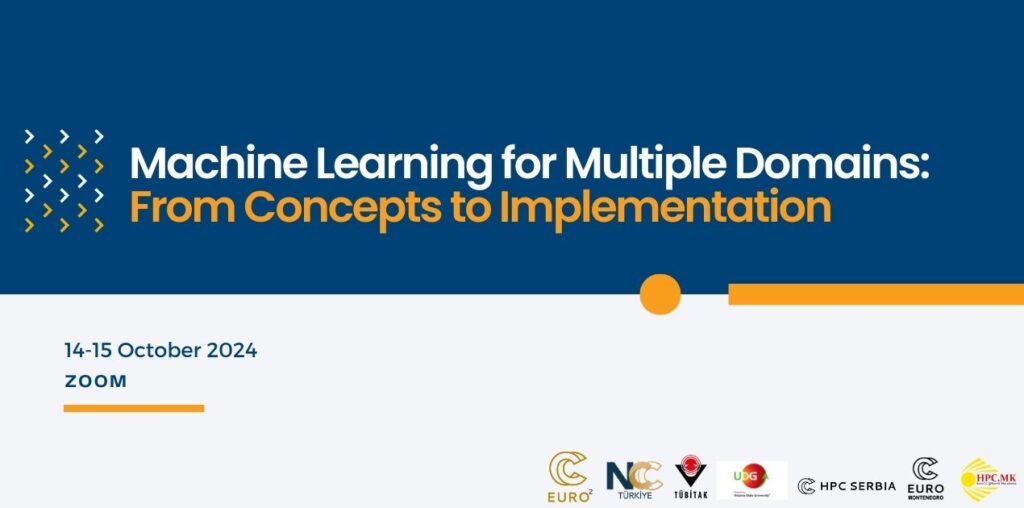
NCC Türkiye, NCC Serbia, NCC Montenegro, and NCC North Macedonia are pleased to announce a joint online training event titled “Machine Learning for Multiple Domains: From Concepts to Implementation,” scheduled for October 14-15, 2025, starting at 10:00 AM.

Participants can expect engaging program at both beginner and intermediate levels and will feature hands-on sessions along with key presentations spread across two days: Brief introductions on HPC/AI activities by 4 NCCs; Supercomputing access demo (TRUBA HPC infrastructure), presentations from NCC Macedonia (Design, Develop, Deploy, and Iterate on Production-Grade ML Applications) and NCC Turkey (Protein Language Models and Using Them for Downstream Prediction Tasks) on Day 1, and presentations from NCC Serbia (Modeling of Large-Scale Social Data) and NCC Montenegro (Analyzing Social Media Trends) on Day 2.

We look forward to your participation in this valuable opportunity to enhance your skills in HPC and machine learning!

More information on the training program, timetable and registration details you can find here: https://indico.truba.gov.tr/e/ML4MultipleDomains

BSc thesis on prompt engineering

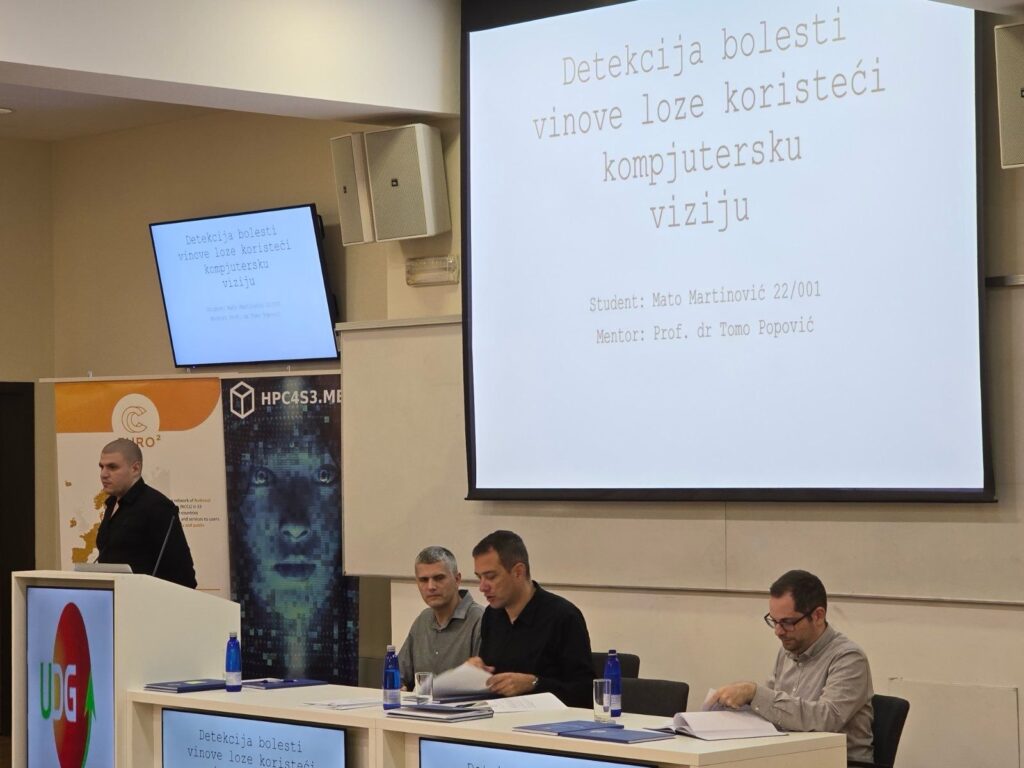
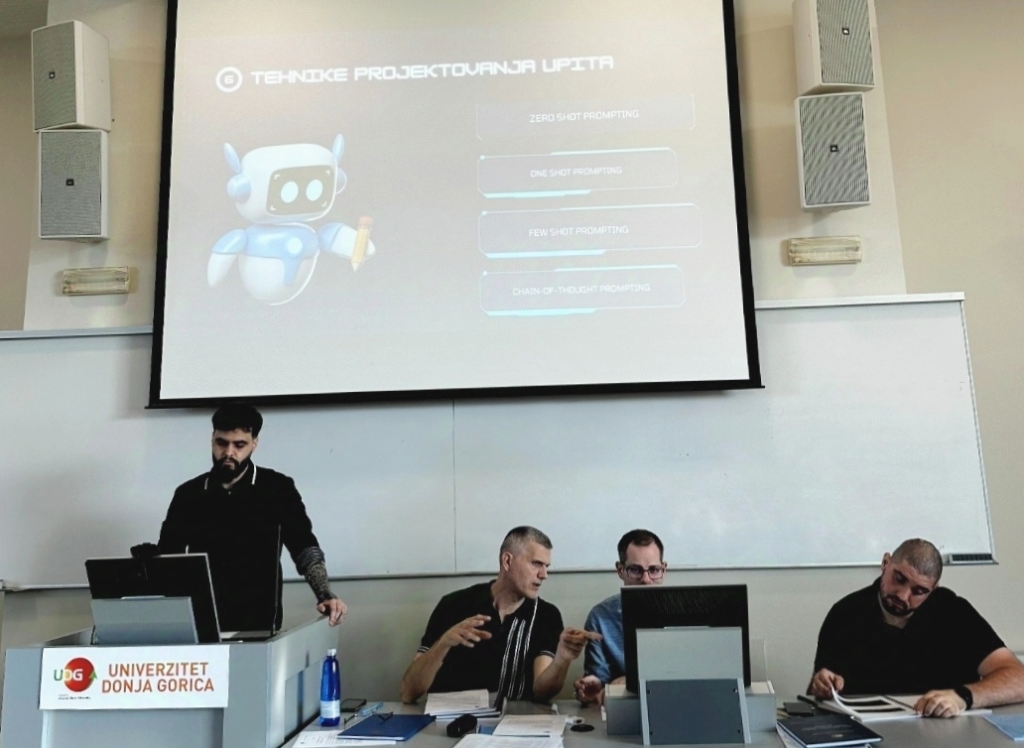
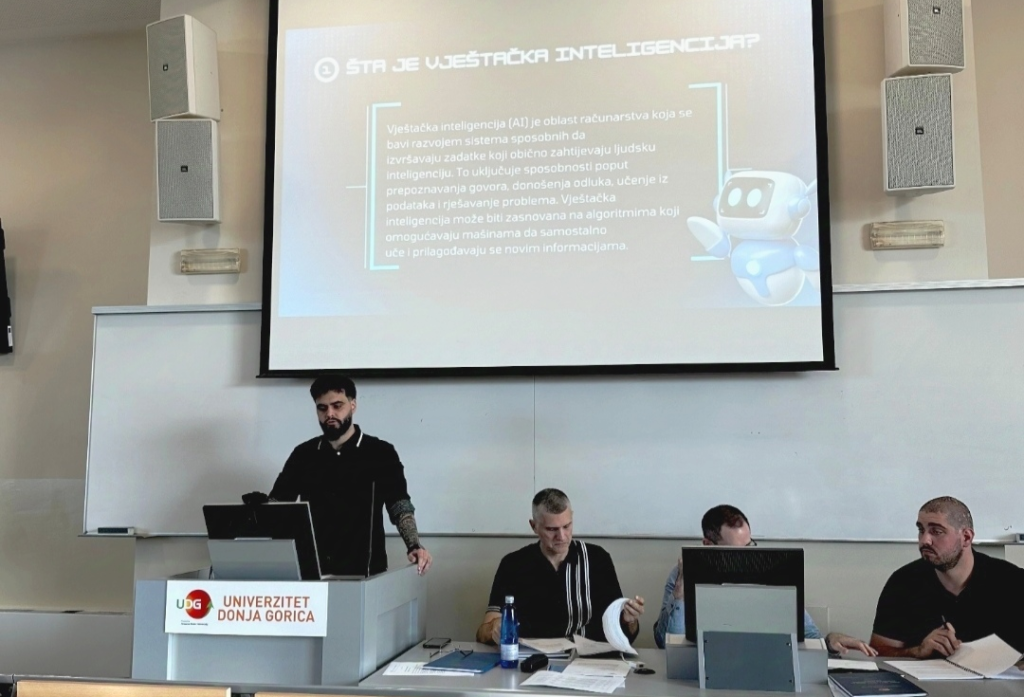
Mr. Veselin Andric defended his BSc thesis titleld “Prompt endineering for LLMs” at the Faculty for information systems and technologies. The devence took place on 2 Oct 2024 and it was done under mentorship of the EuroCC (NCC Montenegro) and HPC4S3ME teams’ members. This was a part of the effort to promote HPC and AI related technologies in the teaching curricula and research activities at UDG.

ABSTRACT – Prompt engineering is one of the primary areas of Natural language processing (NLP). It is a process that involves designing and improving inputs that are given to a language model such as ChatGPT, with a goal of getting wanted results. This dissertation investigates details of prompt engineering, it’s theoretical foundation, methodologies and practical uses in different tasks of NLP.

Mr. Veselin Andric defended his BSc thesis on Prompt Engineering
The provided an overview of NLP, LLMs and prompt techniques

Collaborating for Smarter, Competitive and Sustainable Tourism

The dynamic of digital transformation, adoption of cutting-edge technologies and proliferation of innovative business models, provide Montenegro with strategic opportunities to elevate its tourism sector through data-driven and AI-powered solutions. NCC Montenegro is initiating collaboration with local municipalities and tourist organizations, on Tourism 4.0 project initiatives to optimize visitor experiences, provide smart destination management and promote sustainable tourism.

By leveraging next-generation technologies such as IoT, Computer Vision, Big Data, Artificial Intelligence, Machine Learning, and High-Performance Computing, NCC Montenegro in cooperation with high-tech SME and local municipality, is preparing project initiative on real-time analytics and predictive insights related to tourism dynamic and trends to provide multiple benefits for public authorities, tourist organizations, cultural institutions and local businesses.

By embracing new technologies, advanced data analytics and intelligent modelling key tourism policymakers and stakeholders can achieve multiple benefits. These benefits include data-driven decision making, proactive management of tourist destinations/attractions, efficient resource allocation and capacity planning, better protection/valorization of cultural heritage/sites, increased visitors satisfaction and engagement, tailored offers and targeted marketing by local business, as well as “a-year-round” enhanced tourism strategies. Creating a scalable and collaborative platform for smart tourism management ultimately contributes to attractiveness and competitiveness of the Montenegro tourist destinations.

EuroCC success story booklet 2024

The new Success Story Booklet for EuroCC 2024, created in collaboration by CASTIEL and the National Competence Centres (NCCs), is now available online!

The success stories in the EuroCC 2024 booklet span a diverse range of sectors, including:

  • IT and Software
  • Natural Sciences and Aeronautics
  • Environment, Energy, and Agriculture
  • Pharmacy and Medicine
  • Manufacturing and Engineering
  • Finance and Mobility
  • Public and Communication

These stories showcase achievements and innovations across multiple industries, highlighting the wide-reaching impact of EuroCC initiatives.

One of the featured success stories highlights the collaboration between NCC Montenegro and the Montenegrin company Fleka, showcased through the project “Personalized Banking Software Solutions.” This partnership shows how local innovation can create custom ML predictions for the banking sector and personalized financial-tech sector.

Discover inspiring success stories that highlight innovative achievements across Europe.

New academic paper on Montenegro’s HPC ecosystem development

A new academic paper ‘Sizing HPC Opportunities in Montenegro: Market Insights, Best Practices and Use Cases’ has been published in the scientific journal “Entrepreneurial Economy“.

The paper highlights the pivotal role of HPC in addressing critical societal, scientific, and industrial challenges, and explores its growing impact on businesses through data-driven decision-making, workflow optimization or innovative product design. The study underscores the importance of HPC infrastructure, Cloud services, and AI applications in driving digital transformation and enhancing the industry competitiveness of SMEs.
The research also identifies key challenges in Montenegro including a shortage of HPC expertise, low demand for critical HPC performance, and certain concerns related to data security and IPR. Despite these challenges, market research revealed HPC opportunities related to high Cloud adoption, innovative product development and favourable business prospects. The paper also describe activities of the HPC National Competence Centre Montenegro, established through the EuroCC project, related to established HPC and AI related academic programs and training portfolio, and productive industry collaborations, demonstrated through successful use cases in smart agriculture, precise weather forecasting, and FinTech.

By harnessing both national expertise and international supercomputing resources, the NCC Montenegro has effectively integrated HPC technologies into research and business practices, driving technology innovations and smart growth.

New model developed in the field of HPC technologies through the collaboration of DigitalSmart and NCC Montenegro

In collaboration with the National Competence Center Montenegro (NCC Montenegro), the University of Donja Gorica (UDG), and the University of Montenegro (UCG), the company DigitalSmart has successfully started the development of a new model utilizing advanced High Performance Computing (HPC) technologies. This partnership represents an important step towards applying HPC resources to solve complex problems and enhancing academic and industrial processes in Montenegro.

The new model is designed to optimize data processing, providing faster and more efficient solutions for research and development in the field of generative artificial intelligence. The use of HPC technologies in this context enables greater scalability and precision in the analysis and processing of large datasets.

The experiment has been successfully submitted through the Fortissimo call, paving the way for further validation and application of this model on an international level.

Virtual bootcamp “AI for Scientific Computing” successfully conducted by NCC Germany, Sweden, Austria and Montenegro

NCC Montenegro representative Luka Filipovic took an active part as a Teaching Assistant in the Nvidia and EuroCC2 supported bootcamp “AI for Scientific Computing”, successfully organized by NCCs Germany, Sweden, Austria and Montenegro, on June 25–26, 2024.

The Bootcamp offered a comprehensive introduction to deep neural networks, focusing on applications in scientific computing and physical systems defined by differential equations. The curriculum included advanced topics based on NVIDIA Modulus to develop and train the models in various areas. This online Bootcamp features guided instructions and support from cross-NCC teaching assistants to facilitate learning, supporting participants to build and enhance AI/DL models.