

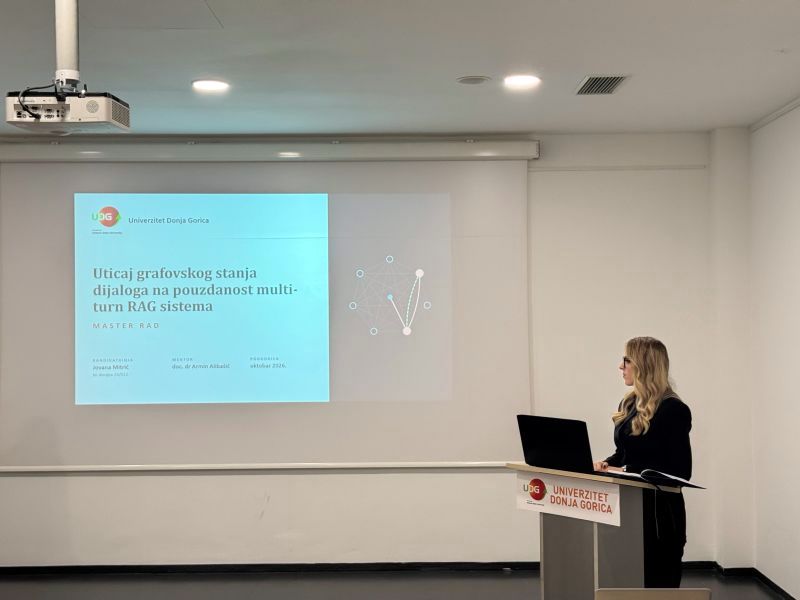
On 23th October 2026, MSc candidate Jovana Mitric defended her thesis entitled “The influence of the graph state of the dialogue on the reliability of the multi-turn RAG system” within the Information Technologies Master’s programme at the Faculty for Information Systems and Technologies, University of Donja Gorica, under the mentorship of prof. dr Armin Alibasic.
The research and experimental work presented in this study was partially carried out with the support of the National Competence Centre for High-Performance Computing of Montenegro (NCC Montenegro), through access to HPC infrastructure and expert support provided within the EuroCC3 project. By supporting academic research and strengthening research capabilities in artificial intelligence (AI) and high-performance computing (HPC), NCC Montenegro contributes to the advancement and application of advanced computing technologies, particularly in the fields of natural language processing and responsible AI development.
The thesis investigates how explicit graph-based dialogue state modeling affects the reliability of retrieval-augmented generation (RAG) systems in multi-turn conversations, using the telecommunications services domain as a controlled evaluation setting. The focus is on a multidimensional evaluation framework covering answer faithfulness, retrieval quality, recovery after topic return, stability across the conversation, and contradictions, rather than a single overall accuracy metric. By comparing four configurations (LLM-only, standard RAG, intent RAG, and graph-state RAG) on the same set of 24 conversations, the thesis examines whether structural dialogue control represents a justified extension of the standard RAG architecture.
ABSTRACT – This thesis investigates the impact of graph-based dialogue state modeling on the reliability of multi-turn RAG systems. A graph-state RAG approach was developed in which the current and previous focus areas are tracked and used to guide retrieval. The experiment was conducted on 24 multi-turn conversations in the telecommunications domain and compared four configurations: LLM-only, standard RAG, intent RAG, and graph-state RAG. Evaluation covered answer faithfulness, retrieval quality, recovery after topic return, performance stability, and contradictions. The results did not show a statistically significant advantage of graph-state RAG over simpler RAG configurations. However, the approach provides a structured and interpretable mechanism for managing conversational flow and offers a basis for future research on more complex multi-turn scenarios.