

On 23th October 2026, MSc candidate Igor Radulović defended her thesis entitled “Development and evaluation of Multi-Agent RAG system for legal analysis of Montenegrin legislation using HPC infrastructure” within the Information Technologies Master’s programme at the Faculty for Information Systems and Technologies, University of Donja Gorica, under the mentorship of doc. dr Luka Filipović.
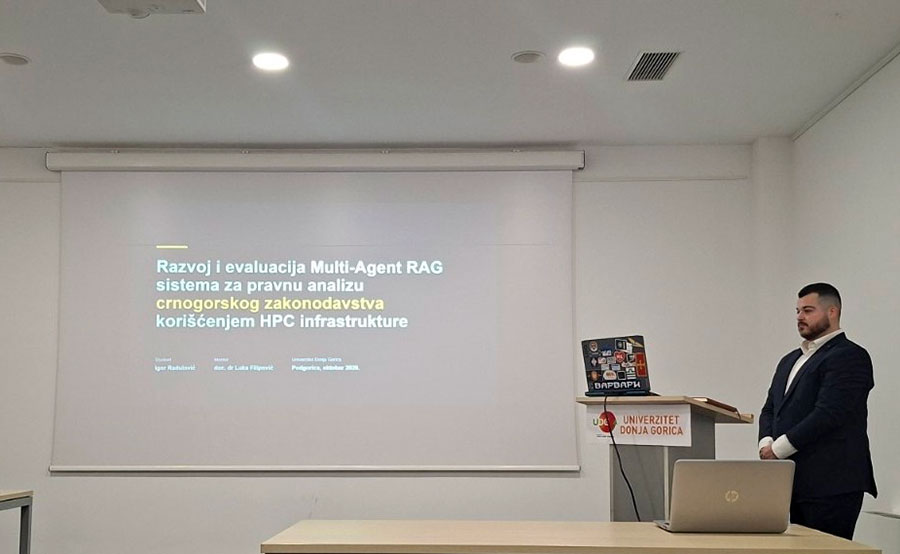
The research and experimental work presented in this study was partially carried out with the support of the National Competence Centre for High-Performance Computing of Montenegro (NCC Montenegro), through access to HPC infrastructure and expert support provided within the EuroCC3 project. By supporting academic research and strengthening research capabilities in artificial intelligence (AI) and high-performance computing (HPC), NCC Montenegro contributes to the advancement and application of advanced computing technologies, particularly in the fields of natural language processing and responsible AI development.
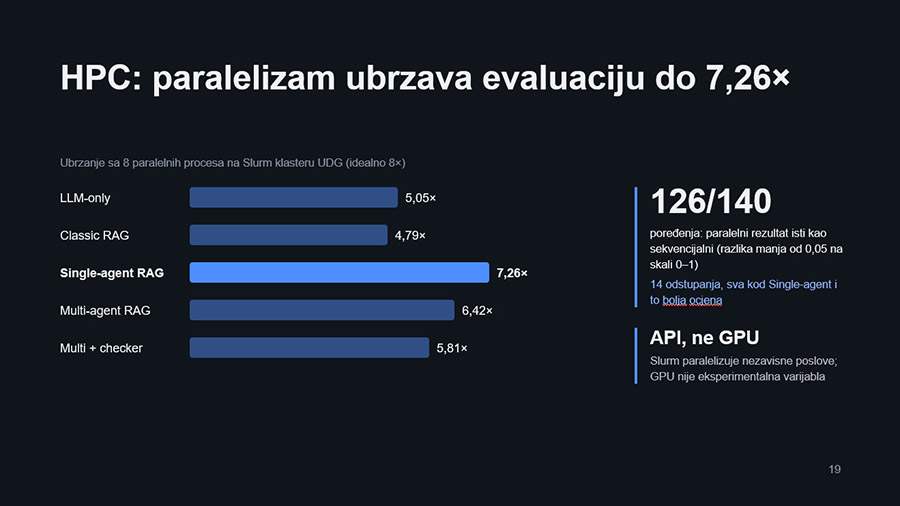
The thesis investigates the development and evaluation of a multi-agent RAG system for legal analysis of Montenegrin legislation, using HPC infrastructure to scale the experiments. The focus is on a stepwise comparison of five architectures (LLM-only, classic RAG, single-agent RAG, multi-agent RAG, and multi-agent RAG with citation verification) through a multidimensional evaluation framework covering citation accuracy, hallucinations, legal reasoning quality, latency, and cost, rather than a single overall quality metric. The evaluation combines automatic metrics, an AI evaluator, and the ratings of two independent human reviewers, in order to determine whether each added agentic component justifies its complexity and cost.
ABSTRACT – This thesis presents a methodological evaluation of the quality and research usability of three synthetic mental health diary datasets produced through workflows based on GPT-5.5, Claude Sonnet 4.6 and Gemini 3.1 Pro. Each dataset contains 1,000 entries across 100 journals, sharing a common data schema and co-generated labels, with the journal treated as the unit of statistical independence. The evaluation combined cluster-aware permutation inference with Benjamini-Hochberg correction, a classifier two-sample test against a human reference corpus (SemEval-2026 Task 2), cross-dataset transfer experiments, a TF-IDF versus RoBERTa comparison, and zero-shot mmBERT transfer between paired English and Montenegrin text. The datasets differed significantly in seven of nine labels, and synthetic text remained clearly separable from human-written text even after controlling for text length (balanced accuracy 0.9855–0.9942). All 30 cross-dataset comparisons showed performance drops (26.04%–84.99%), while RoBERTa outperformed the TF-IDF baseline (macro-F1 0.7872 vs. 0.7118). The findings show that the datasets support controlled experiments but are not distributionally interchangeable, and that synthetic data quality requires multidimensional evaluation rather than a single metric. The results do not establish clinical validity of the labels or rank the generators by quality.