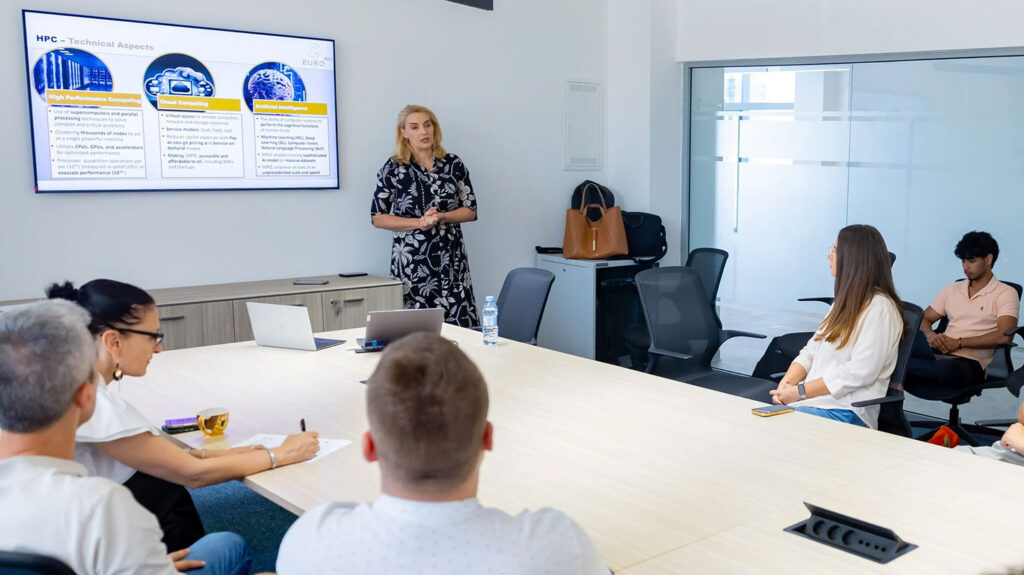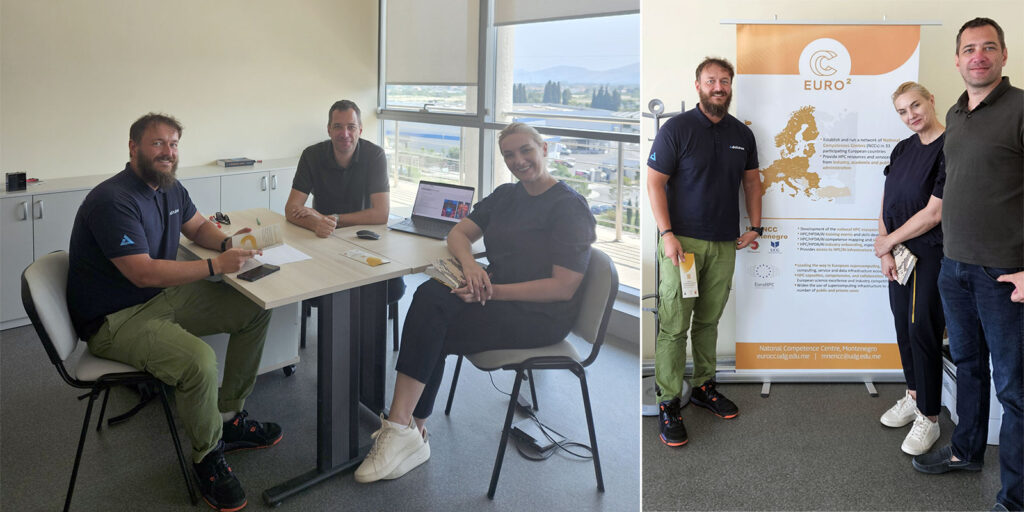
Representatives of the company Deltahes recently visited the National Competence Centre Montenegro @UDGa, to explore potential or collaboration in the fields of digital transformation, industrial automation and high-performance computing. Deltahes is an innovation-driven startup founded in late 2022, specializing in digital transformation through cutting-edge solutions in industrial automation and IT. Their flagship platform, the Common Data Stack, enables seamless integration of production data and customized software systems—like MES, SCADA, and EMS—providing a centralized “cockpit” for efficient, data-driven industrial management.
Meeting with DeltaHes
Aleksandar Duković, founder of Deltahes was introduced to the EuroCC2/EuroCC4SEE project, NCC’s services portfolio, including training programs, technical support, and access pathways to EuroHPC resources for SMEs and innovative companies. Particular emphasis was placed on the opportunities for utilizing HPC infrastructure for industrial innovation, as well as the potential integration of HPC-based analytics within platforms like Deltahes’ Common Data Stack. Both sides expressed interest in further collaboration in applying for EuroHPC resources to accelerate the adoption of advanced technologies in Montenegro’s industrial/energy sector.
NCC Montenegro will take part in the upcoming CMBEBIH 2025 conference, which will be held from September 11-13, 2025, in Sarajevo, Bosnia and Herzegovina.
Organized by NCC HPC Bosnia and Herzegovina, in collaboration with partners, CMBEBIH 2025 is one of the region’s leading conferences dedicated to medical and biological engineering. The event brings together scientists, engineers, clinicians and innovators to exchange knowledge and shape the future of health technologies.
As part of this international conference, the first major EuroCC event in Bosnia and Herzegovina will be hosted. This will include a dedicated HPC session, where NCC Montenegro will present its success stories and contributions to advancing HPC adoption in industry, research and public services. This session is a unique opportunity for all NCCs to showcase impactful initiatives and explore avenues for joint actions, including cross-border workshops and collaborative projects, as previously discussed within our network.
📢 Call for Papers – Special Issue in Technology and Health Care (THC)
EuroCC colleagues are encouraged to submit papers for a special issue of the SAGE journal Technology and Health Care. Submissions representing the work of NCCs are especially welcome and will strengthen the visibility of our community’s contributions.
Submission Timeline:
Initial Submission: September 20, 2025
First Feedback: October 20, 2025
Final Submission: November 25, 2025
Papers must comply with the journal’s peer-review standards. More details are available on the [link].
💡 Oncology Hackathon at CMBEBIH 2025
There will also be organized a special Hackathon in oncology, offering a space for interdisciplinary teams to co-create innovative solutions for cancer care. All interested students, researchers, clinicians, developers and data scientists are invited to register and join the challenge!
👉 Join us in Sarajevo and contribute to this milestone event for the EuroCC community!
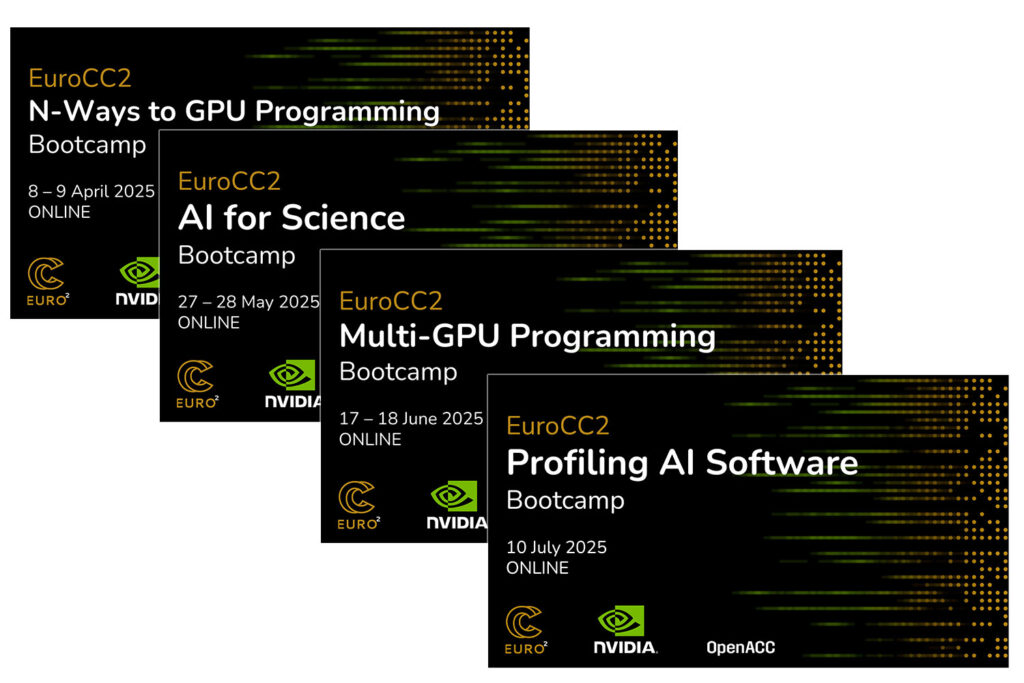
Together with NVIDIA and OpenACC organization, EuroCC2 will host a virtual Profiling AI Software Bootcamp on July 9-10, 2025.
The Profiling AI Software Bootcamp covers the process and tools needed to profile AI and machine learning applications to fully utilize high-performance systems. Attendees will learn to profile applications using NVIDIA Nsight™ Systems, a system-wide performance analysis tool; analyze and identify optimization opportunities; and improve performance of applications to scale efficiently across systems of any quantity or size of CPUs and GPUs. Additionally, this bootcamp will walk through the system topology to learn the dynamics of multi-GPU and multi-node connections and architecture.
People who complete the bootcamp are encouraged to apply to participate in the upcoming EuroCC AI Hackathon, which will be open for applications shortly.
Due to EuroCC2 regulations, generic or private email addresses cannot be accepted. Please use your official university or company email address to prove your affiliation when applying.
Application Deadline: 16th June 2025
Prerequisites: Basic experience with Python programming and PyTorch distributed training.
Event format: This bootcamp will be hosted online in Central European Summer Time (CEST). All communication will be through Zoom, Slack and email.
Compute Resources: Attendees will be given access to a GPU cluster for the duration of the bootcamp.
Join the 12th edition of the POLICY ANSWERS Monthly Webinar series as we explore how the Western Balkans can align their priorities with the European Union in crucial areas such as Digital Transformation, the Green Deal, and Health Policy. This month’s webinar Luka Filipovic will present how High-Performance Computing (HPC) and digital research infrastructures are pivotal to Montenegro’s development and its integration into the European Research Area. Don’t miss out on this opportunity to learn how cutting-edge technologies are shaping innovation in the region.
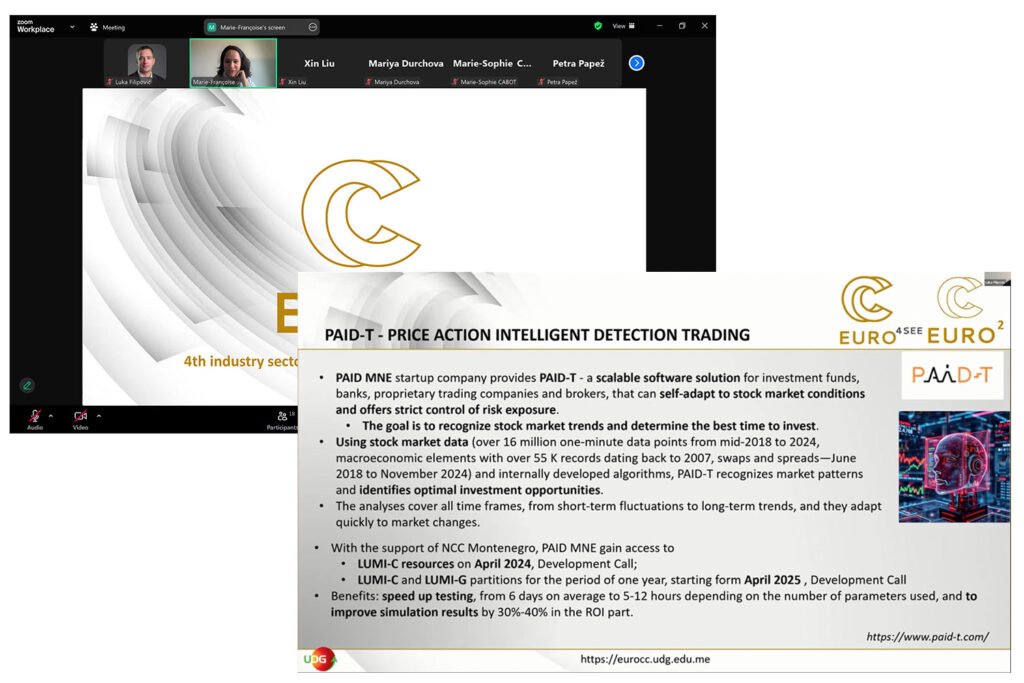
PAID Montenegro has achieved success in the EuroHPC Joint Undertaking Development Call, marking a significant milestone in its efforts to strengthen its capacities in high-performance computing (HPC).
The initiative successfully completed the first round of the development call, demonstrating strong technical potential and relevance to the EuroHPC objectives. Following this achievement, PAID Montenegro submitted a second application, which was once again approved. As a result, the team has secured access to one of Europe’s most powerful supercomputing infrastructures — LUMI, the pan-European pre-exascale supercomputer. PAID Montenegro was granted 4,000 node hours on LUMI-C (CPU partition) and 4,500 node hours on LUMI-G (GPU partition), providing substantial computational power for advanced simulations, data processing, and AI research.
Representatives of NCC Montenegro met with Vuk Cadjenovic and Milos Borozan from Damar, a pioneering Montenegrin research institute established in 1993 that specialises in social research, public opinion polling, and data analysis. Over the years, Damar evolved into a comprehensive scientific and research institute, expanding its expertise to encompass a diverse range of qualitative, quantitative, and computational methodologies.
During the initial meeting held on April 15, 2025, and the follow-up on May 9, 2025, discussions focused on the potential integration of HPC resources into Damar’s operations. The goal is to leverage Damar’s extensive, multi-year data pool on public opinion and social issues to enhance its analytical capabilities through advanced predictive and prescriptive AI models.
The application of HPC would enable more precise modelling of complex social phenomena, improved data visualization, and real-time data processing—significantly increasing the relevance, depth, and impact of research outputs. The meetings also addressed opportunities for joint participation in research and innovation projects aimed at developing data-driven, AI-solutions for the public and private sectors.
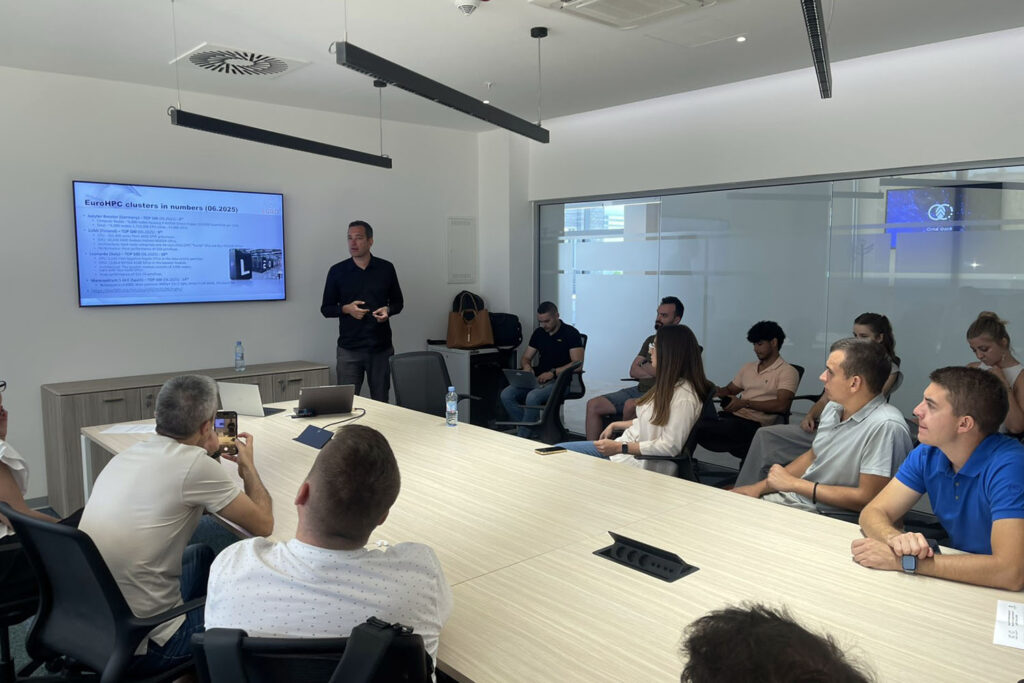
NCC Montenegro and ICT Cortex hosted Supercomputing Opportunities for Industry Leaders—a dynamic industry event showcasing how HPC and AI are reshaping the innovation landscape for businesses in Montenegro.
The event was opened by Sanja Nikolić, who presented NCC Montenegro as a national hub dedicated to fostering driving innovation, digitalization and competitiveness through Cloud HPC and AI technologies.
Following the introductory part, Luka Filipović emphasized NCC Montenegro’s role as a national gateway to the EuroHPC supercomputing infrastructure. His presentation offered a practical roadmap and expert insights into the Open Access Calls, providing businesses with clear guidance on how to leverage some of the most powerful supercomputers in Europe—and globally—for research, development, and innovation.
The second part of the event featured a panel discussion with representatives from innovative companies in the Montenegrin IT sector—technology visionaries who are actively applying HPC and AI in real-world projects. The panel highlighted successful collaborations with NCC Montenegro and included:
Milutin Pavićević, Chief Creative Director at Alicorn, presented NameSentinel—an AI-powered service that enables smart search and generation of memorable domain names by processing user preferences and startup descriptions. The platform leverages HPC to process tens of millions of domain records daily, enabling real-time, ultra-fast domain availability checks.
Marko Lekić, CTO of Fleka, shared insights into the company’s work in the FinTech industry, highlighting the development of ML-based, HPC-empowered SaaS solutions aimed at enhancing personalized banking experiences. Their approach leverages intelligent algorithms for transaction and spending classification, enabling smarter, more tailored financial services.
Đuro Stojanović, CEO of UHURA Solutions, an AI startup specializing in automating document-driven processes, emphasized the benefits of leveraging EuroHPC resources, specifically the Leonardo supercomputer. He discussed how it can be used to train and fine-tune LLMswith up to 70 billion parametersondomain-specific datasets, enhancing the efficiency and accuracy of AI-driven financial solutions.
Nebojša Jovanović, Co-Founder and Product Owner of PAID, presented the development of a B2B software solutionforquantitative tradingon stock exchanges. The solution requires training sophisticated AI/ML models and running up to 1.2 million simulations per financial instrument—a process that, thanks to access to the LUMI supercomputer, was completed in just 4.7 hours, compared to the estimated 10 months.
This event not only showcased the industry potential of HPC and AI—particularly within the IT sector—but also emphasized NCC Montenegro’s supportive role in making these advanced technologies both accessible and actionable for the local and regional business ecosystem.