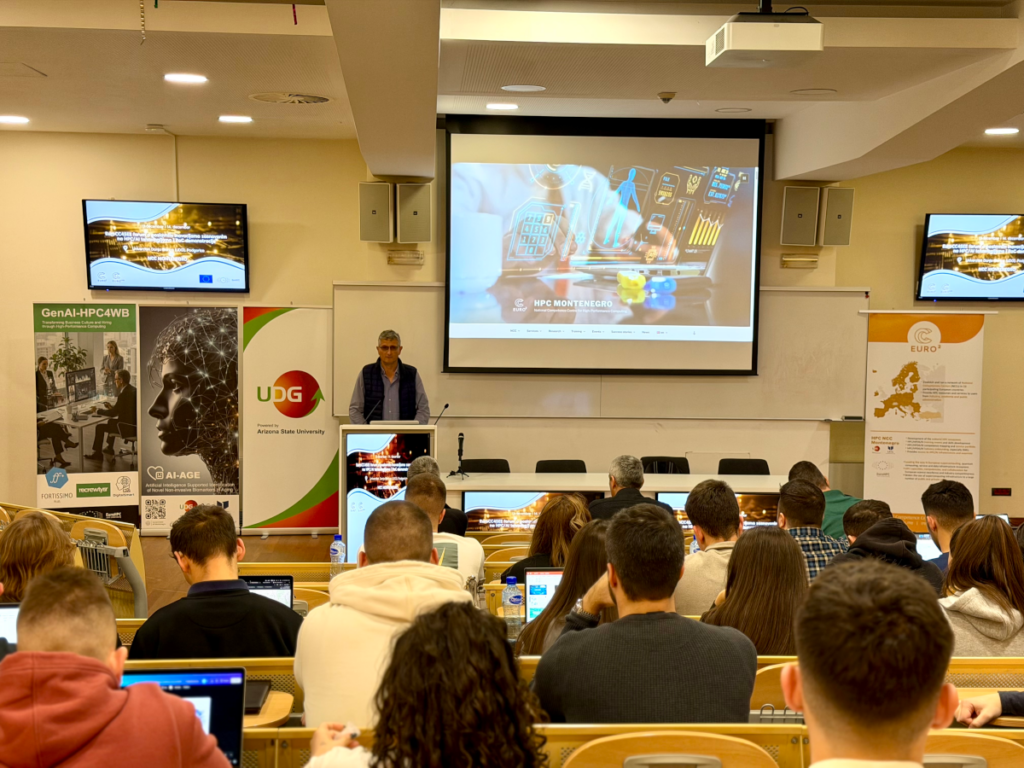
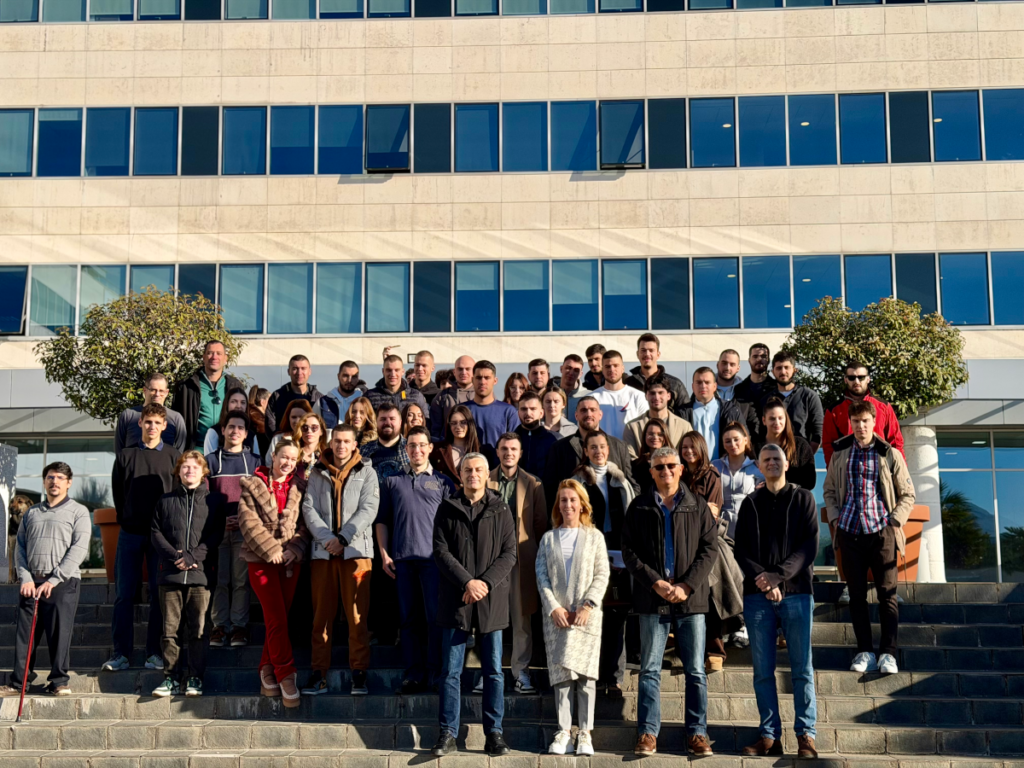
On 13–14 December, NCC Montenegro hosted the EuroCC4SEE Forum dedicated to business innovation supported by High-Performance Computing (HPC) and Artificial Intelligence (AI). The event brought together representatives from academia, industry, the public sector, and the startup ecosystem, with the aim of strengthening national capacities and supporting Montenegro’s digital transformation.
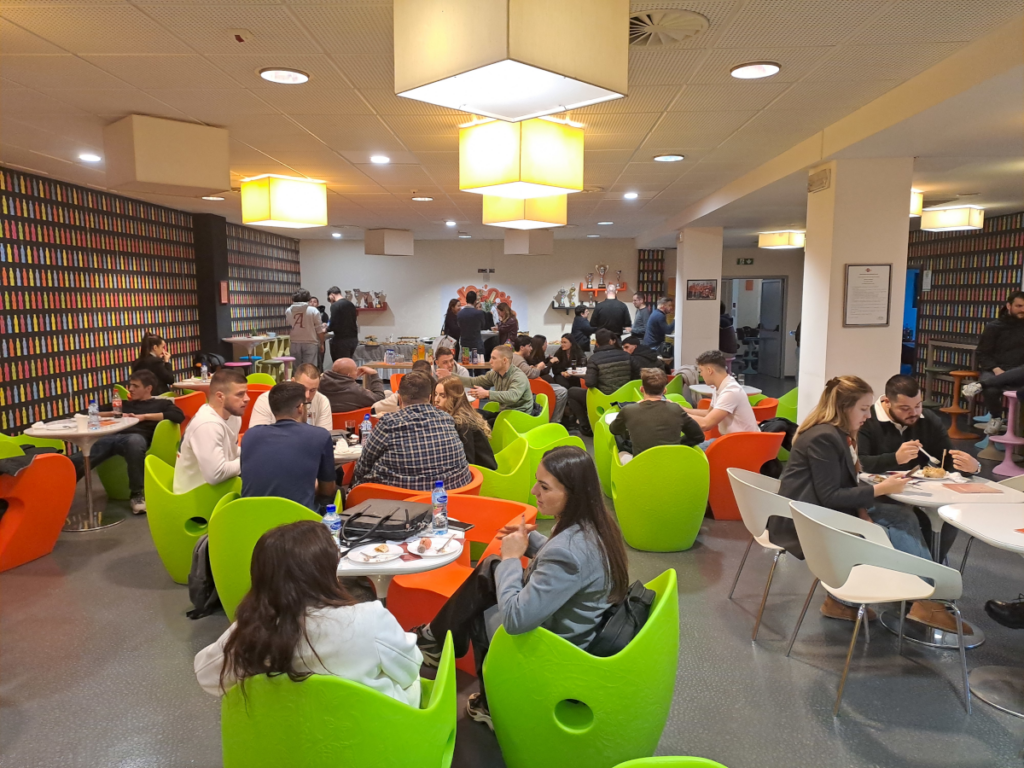
Welcome note from NCC Montenegro – prof. Bozo KrstajicWe organized networking activities during the breaks
During the two-day program, participants explored practical applications of HPC and AI through Proof-of-Concept demonstrations in the fields of energy, agriculture, health, and mobility, alongside discussions on innovation policies, MLOps approaches, skills development, and business–academia collaboration.
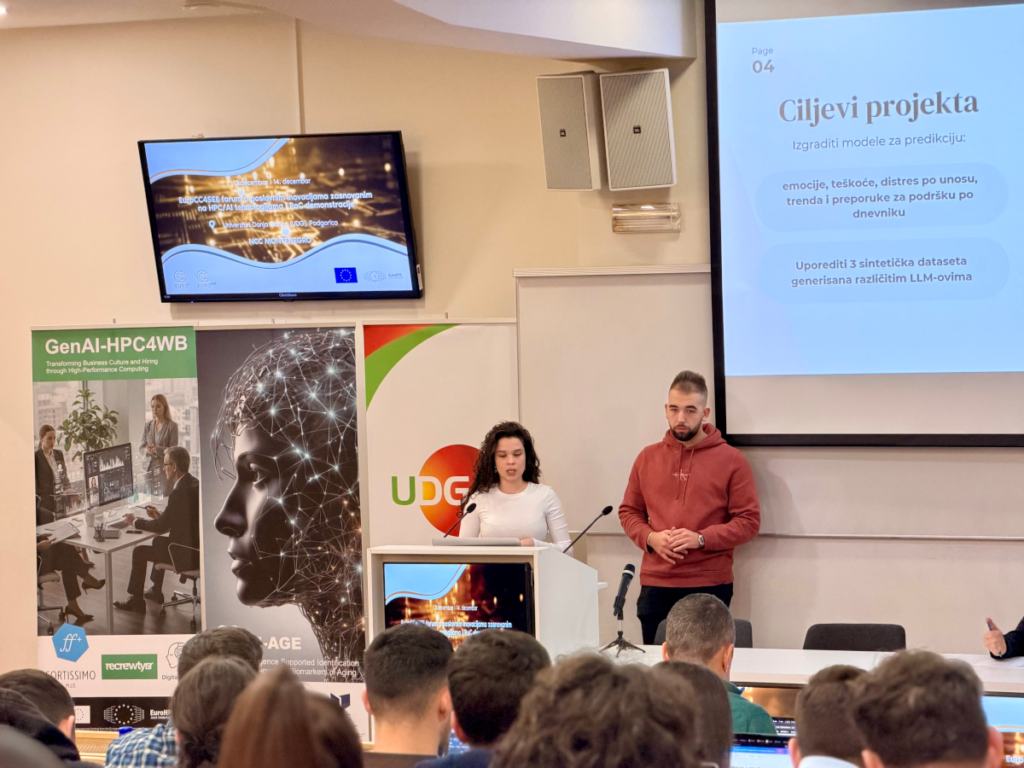
Discussions were focused on AI/HPC driven innovation in business and PoC demonstratorsPoC presentations were based on acamia-industry collaboration
The forum also highlighted the importance of regional and European cooperation, EU funding opportunities, and future activities within the EuroCC4SEE network, contributing to the strengthening of Montenegro’s position within the regional HPC/AI ecosystem. A proceedings booklet with brief elaborations of all covered topics will be made available on the project website.
NCC Monetenegro will host the EuroCC4SEE Forum on HPC/AI-Enabled Business Innovation & PoC Demonstrations on 13–14 December, bringing together representatives from academia, industry, government, and the startup community. The two-day event will highlight how High-Performance Computing (HPC) and Artificial Intelligence (AI) can accelerate innovation, strengthen national capacities, and support Montenegro’s digital transformation.
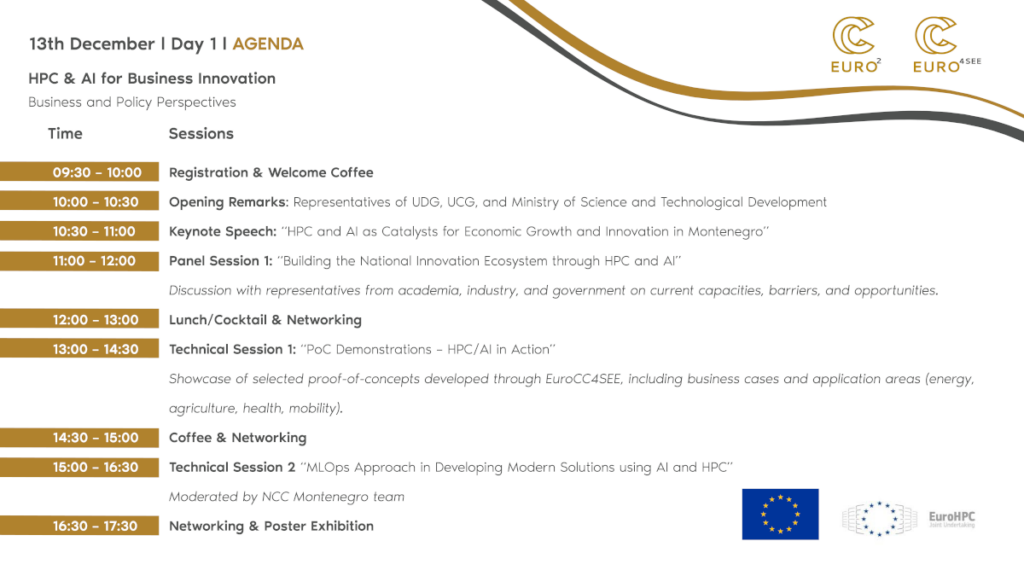
Day 1 will focus on business innovation and policy perspectives, featuring opening remarks from national institutions, a keynote on the role of HPC and AI in economic growth, and a high-level panel on building Montenegro’s innovation ecosystem. The program will also include technical sessions, with PoC demonstrations developed through EuroCC4SEE in sectors such as energy, agriculture, health, and mobility, followed by a session on MLOpsapproaches moderated by the NCC Montenegro team. A networking and poster exhibition will showcase student work and local startup projects.
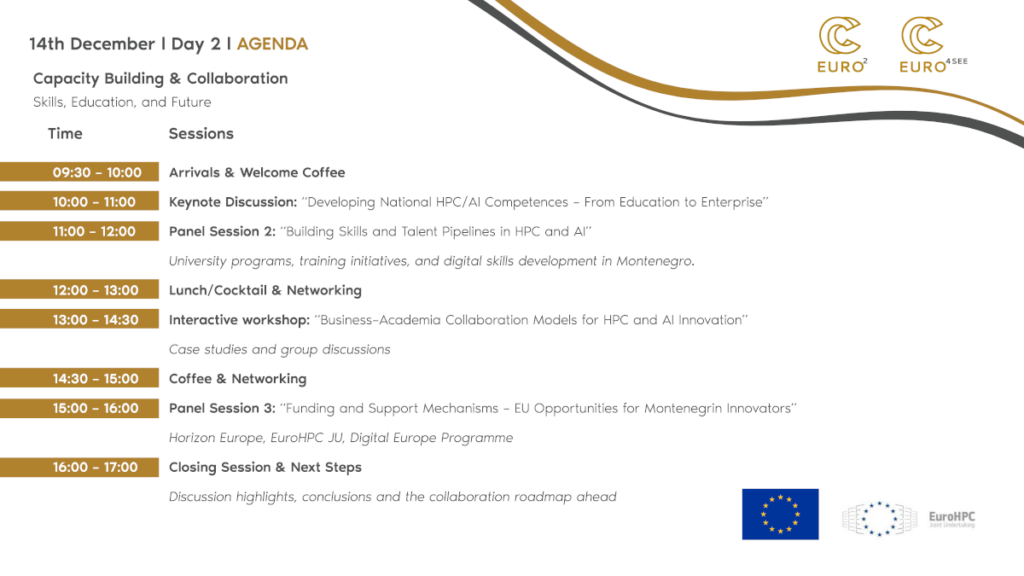
Day 2 will shift toward skills, education, and collaboration. Participants will explore national competence development in HPC/AI, talent pipeline building, and business–academia cooperation models through panels and an interactive workshop. The event will conclude with an overview of EU funding opportunities (Horizon Europe, EuroHPC JU, Digital Europe Programme) and a roadmap for further collaboration within the EuroCC4SEE network.
The forum aims to strengthen Montenegro’s position in the regional HPC/AI landscape and foster partnerships that empower innovation and research excellence.
The Second National AI Conference “AI DIREKTNO: Montenegro in the Time of AI Challenges” was held on 3 December 2025 at the Science and Technology Park of Montenegro, gathering leading representatives from government, academia, health institutions, industry, and the innovation ecosystem. The event was organized by the Association of Managers of Montenegro (AMM), the AMM Academy for Leadership, Management and Corporate Governance, and the Science and Technology Park of Montenegro.
NCC Montenegro took an active role throughout the conference, contributing to discussions on strengthening Montenegro’s AI ecosystem, responsible adoption of advanced technologies, and the importance of high-performance computing (HPC) for research, innovation, and industry. NCC-affiliated representatives participated in panel discussions focused on the practical impact of AI, digital transformation, and new opportunities emerging across sectors.
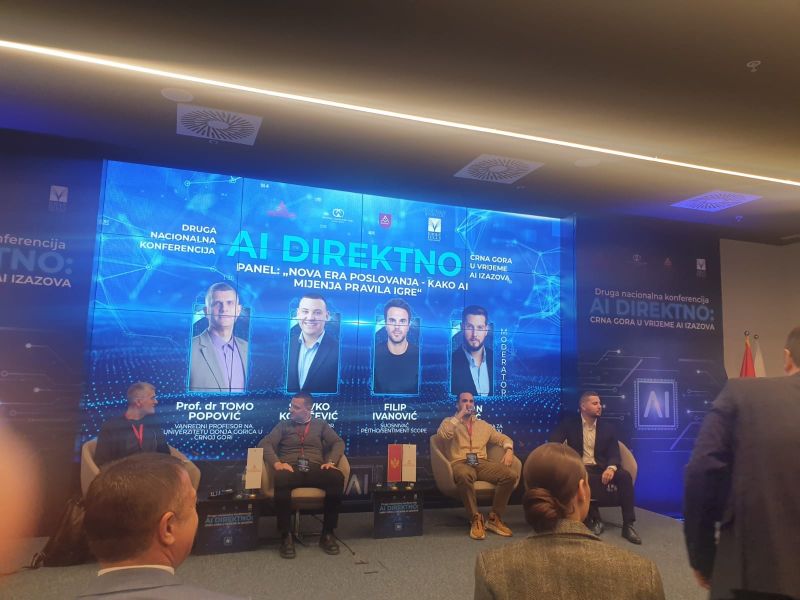
One of the key contributions came during the panel “A New Era of Business – How AI Is Changing the Rules of the Game”, where Prof. Dr. Tomo Popović (University of Donja Gorica & NCC Montenegro) highlighted real-world AI adoption, the growing need for scalable HPC resources, and the importance of building multidisciplinary teams capable of delivering trustworthy AI solutions. The discussion also featured insights from industry leaders, some of which are already using EuroHPC Ju access, on emerging business models and AI-driven innovation. Agenda avaliable at [link].
The panel included NCC team members and representatives from companies already using EuroHPC resources
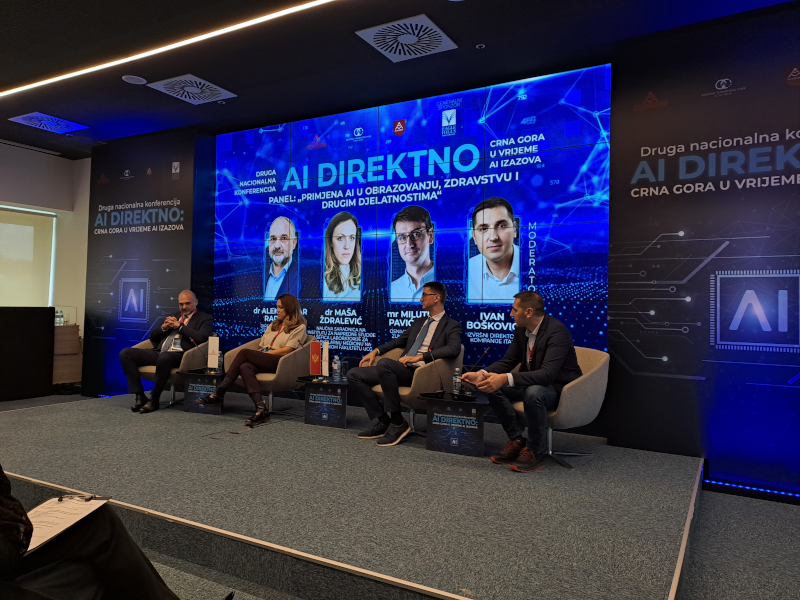
Another important contribution from the NCC community was made earlier in the day by Mr. Milutin Pavićević, assistant at UDG and founder of the startup Zuno, who participated in the panel “Application of AI in Education, Healthcare, and Other Sectors.” He emphasized practical challenges startups face in implementing AI-driven products, and the value of national digital infrastructure and research institutions in supporting early innovation.
The other panel focused on AI and Healthcare sector
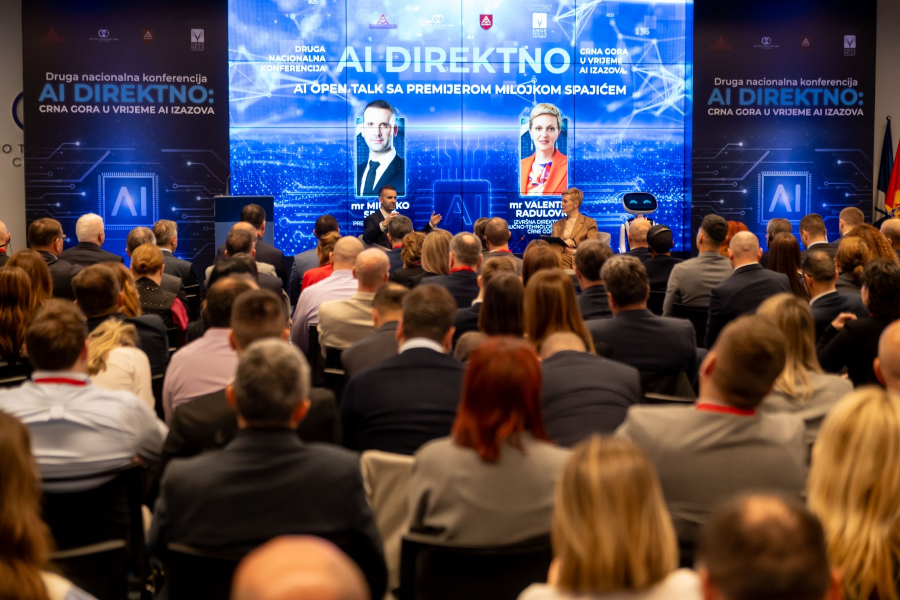
The conference also included an open talk with the Prime Minister, sector-specific panels on banking, healthcare, and education, and strategic reflections from Montenegro’s growing AI and tech community. NCC Montenegro’s participation reinforces its mission to support the adoption of AI and HPC technologies, strengthen skills development, and build an innovation ecosystem aligned with European standards and capabilities.
The conference also included an open talk with the Prime Minister
At the end of November 2025, representatives of NCC Montenegro visited the Verlab Institute and NCC Bosnia and Herzegovina in Sarajevo for a two-day working meeting held within the EuroCC4SEE framework. The visit focused on strengthening regional cooperation, supporting twinning and mentoring activities, and expanding joint engagement with academia and industry. The meetings brought together both NCC teams as well as IT industry stakeholders, underscoring the growing importance of SMEs in HPC and AI adoption across the Western Balkans.
Day 1: Coordination, Planning, and Strategic Alignment
The first day centred on aligning the two NCCs on upcoming activities and mapping joint priorities for the next three months. The discussions focused on student engagement, training coordination, and preparation of several regional events.
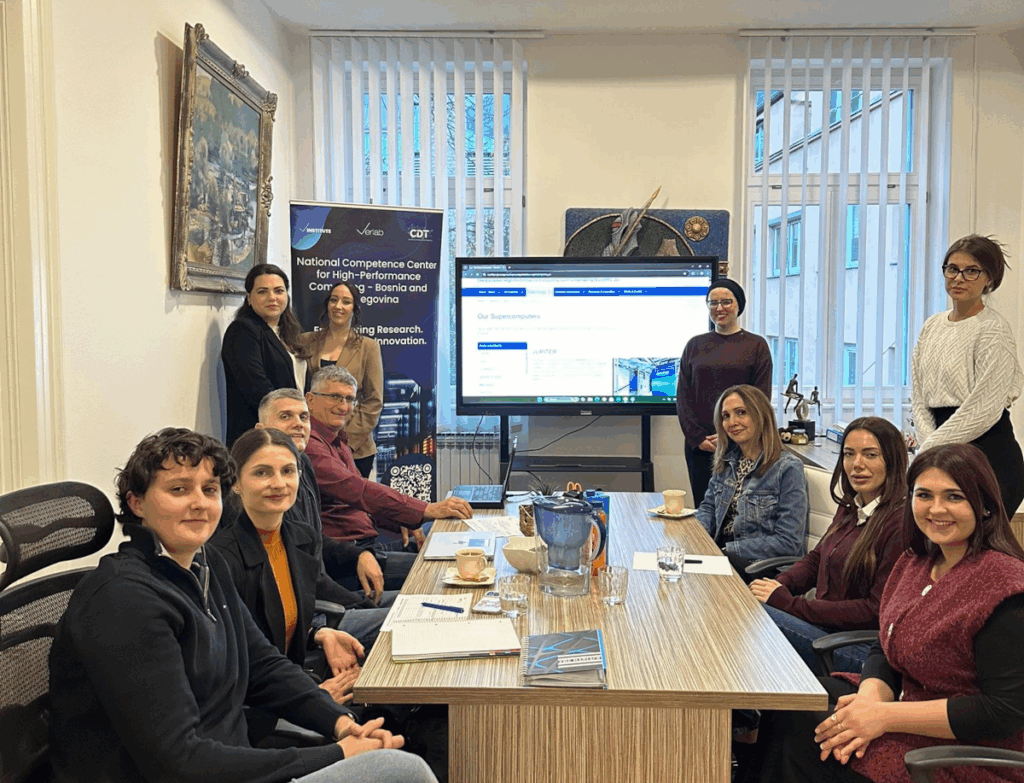
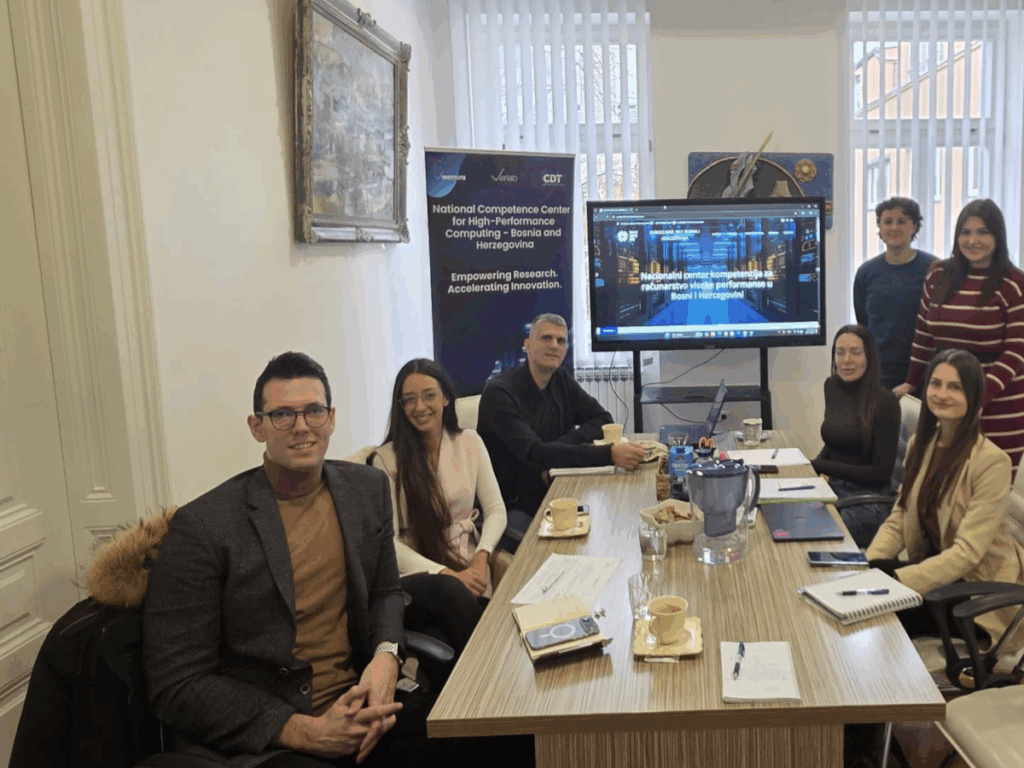
Continuation of NCC collaboration between NCC Montenegro and NCC Bosnia and Herzegovina
Key outcomes included:
NCC BiH participation in the NCC Montenegro Conference (13 December 2025), showcasing HPC/AI proof-of-concepts and project activities.
Joint planning of workshops and PoC support for companies, combining experiences from Montenegro and Bosnia and Herzegovina, and building on ongoing collaborations with NCC Poland and NCC Latvia.
Agreement to co-organise major events in early 2026, including the AI in Medicine event in Montenegro and the Žabljak IT Conference.
Coordination on joint scientific publications, using existing datasets and aligning research topics across the two centres.
These discussions reaffirmed the value of EuroCC4SEE’s twinning and mentoring model, enabling both NCCs to share practices, strengthen their training pipelines, and streamline outreach to researchers and SMEs.
Both UDG and UCG representatives participated in the meetings with NCC BiH team
Day 2: Knowledge Exchange, SME Engagement, and Practical Collaboration
The second day focused on operational collaboration, with a workshop dedicated to industry outreach and experience exchange related to HPC and AI services. NCC Montenegro shared its methodology for working with companies, including how to communicate EuroHPC JU opportunities and guide SMEs through resource applications.
Day 2 included exchange of experiences, SME engagement, EuroHPC access to resources
A local IT company that already uses NCC BiH resources joined the discussion. Their participation added a practical industry perspective and resulted in commitments to:
take part in the AI in Medicine event in Montenegro,
join the Žabljak IT Conference,
explore deeper involvement in EuroHPC-supported pilot activities.
The workshop also enabled both NCCs to discuss effective utilisation of local HPC clusters, exchange good practices on scaling AI workloads, and review success factors for EuroHPC JU applications based on real user cases.
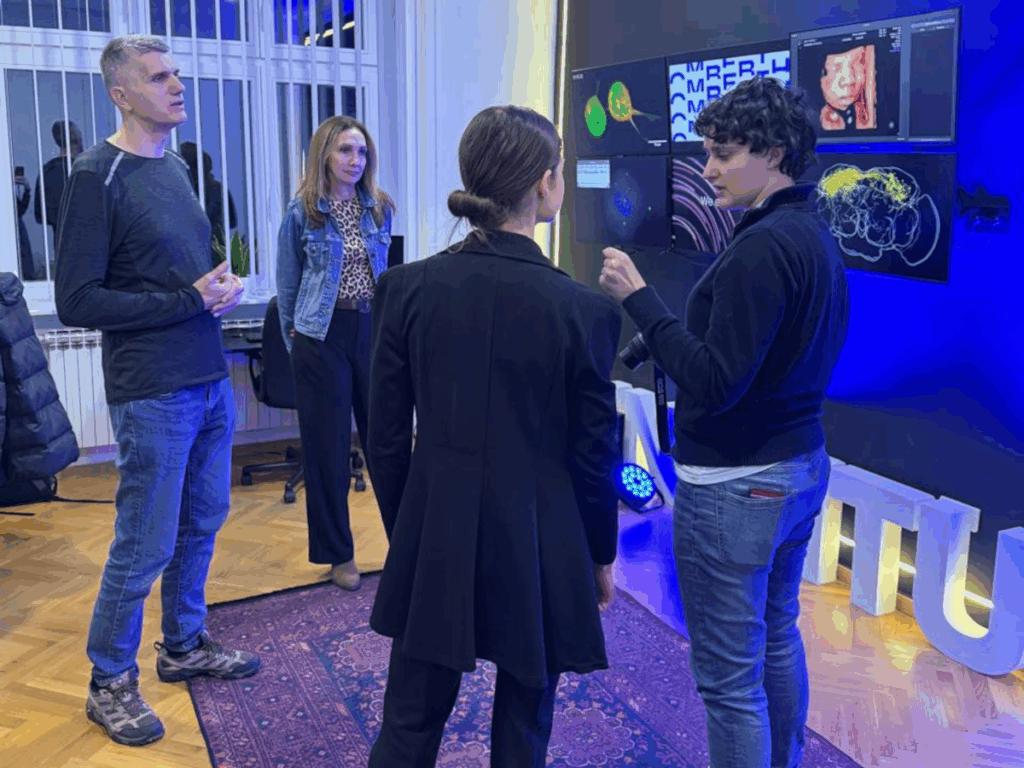
We discusssed joint PoC activities in medical and healthcare domains
Finally, the partners agreed to jointly explore Horizon Europe funding opportunities related to HPC scalability, applied AI, and capacity building—further extending the collaboration beyond EuroCC4SEE.
A Visit That Strengthened Regional Ties
The meetings in Sarajevo were assessed as highly productive, resulting in clear commitments, strengthened operational cooperation, and a shared plan for the months ahead. By combining training coordination, SME engagement, research collaboration, and strategic event planning, NCC Montenegro and NCC Bosnia and Herzegovina continue to build a more connected and capable regional HPC and AI ecosystem—fully aligned with the mission of EuroCC4SEE.
University of Montenegro, a member of NCC Montenegro team, is organizing a short training dedicated to students, young researchers and professionals from industry, willing to learn about using HPC in their work, through a practical example. After learning how to create a simple neural network, training participants will be trained to prepare local environment for the development and then to copy and run the code on HPC, thus enabling model training on multi-GPU HPC.
Date: 12.12.2025 at 12:00h
Venue: Faculty of Science and Mathematics, University of Montenegro, Room 210
Title: Training on Building a Neural Network, Code Preparing for Multi-GPU HPC and Running Large-Scale Training
Designed for: students, researchers, and professionals with basic Python knowledge
Short course on Neural networks using Multi-GPU HPC and Running Large-Scale Training
Training content overview
Creating simple neural network for defect detection in manufacturing (1h)
Explaining docker containerization tool, and preparing local environment for development (2h)
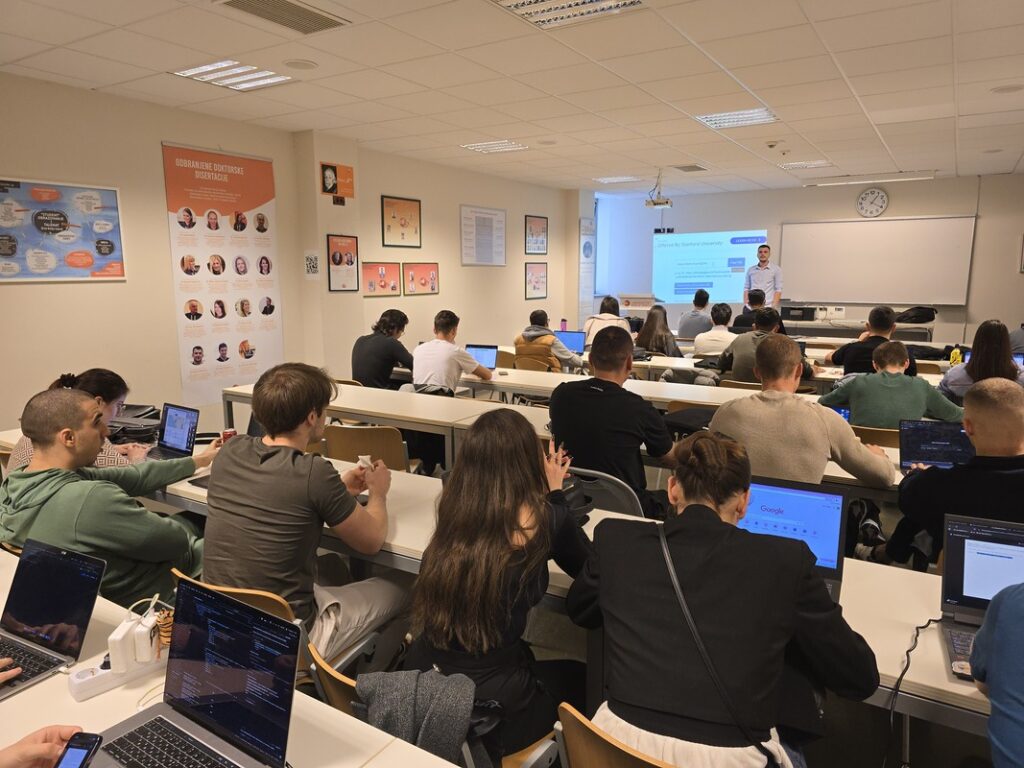
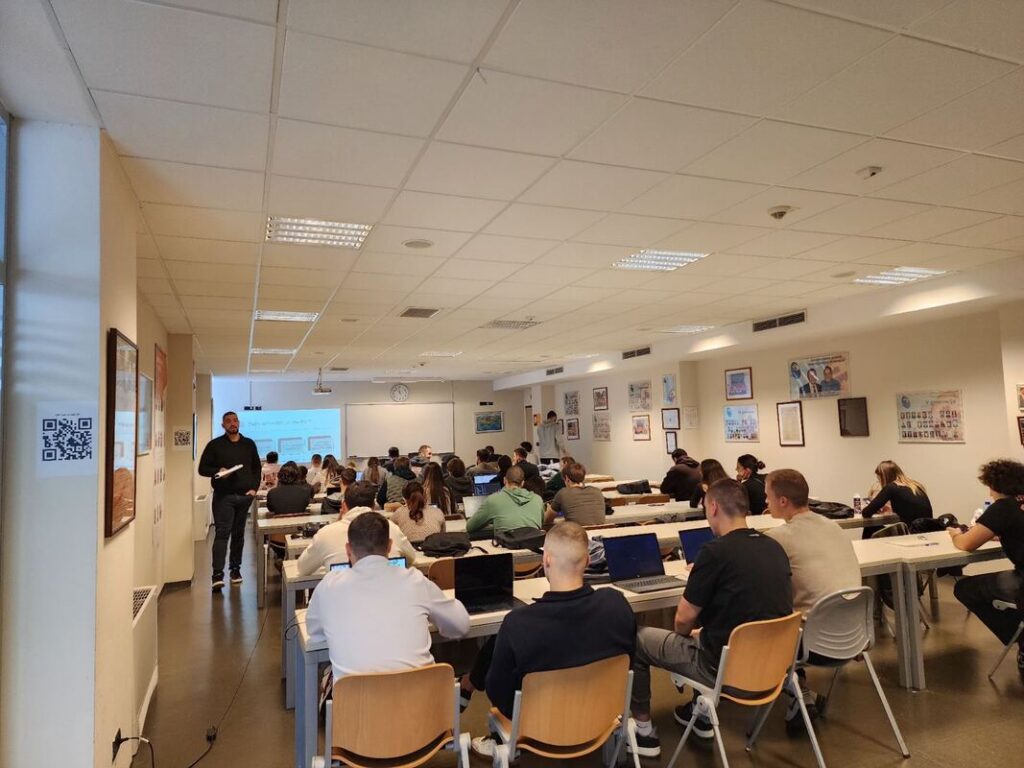
On 21.11.2025, NCC Montenegro successfully delivered a short course as part of the EUROCC 2 and EUROCC4SEE initiatives. The program brought together an excellent cohort of students, researchers, and industry professionals who demonstrated remarkable curiosity, teamwork, and practical problem-solving skills throughout the training.
The course was delivere by mr Dejan Babic and mr Ivan Jovovic
The course explored the evolution of conversational AI, beginning with traditional natural language understanding (NLU) approaches based on intents and entities, and progressing toward modern Large Language Model (LLM) architectures and Retrieval-Augmented Generation (RAG) systems. Participants were introduced to prompt design, tool and function calling, and essential aspects of safety, privacy, and guardrails in AI systems. The curriculum also covered embeddings, vector indexes, hybrid search techniques combining BM25 with dense vectors, and re-ranking strategies for improving retrieval quality.
A significant component of the course was a hands-on laboratory session where participants built a small RAG-based chatbot using domain-specific documents. The HPC perspective was also highlighted, including batch embedding generation, large-scale indexing considerations, and methods for stress testing AI pipelines. The course concluded with live demonstrations using Azure AI Foundry, showcasing Prompt Flow, Evaluate, and AI Search capabilities.
There was around 20 participants in the event
Participants quickly absorbed the theoretical concepts, engaged with thoughtful and challenging questions, and worked independently during practical sessions. By the end of the course, they delivered functional prototype systems featuring grounded answers and clear evaluation reports—demonstrating both strong technical understanding and applied competence.
This short course covers the foundations of conversational systems—classic NLU (intents, entities, slot filling, dialogue design) and modern LLM workflows (prompt engineering, function calling, RAG). Participants build a practical chatbot grounded in their own documents, evaluate quality and safety, and deploy a lightweight interface. An HPC module is included for large-scale embeddings and offline evaluation/load testing.