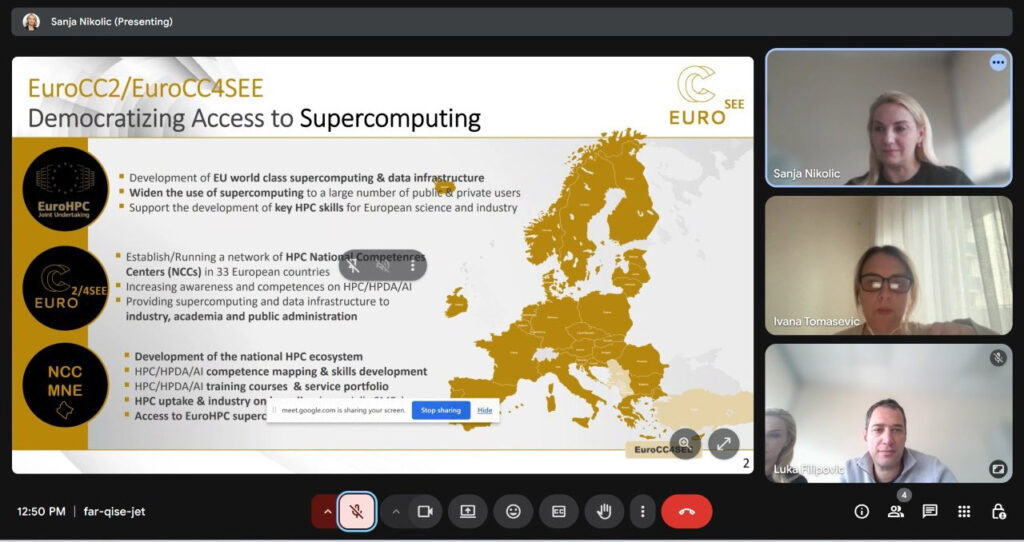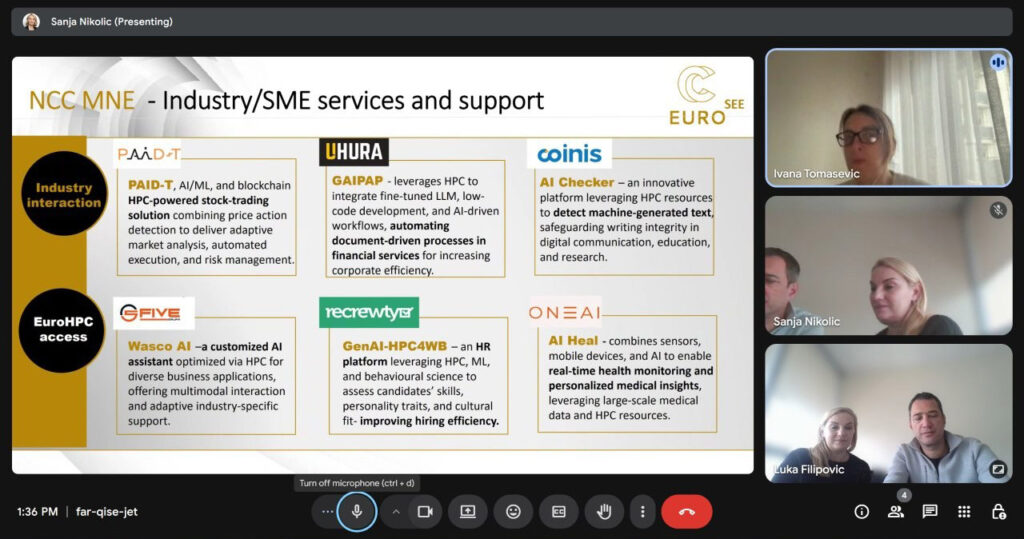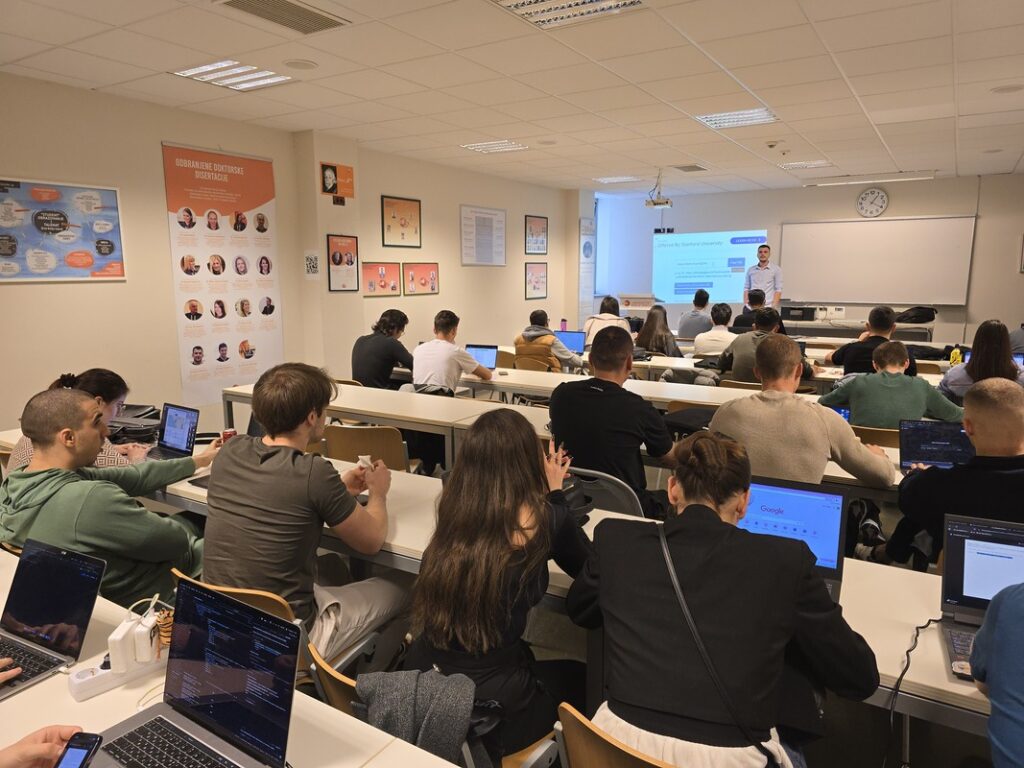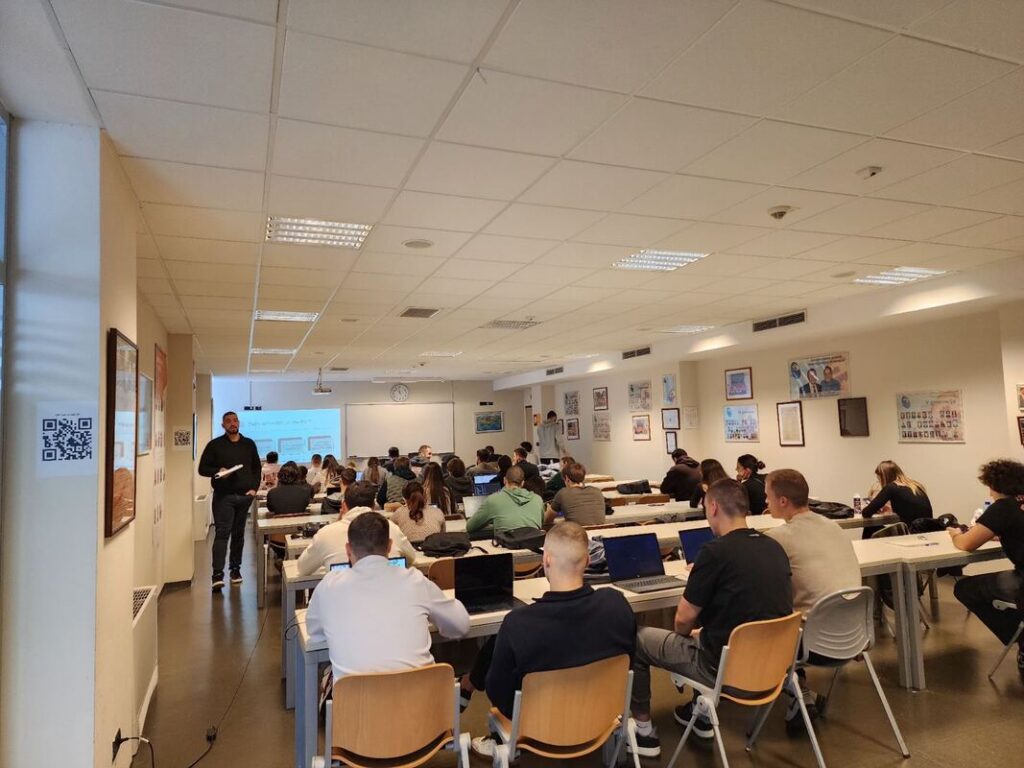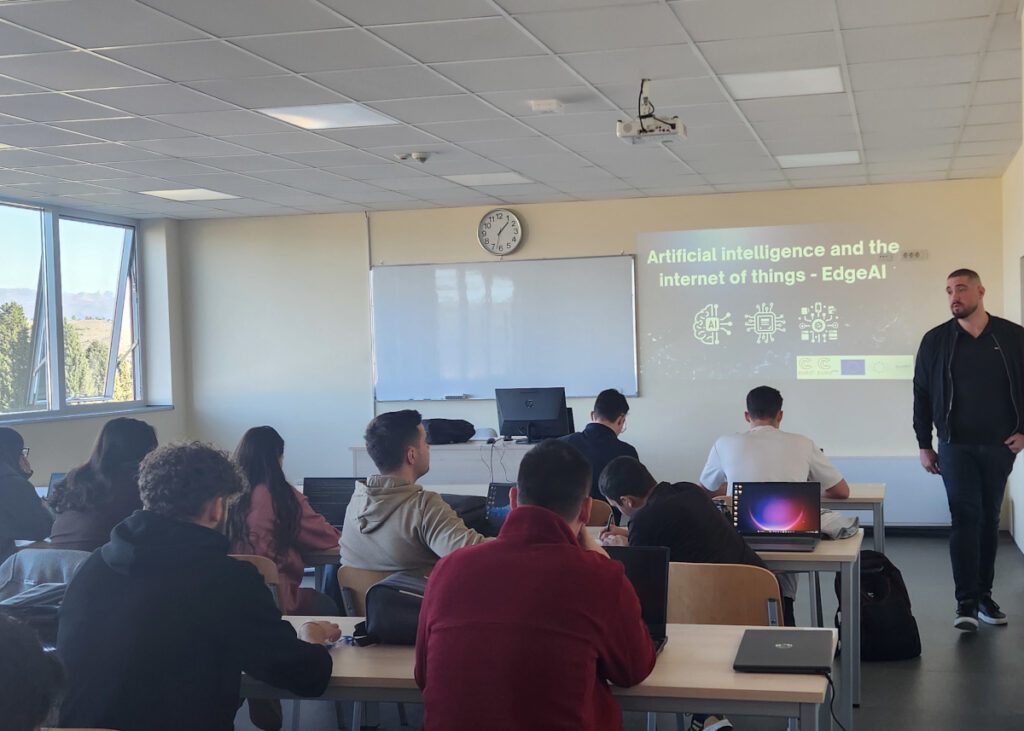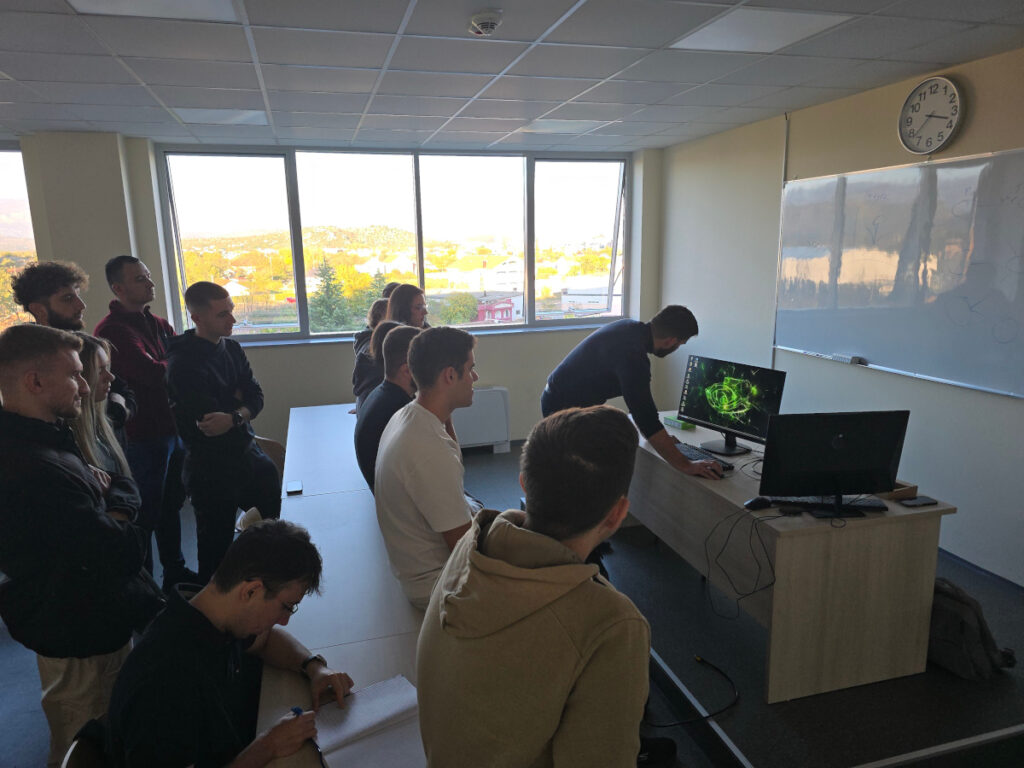
Prof. Enis Kočan, a member of NCC Montenegro, has visited TRID TECH in Podgorica. TRID TECH is a new IT company specializing in comprehensive and customizable managed cybersecurity services, delivered by a team of highly trained professionals. Their focus is on managing cyber risks and ensuring compliance, with the aim of providing an exceptional client experience. Their services include cybersecurity advisory, endpoint and network security, data privacy, and cloud infrastructure security, all geared towards creating robust, secure architectures and meeting regulatory requirements.
During the visit, Prof. Kočan introduced the EuroCC2/EuroCC4SEE project to TRID TECH’s director, Mr. Dmitar Ćulafić, and his team. He detailed the available services and training programs, highlighting the opportunity to access HPC resources for free through EuroHPC JU open calls. TRID TECH, which is working on several GPU-intensive projects, recognized this as a valuable chance to test their algorithms and improve their big data processing efficiency. Prof. Kočan also presented the upcoming 2nd Open FFplus Call for Innovation Studies, outlining its goals, eligibility criteria, and potential benefits..
NCC Montenegro team from the University of Montenegro (UoM), prof. Božo Krstajić and prof. Enis Kočan has visited startup company Deepmark, co-founded by former researcher from the Faculty of Electrical Engineering – UoM, Slavko Kovačević, MSc. This startup company represents an example of how top-tier academic research transforms into real-world solutions.
DeepMark develops technology for invisible and permanent digital marks (watermarks) that can be embedded in images, audio, and video content without compromising quality. These marks enable proof of origin, ownership, and authenticity of content – which is becoming crucial in the era of artificial intelligence and generative media.
NCC Montenegro team visiting DeepMark startup
NCC team has presented the opportunities to access EUroHPC JU resources through different open calls, as well as to obtain financial support to realize ideas through FFplus calls. Deepmark company has already used HPC resources on a commercial basis and plans to prepare proposal to access EuroHPC JU resources.
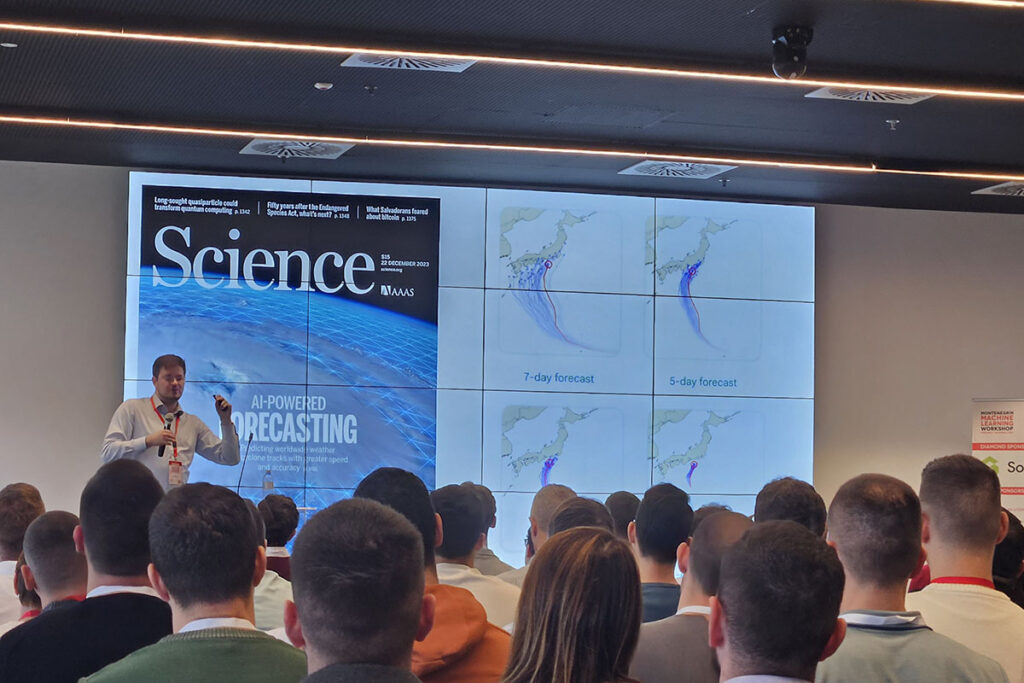
Within the framework of the international conference CMBEBIH 2025, organized by the Society for Medical and Biological Engineering in BiH, with the co-organization of Verlab and the University of Donja Gorica, experts from the fields of biomedical engineering, technology, and innovation gathered together.
EuroCC and HPC use cases presentation at the opening ceremony of CMBEBIH 2025
A special segment of the conference was dedicated to the National Competence Centres for High-Performance Computing (NCC HPC), where NCC HPC BiH, NCC HPC Montenegro, and NCC HPC Serbia jointly presented:
HPC services available to academia, industry, and the public sector
Successful examples of HPC solutions implemented in companies and institutions
Opportunities for collaboration, development, and support in digital transformation
Presentation of NCC services and success stories for public sector
This event once again confirmed the importance of regional cooperation among NCCs in Southeast Europe, which, through the exchange of knowledge, experience, and resources, strengthens the region’s technological infrastructure and innovation capacity.
Joint initiatives such as this represent a strong step forward in connecting science, industry, and the public sector through the application of advanced digital technologies.
The Chamber of Economy of Montenegro (PKCG), in cooperation with the Science and Technology Park of Montenegro (NTP), organized the interactive event “KOMPakt”, bringing together entrepreneurs, SMEs, innovative companies, IT representatives, universities, and institutions. The event served as a platform to present institutional support measures, promote initiatives for digital and green transformation, and connect businesses with new technologies to enhance international competitiveness.
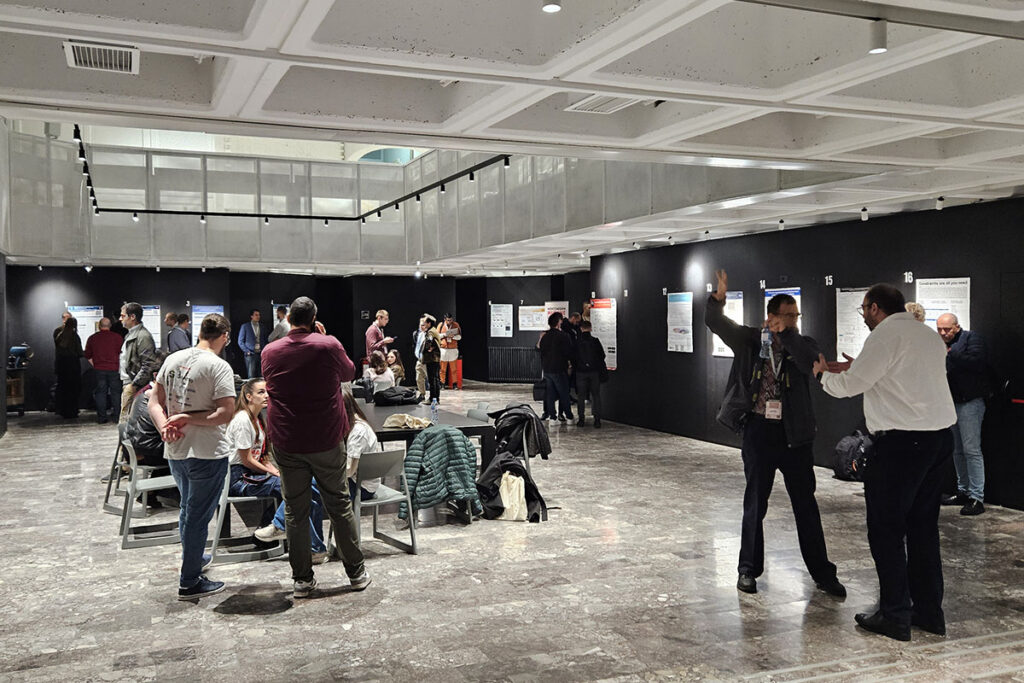
KOMPact- engaging atmosphere
In her opening remarks, the President of the Chamber of Commerce of Montenegro, Dr. Nina Drakić, emphasized that KOMPakt was conceived as a bridge between business needs and innovative technical solutions, noting that a strong SME sector is essential for Montenegro’s digital and green transformation, European integration, and global competitiveness. Valentina Radulović, Director of the Science and Technology Park of Montenegro, highlighted the role of NTP as a hub where ideas, business and technology converge, encouraging participants to harness the country’s innovative potential and create value-added partnerships.
Ready for HPC talks… where ideas meet supercomputers!
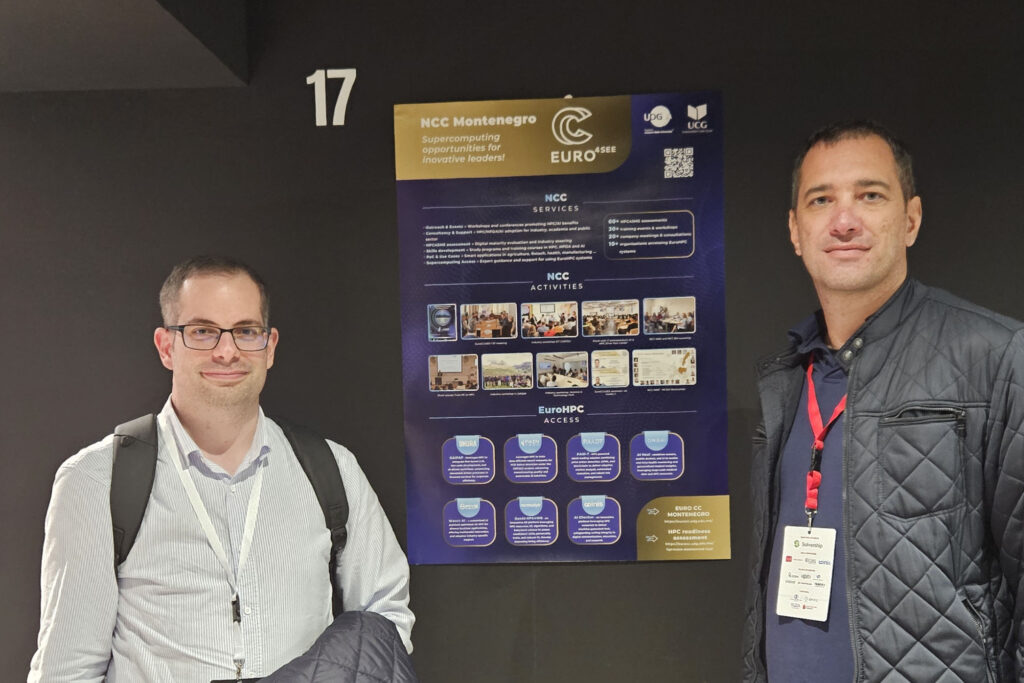
NCC Montenegro participated as one of the exhibitors, presenting its activities within the EuroCC2/EuroCC4SEE project. The NCC highlighted opportunities for Montenegrin entrepreneurs, innovators, and industry to adopt HPC and AI solutions—offering customized training, expert consultancy, and access to leading European supercomputers at no additional cost. Visitors engaged in discussion on their project ideas and business needs, ranging from advanced trading strategies for the capital markets, over smart tourism app enhancements, to precise long-term weather forecasting models, leveraging HPC capabilities and NCC support.
KOMPact –opportunity for new productive collaborations
By engaging directly with key national stakeholders and innovative SMEs, NCC Montenegro reaffirmed its mission to drive digital acceleration and enhance industry competitiveness through the powerful convergence of HPC and AI.
We are delighted to announce that our General Manager, Sandra Tinaj, and Professor Tomo Popović will take part in Infofest 2025 in Montenegro. They will present the EuroCC 2 and EuroCC4SEE project and discuss how supercomputing is opening new opportunities for science, innovation, and industry.
For more than three decades, INFOFEST has brought together leaders from academia, industry, and the public sector, and this year our team will contribute to the dialogue on the digital future.
NCC Montenegro will participate in this year’s INFOFEST with a presentation on 30 September
In June 2025, the JUPITER supercomputer was inaugurated at Forschungszentrum Jülich (FZJ), through the Jülich Supercomputing Centre (JSC) and within the EuroHPC Joint Undertaking initiative. With this milestone, Europe has launched its first exascale system, which immediately became the fastest computer on the continent and ranked fourth on the global TOP500 list of supercomputers. JUPITER distinguishes itself not only with its performance but also as the most energy-efficient among the world’s top five fastest systems.
Between the racks of the JUPITER supercomputer (source: Forschungszentrum Jülich)
The system is based on a modular architecture and integrates around 24,000 NVIDIA GH200 “Grace Hopper” superchips, making it particularly suitable for highly parallel applications such as training large language models and running complex scientific simulations. JUPITER combines “Cluster” and “Booster” modules, reaching a total performance exceeding 1 exaflop per second, firmly positioning Europe in the exascale era. Sustainability has also been a priority: the system consumes around 15 MW of electricity, powered entirely by renewable sources, while its waste heat is reused for district heating across the Forschungszentrum Jülich campus.
Aerial view of the Jülich campus (source: Forschungszentrum Jülich)
The significance of JUPITER is manifold. As a symbol of European technological independence, it strengthens digital sovereignty and provides researchers and industry across Europe with access to unprecedented computing capabilities. Its immense power is expected to accelerate progress in critical domains such as climate simulations, brain research, quantum simulation, and the training of advanced AI models. The project is the result of close collaboration between European institutions and industrial partners under the EuroHPC JU framework, standing as a prime example of successful synergy between the public and private sectors in support of science, innovation, and industrial development.
The JUPITER supercomputer is not only the fastest European system but also a symbol of Europe’s entry into the exascale era and its ambition to lead in high-performance computing and artificial intelligence. Learn more at [link].
In order to successfully conduct new research directions within the project “AI Segmentation and Inspection by 3D Scanning,” researchers from the Center for Computer Sciences at the Faculty of Science and Mathematics have developed another successful application for utilizing HPC resources provided by EuroHPC Joint Undertaking. After completing the report for previous resource usage under the Benchmark call, and with the support of the NCC Montenegro team from the University of Montenegro, an application was prepared to access the Leonardo supercomputing center under the Development call.
As a result of this project, it is anticipated that the system for automatic segmentation of 3D representations of mechanical assemblies obtained through 3D scanning will be expanded. This opens up possibilities for applications in fields such as reverse engineering, quality control, augmented reality (AR), virtual reality (VR), and more. Additionally, the project is expected to culminate in the defense of a doctoral dissertation in this area.