NCC Montenegro Strengthens Collaboration through Mentoring/Twinning Sessions with NCC Latvia and NCC Spain

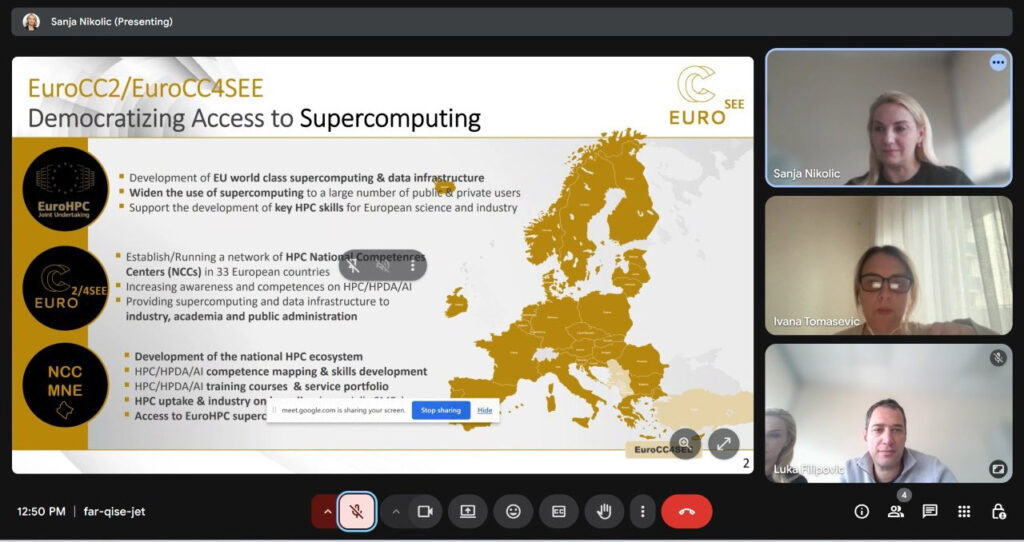
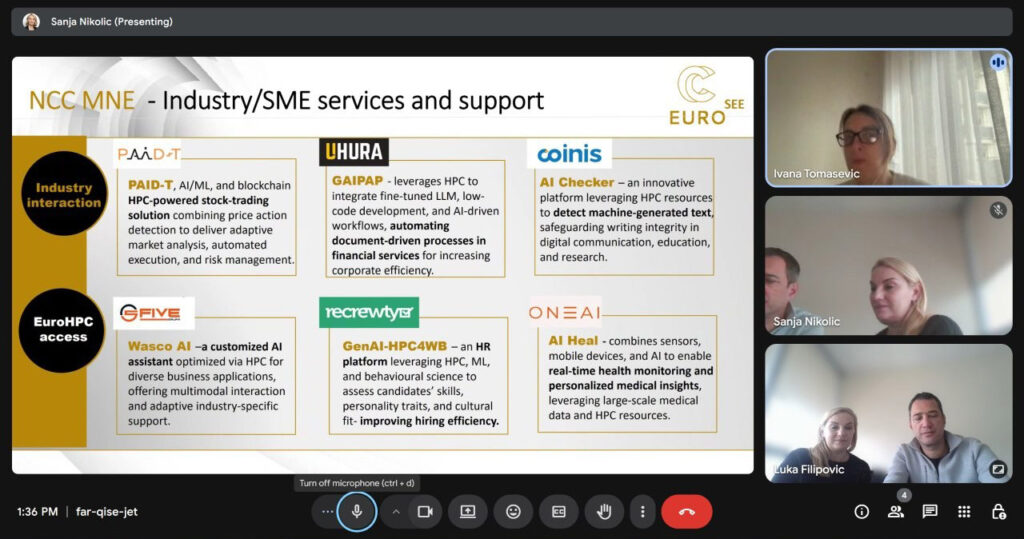
As part of ongoing EuroCC2 collaboration, NCC Montenegro participated in two mentoring/twinning online sessions with partner NCCs to exchange knowledge and share best practices and improve internal processes for seamless interaction and  integration within the HPC/AI national ecosystem.

The first session, held with NCC Latvia on 22 October 2025, focused on Customer Relationship Management (CRM) tools and effective practices for managing project communications, coordinating client interactions, and tracking HPC/AI user data. NCC Latvia representatives provided a live demonstration of CRM workflows, offering practical insights and best approaches to streamline internal processes and monitor engagement with NCC services.

The second session, organized with NCC Spain on 31 October 2025, addressed Newsletter strategies for improving service visibility and customer outreach. Discussions included digital communication/ marketing tools, techniques for crafting engaging content, balancing updates on upcoming activities with past achievements, segmenting audiences effectively, and leveraging analytics to measure impact.

These mentoring sessions contribute to NCC Montenegro’s continuous efforts to enhance internal efficiency, optimize service delivery, expand outreach capacity, and strengthen stakeholder engagement.

Artificial intelligence and the internet of things – EdgeAI

This focused short course explores how artificial intelligence (AI) can be embedded into Internet of Things (IoT) systems, with a special emphasis on edge AI – running ML models directly on devices, close to where data is generated. Participants will learn how to design AIoT pipelines, when to process data on the edge vs. in the cloud, and how to deploy lightweight ML models on resource-constrained hardware. The course is intended for students, researchers, and professionals who want to move from “connected devices” to intelligent devices.

Course date: 05.11.2025 at 13:30
Venue: S34, UDG
Registration: required
Registration link: https://forms.gle/2DktEUqf5KZosFth7

Designed for: students, researchers, and professionals interested in AI, IoT, edge computing and applied ML.

Course Content Overview

Session 1 — AI + IoT theoretical framework

  • AI–IoT convergence: from sensing to intelligent action
  • edge vs. cloud vs. fog: latency, bandwidth, privacy, cost
  • edge AI pipeline: device → preprocessing → inference → actuation
  • lightweight/embedded ML (TinyML, quantization, pruning)
  • platforms and use cases (Raspberry Pi, Jetson, smart agriculture, industry)

Session 2 — hands-on edge/AI lab

  • preparing the edge/IoT environment and data source (sensor/camera/mock)
  • deploying a small ML model to the device
  • running inference locally and sending results to backend/cloud
  • monitoring and simple performance checks
  • how to scale to real deployments

Learning outcomes

By the end of the course, participants will be able to:

  • explain the relationship between AI, IoT and edge computing
  • decide when inference should run on the device and when in the cloud
  • deploy a lightweight ML model to an IoT/edge setup
  • outline an end-to-end AIoT application for their own domain (e.g. agriculture, smart city, industry)

Computer Vision and Convolutional Neural Networks

This focused short course introduces the core concepts of computer vision (CV) and modern convolutional neural networks (CNNs), then applies them in practice. Participants will understand how images become features, how CNNs learn robust representations, and how to train/evaluate models for real-world tasks. Designed for students, researchers, and professionals with basic Python knowledge, the course blends a clear theoretical framework with a hands-on lab that delivers a working image classifier and practical tips for improving accuracy and robustness. Participants will have an opportunity to run their experiments on the HPC cluster at NCC Montenegro.

Course date: 29.10.2025 at 13:30 (S32, UDG)

Registration for this course is required. You can register on the following form at link https://forms.gle/1FkRDBGCxdrPx9fF6

Designed for: students, researchers, and professionals

Computer Vision and Convolutional Neural Networks course

Course Content Overview

Session 1 — theoretical framework

  • pixels → features: convolutions, padding/stride, receptive fields
  • key blocks: activations, pooling, batchnorm, dropout, residuals
  • landmark architectures: lenet → resnet → efficientnet
  • training essentials: loss, optimizers, lr schedules, augmentation, metrics
  • transfer learning basics

Session 2 — hands-on lab

  • setup + dataset (cifar-10 or small custom), clean splits, transforms
  • baseline cnn train → evaluate (accuracy/F1, confusion matrix)
  • fine-tune a pretrained resnet; freeze/unfreeze; early stopping
  • export best model (pth/onnx) and tiny inference script

Learning Outcomes

By the end, participants will be able to:

  • Explain how CNNs extract hierarchical features and why core blocks/architectures matter.
  • Build a solid training pipeline with proper splits, augmentation, and metrics.
  • Fine-tune a pretrained model and diagnose errors with interpretability tools.
  • Export a trained model for downstream use in apps or services.

Course : Parallel Computing

The University of Donja Gorica and NCC Montenegro are organizing a course on Parallel Computing. This course emphasizes the importance of parallel computing in addressing complex numerical problems that cannot be efficiently solved by sequential programs.

Participants, including students and industry partners, will be introduced to the fundamentals of distributed and parallel computing, as well as key performance indicators of parallel programs.

In the second part of the training, participants will learn the basics of parallel programming on multicore HPC systems, utilizing both shared-memory and distributed-memory architectures through OpenMP and MPI. After mastering the essentials, the course will cover the complete process of decomposing a serial program, transforming it into a parallel version, and identifying potential challenges related to parallelization and communication.

In the final part of the course, participants will be introduced to the fundamental concepts of GPU programming, exploring how graphics processing units can be used to accelerate computation.

The course is designed to last six weeks, with weekly 90-minute sessions held in the afternoon.

Course start : 30.10.2025, 17.15,
Location : University of Donja Gorica, S43 (4th floor),
More info : mnencc@udg.edu.me

NCC Montenegro and Telekom Montenegro Explore Cooperation in HPC and AI-Driven Innovation

On 24 October 2025, NCC Montenegro held an initial meeting with Telekom Montenegro to discuss potential cooperation opportunities in the field of AI-driven innovation and HPC resource utilisation within the scope of ICT networks and services.

The meeting marked an important step towards strengthening the link between advanced computing infrastructure and AI innovation across the industry’s diversified portfolio. Discussions focused on identifying potential use-case scenarios where HPC and AI technologies could enhance network optimisation, predictive maintenance, and customer experience through diagnostic and predictive data analytics and advanced AI modelling.

Representatives of Telekom Montenegro expressed strong interest in exploring how NCC Montenegro could support experimentation, testing, and capacity-building initiatives. Both parties agreed to continue with technical consultations and support activities based on international benchmarks and the adaptation of successful Telco use cases and best practices to local needs, particularly in the areas of network efficiency and advanced customer analytics.

This collaboration aligns with the mission of NCC Montenegro to accelerate the adoption of HPC and AI technologies across large enterprises and strategic national industries.

Exploring HPC Collaboration for Smart Energy and Precision Weather Forecasting

Podgorica, 23.10.2025 – NCC Montenegro held a follow-up meeting with representatives of Tara Resources, and the Institute of Hydrometeorology and Seismology of Montenegro (IHMS), to discuss project cooperation in the field of precise weather forecasting and smart energy solutions based on WRF model simulations and HPC capacities. This meeting built upon the initial consultations held on 9 October 2025 with Tara Montenegro, where opportunities for applying high-performance computing to energy optimisation in connection with precision weather forecasting were first explored.

The discussion highlighted the cross-industry potential of supercomputing technologies to improve regional weather prediction accuracy, enable data-driven planning for microclimate patterns, and support renewable energy management. Representatives of Tara Montenegro and IHMS expressed strong interest in continuing cooperation with NCC Montenegro through joint R&D activities connecting scientific expertise, industrial application, and HPC infrastructure.

It was agreed to proceed with technical consultations and project scoping under the EuroCC4SEE framework to further advance HPC-enabled cross-industry innovation in meteorology and smart energy.

NCC Montenegro Presented at the “Montenegro 2025” Economic Conference

At the 14th Conference on Economics “Montenegro 2025”, organized by the Chamber of Economy of Montenegro in Budva, the services, activities, and results of the EUROCC / NCC Montenegro project were presented. This year’s conference, themed “Regional Economies Facing Today’s Challenges”, gathered over 400 participants from Montenegro, the region, and the European Union — representatives of business, institutions, and academia.

During the panel “Digital Transformation – Where Are We and Where Do We Need to Be”, the EUROCC / NCC Montenegro project was introduced in detail as an initiative that actively supports digital transformation and the development of innovation capacities in Montenegro through a network of services and expertise in High-Performance Computing (HPC)Artificial Intelligence (AI), and Data Analytics.

The panel opened an important discussion on Montenegro’s current position on the path of digital development and the key steps needed to build a modern, connected, and technologically advanced society. Special emphasis was placed on the role of NCC Montenegro in strengthening cooperation between academia, industry, and the public sector, and in building a sustainable digital ecosystem.

The discussion was complemented by a video presentation showcasing EUROCC / NCC Montenegro’s activities, results, and available services for researchers, institutions, and the business community.

The participation of NCC Montenegro at the conference reaffirmed its strategic role in connecting research, education, and industry, and in fostering digital and innovation competitiveness in Montenegro.