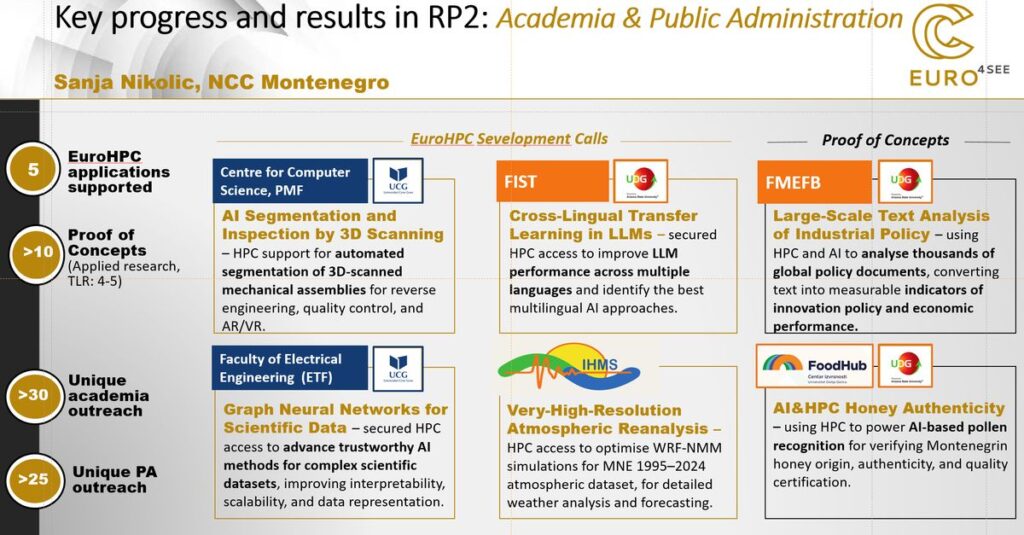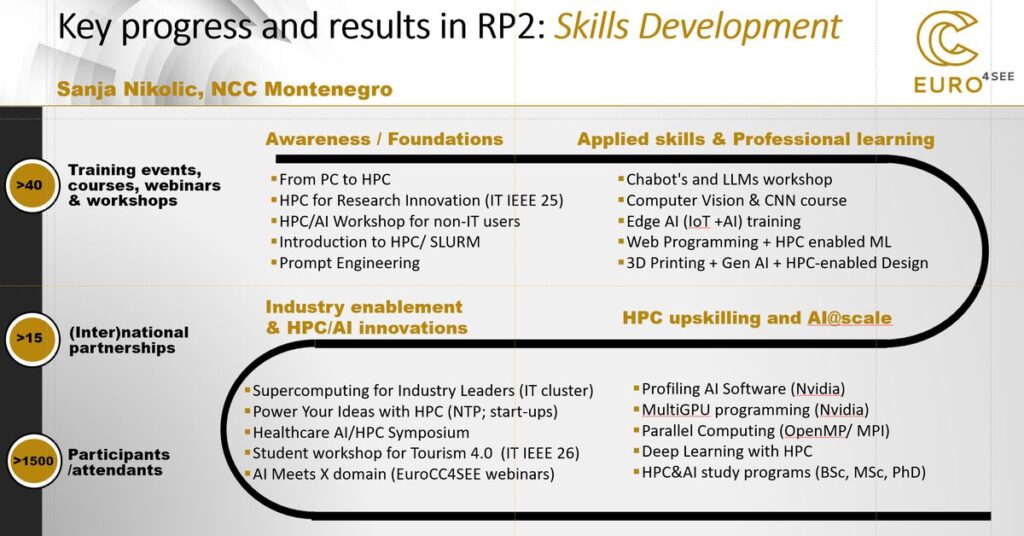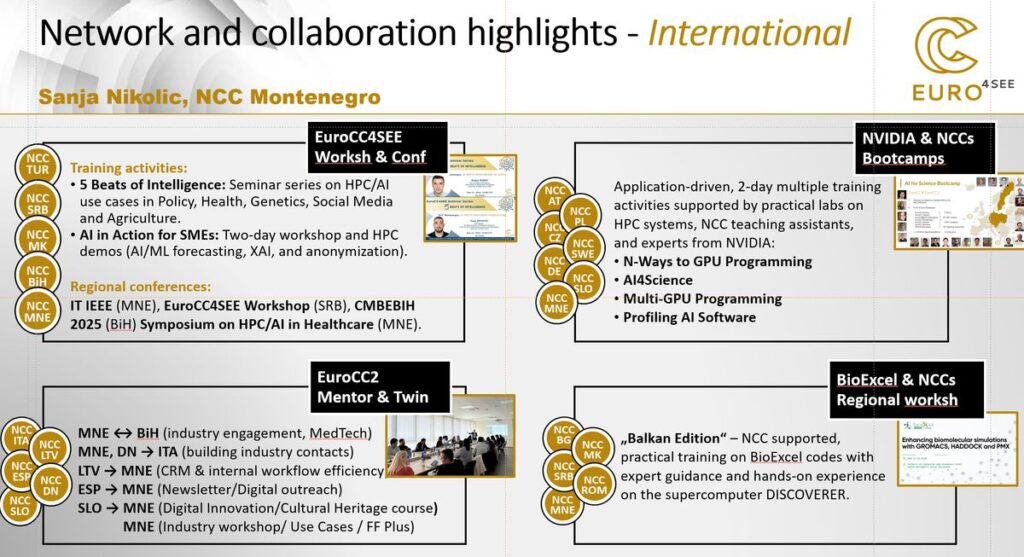
Gray Scott school 2026

The Gray Scott School is an advanced training program dedicated to High-Performance Computing (HPC), led by experts from IJCLab, CNRS, Inria, LUPM, LPNHE & LISN. This summer school, in a unique format and entirely free of charge, is dedicated to programming and optimization on Heterogeneous Architectures.

The school covers the optimization of computations on different types of hardware (CPU, GPU), presenting their respective characteristics, architectures and bottlenecks. It covers generic optimization methods applicable to all types of hardware, as well as the various libraries, technologies and languages available to achieve the best possible performance. Ideally, the peak performance of the machine.

Gray Scott school 2026

Through hands-on sessions, lectures, and regular technical webinars, the school equips participants with the skills needed to design, optimize, and scale high-performance applications.

All optimization techniques taught during the school are illustrated using a single reference problem: the simulation of a Gray Scott reaction.

Dates: 2 weeks between June 22 and July 3, 2026
Location: Online or onsite, or from Satellite Sites
More info & Registration: https://cc-fr.eu/gray-scott-school-2026/
Price : Free of charge.

Open to students, researchers, and professionals with basic programming experience who wish to develop HPC competencies.

Gray Scott Thursdays

What sets this program apart is its in-depth summer sessions combined with a preparatory series of 18 live webinars, from January to June, known as Gray Scott Thursdays. These webinars, held weekly and presented by the school’s professors, provide an early insight into the key concepts and technologies that will be explored more intensively during the school. More info

AIHeal: Using the LUMI Supercomputer to Develop Personalized AI Models for Every Patient

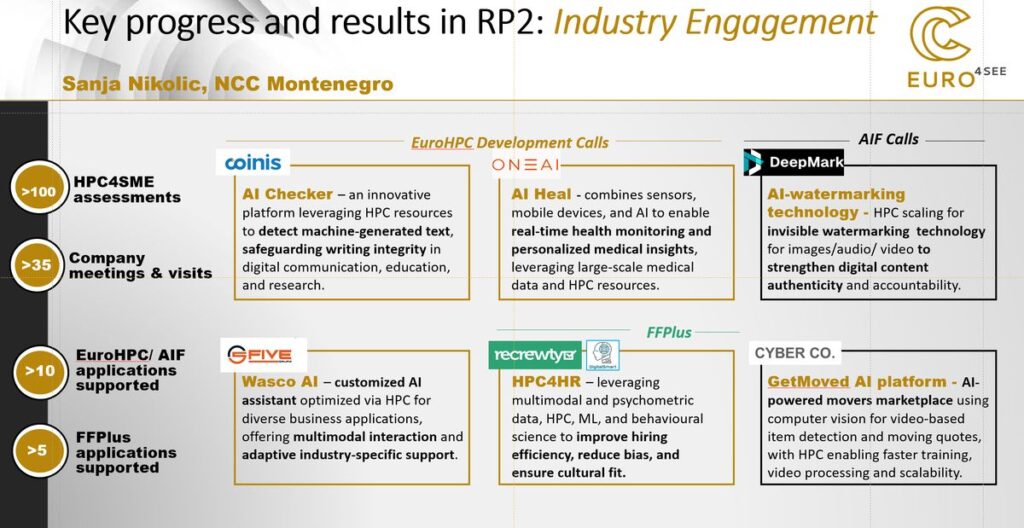
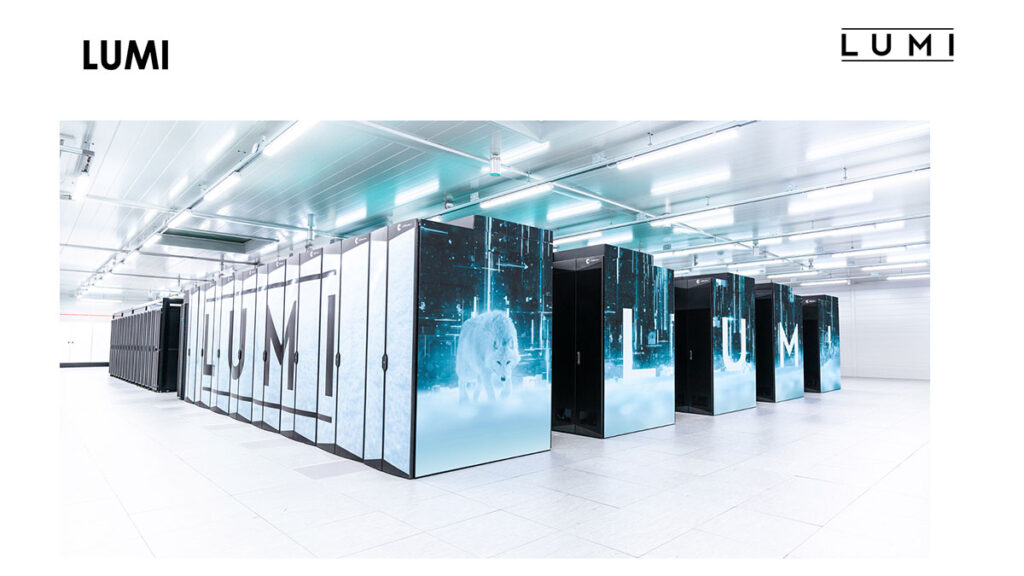
The Montenegrin company ONEAI has successfully carried out a project on the EuroHPC infrastructure, utilizing the LUMI-G supercomputer to develop advanced AI models in the field of ECG signal analysis. Following the successful completion of the previous cycle, the AIHeal project has been granted renewed access to computational resources for the upcoming period.

During the previous project, the team developed a dynamic HPC pipeline that enables training personalized models for each individual patient, with the capability for continuous retraining based on new data. The key innovation lies in establishing an integrated system that connects the existing infrastructure with the supercomputer:

  • data is automatically collected from the AIHeal system,
  • sent to the LUMI supercomputer for training,
  • after processing, the models are returned to the production environment and registered in the MLflow system.

This approach enables the creation of “digital twin” patient models, where each model is tailored to the specific characteristics of the individual, significantly improving anomaly detection accuracy compared to generic models.

By leveraging the LUMI infrastructure, the AIHeal team achieved significant acceleration in the model training process, particularly through parallelization across multiple GPU units and the execution of a large number of experiments simultaneously. This enabled faster identification of optimal models and improved the overall quality of the solution.

The project results confirm that HPC resources play a crucial role in the development of scalable and personalized AI systems in healthcare, especially in the context of real-time biomedical data analysis.

AIHeal

The newly approved access to EuroHPC resources will be used for further model improvement, performance optimization, and expansion of the system to cover a broader range of cardiovascular and other health-related indications.

EuroHPC Access Calls Webinar – Evaluation Process, Technical Assessment and Best Practices

EuroHPC Joint Undertaking has announced an upcoming online event, the EuroHPC Access Calls Webinar – Evaluation Process, Technical Assessment and Best Practices, scheduled for 13 May 2026 from 10:00 to 12:30 (CEST).

The webinar is aimed at researchers and users from both the public and private sectors who are interested in applying for access to EuroHPC supercomputing resources. It will cover key topics such as proposal preparation, evaluation procedures, benchmarking, and successful project implementation. Sessions will be delivered by experts from leading European HPC organizations, offering practical guidance and insights based on real application experiences.

EuroHPC Supercomputers

More information and registration are available at:
https://www.eurohpc-ju.europa.eu/media-events/events/eurohpc-access-calls-webinar-evaluation-process-technical-assessment-and-best-practices-2026-05-13_en

NCC Montenegro Contributes to the Development of the National AI Strategy (2026–2030)

Representatives of NCC Montenegro are actively contributing to the development of the National AI Strategy of Montenegro 2026–2030 as members of the national Working Group coordinated by the Ministry of Public Administration of Montenegro, with support from UNDP Montenegro. The overarching goal of the Strategy is to enable Montenegro to respond to global AI challenges while leveraging its potential for smart, sustainable, and inclusive development, in alignment with European and international standards.

Ministry of Public Administration, regional expert, and UNDP Montenegro coordinating AI Strategy development.

Key milestones in Working Group engagements for AI Strategy development:

  • Constitutive Session (17 October 2025) – Established the foundation for the Strategy by defining key strategic directions for AI development, including governance and ethical frameworks, education and digital skills, and sectoral applications.
  • Second Session (19 January 2026) – Advanced the process through discussions on the methodological framework, key development phases, and alignment with international best practices/ European standards, with particular emphasis on digital infrastructure and data ecosystem challenges in Montenegro.
  • Strategic Workshop (13–14 February 2026, Budva) – Engaged in interactive sessions with national and regional experts, contributing to the identification of strategic directions, core pillars, priority application areas, key challenges and opportunities, and the mapping of the national AI ecosystem.
  • Third Session (27 March 2026) – Focused on defining the work plan until September 2026, including the organization of thematic stakeholder workshops, expert consultations, to ensure comprehensive insights, refining strategic objectives/measures, and support the drafting of the Strategy document.

The emerging strategic framework is built around several core pillars: digital infrastructure and data ecosystems, AI adoption across sectors, skills and capacity development, and regulatory and ethical AI frameworks, supported by appropriate governance mechanisms.

Participation of representatives from public, academic, industry, and civil sectors.

As a member of the Working Group, NCC Montenegro plays a key role in integrating high-performance computing (HPC) and advanced digital technologies into the national AI strategic framework by promoting HPC as a foundational enabler of AI development, supporting data-intensive AI innovations and applications, and aligning national priorities with European HPC and AI initiatives.

The development of the AI Strategy 2026–2030 represents a significant opportunity for Montenegro to strengthen its digital economy, foster innovation and competitiveness, enhance public services, and position itself within the broader European AI landscape. Through its active participation in this process, NCC Montenegro contributes to shaping a resilient, inclusive, and future-oriented AI ecosystem, grounded in robust infrastructure, accessible advanced technologies, skilled human capital, and strong collaborative governance.

PAID MNE Showcased in the EuroCC2/EuroCC4SEE Success Stories Booklet — Powering Smarter Trading with Supercomputing

We are proud to highlight PAID MNE as a featured success story in the EuroCC2 & EuroCC4SEE Booklet — demonstrating how HPC is transforming financial analytics and algorithmic trading.

EuroCC2 & EuroCC4SEE Booklet

At the heart of PAID MNE innovations lies PAID-T (Price Action Intelligent Detection Trading) — a smart trading platform that leverages advanced algorithms and AI/ML to dynamically adapt to market movements, optimise investment strategies, and manage risk with higher precision. Traditional computing systems quickly reached their limits. To unlock the required performance, the team scaled their solution to the LUMI supercomputer, one of Europe’s most powerful HPC infrastructures. By enabling multinode execution and real-time task distribution, PAID MNE achieved over 1.2 million simulations in under 5 hours — a process that previously would have taken days. This acceleration enables processing billions of historical transactions in hours instead of days, rapid identification of critical market patterns and data-driven optimisation/ increased accuracy of trading strategies.

PAID MNE success story

This achievement, showcased through the EuroCC2/EuroCC4SEE project, demonstrates how supercomputing is becoming a powerful enabler of business innovation. PAID MNE’s journey is a clear example of how HPC and AI together can transform complex, critical data into faster, more profitable decisions.

DeepMark Approved GPU Resources through AI Factory Playground Access

DeepMark is a deep-tech startup developing learning-based watermarking and provenance technology for AI-generated content. It previously used EuroHPC JU resources after receiving one year of access to the Leonardo Booster partition through a Development call. DeepMark leveraged these resources to advance next-generation watermarking research and benchmarking.

Deepmark

As the research deepened, the need for additional compute grew. Following consultations with the NCC Montenegro team at the University of Montenegro, DeepMark applied for GPU resources via the AI Factory Playground Access.

DeepMark has been awarded 5,000 GPU hours on the Leonardo Booster partition, granted for three months. This allocation will support work on robust, learning-based watermarking for AI-generated content—improving resilience to real-world edits and AI transformations and strengthening provenance and authenticity at scale. With this new allocation, DeepMark will expand its experiments and validation under real-world constraints.

Uhura Solutions Awarded Extension and Additional HPC Resources on Leonardo Supercomputer

The Uhura Solutions project “Generative AI Intelligent Process Automation Platform” has received a positive evaluation and has been granted an extension, including 4,500 node hours on the Leonardo BOOSTER HPC system for a 12-month period. 

The additional HPC resources will support Uhura Solutions’ ongoing research and development in advanced Generative AI and Large Language Models (LLMs) tailored for the financial sector. Leveraging Leonardo’s state-of-the-art computing capabilities, the project will scale experiments from smaller open-source models to larger LLMs, enabling deeper research into optimization techniques such as parameter-efficient fine-tuning (PEFT), quantization, pruning, and model alignment.

Leonardo HPC

The Generative AI Intelligent Process Automation Platform integrates fine-tuned LLMs, low-code development, and process automation workflows to significantly improve operational efficiency, reduce costs, and enhance customer experience in financial services. A key differentiator of the platform is its focus on industry-specific language and context, supported by carefully curated private datasets with strong attention to data quality, privacy, and compliance.

This extension and access to Leonardo BOOSTER represent a major milestone for the project. The additional computational power allows company to push the boundaries of financial-domain AI and accelerate the delivery of scalable, production-ready solutions for the European market