IEEE IT2026 Conference Announced

The jubilee 30th International Conference INFORMATION TECHNOLOGIES 2026 will be held from 24 to 28 February 2026 in Podgorica and Žabljak. The ceremonial academy on the occasion of the jubilee will be held in Podgorica on 24 February, and the working part of the conference will take place from 25 to 28 February in Žabljak. The Conference will feature lectures and round-table discussions on trends in the development of information and communication technologies worldwide, as well as current events in this field in Montenegro. In agreement with the Conference Organizing Committee, interested institutions may organize presentations of their scientific-research, professional, development, and production projects and achievements.
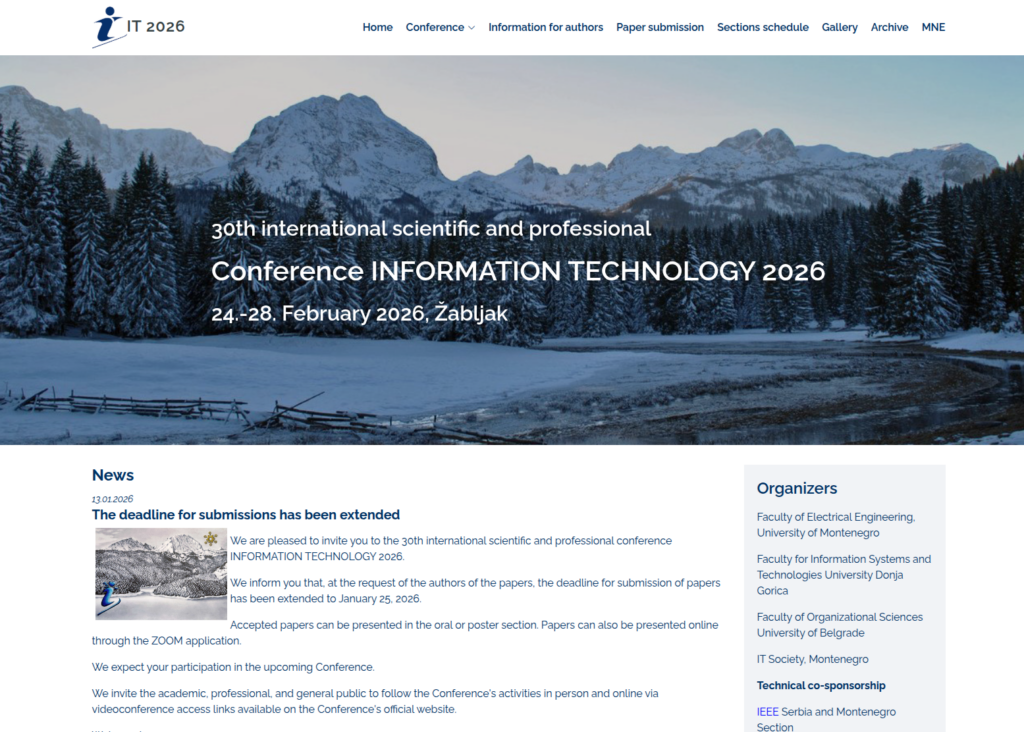
Clic on image to open IT2025 website

Authored papers submitted for presentation will be peer-reviewed and selected based on the complete paper. Papers should be prepared according to the instructions, which can be downloaded here: Instructions.doc.

Accepted papers written in English will be proposed for inclusion in IEEE Xplore, provided they meet the scope and quality requirements of IEEE Xplore, while other papers will be published in the IT conference proceedings.

Papers are submitted via Microsoft’s CMT system, which can be accessed through the “Paper submission” item in the menu. If you do not have an account on the Microsoft CMT system, you can create one via the same link.

We look forward to your support, suggestions and participation in the upcoming IT conference.
HPC Training AI Solutions from Innovative SMEs: Practical Examples and Lessons Learned

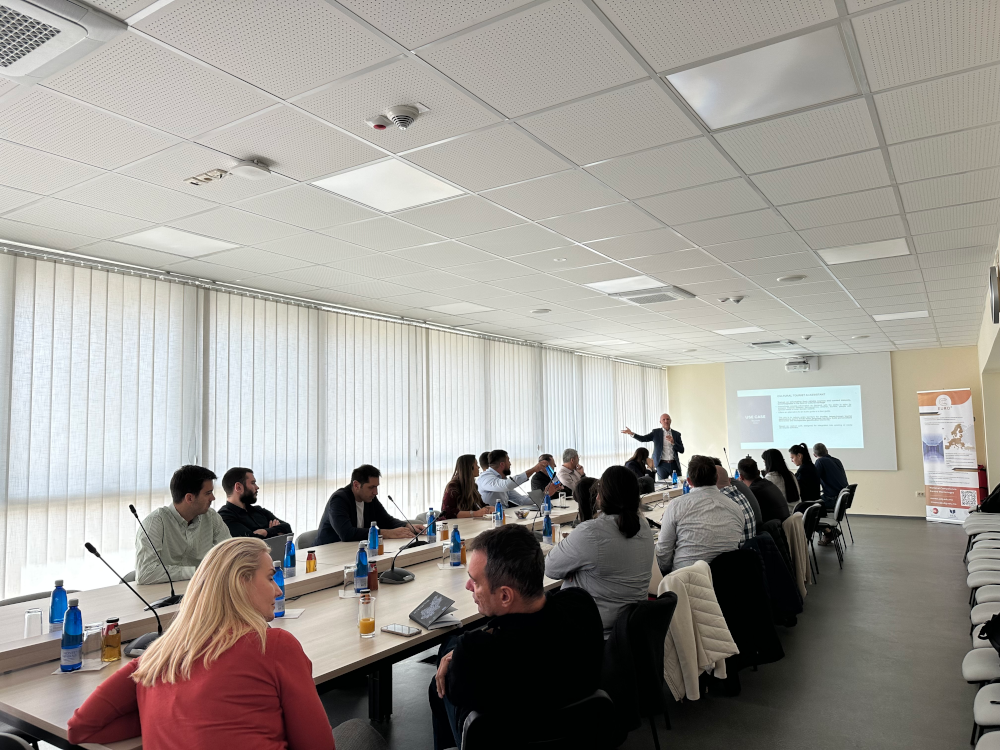
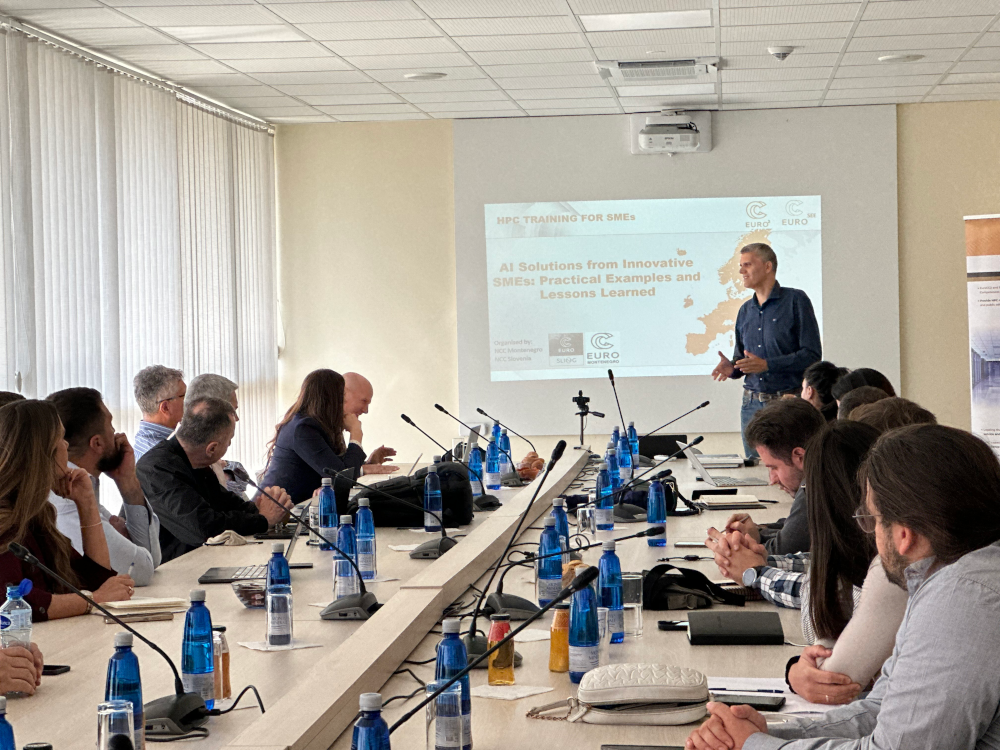
NCC Montenegro, in collaboration with the NCC Slovenia, organized a collaborative workshop and training AI Solutions from Innovative SMEs: Practical Examples and Lessons Learned on October 7, 2025 in Podgorica at University of Donja Gorica. The workshop focused on the opportunities and advantages of HPC and AI technologies in the business sector and best practices in the industry. Approximately 25 participants attended the workshop, including industry experts who deal daily with research and practical examples in the field of artificial intelligence based on HPC.

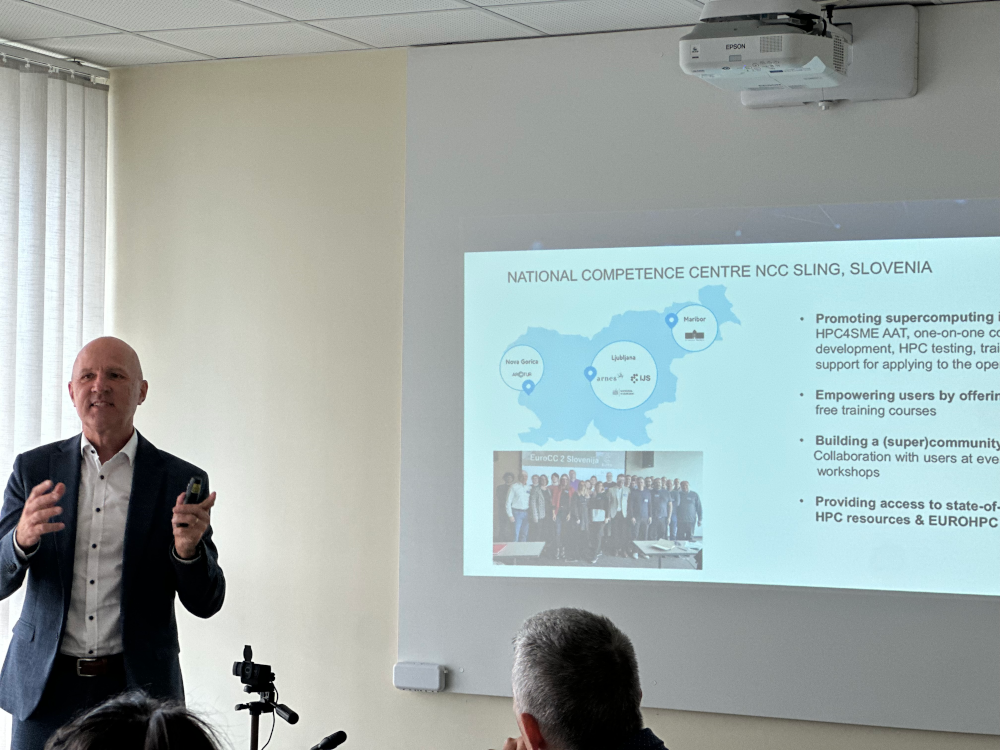
Tomi Ilijas, NCC Slovenia, Arctur

Tomi Ilijaš, representing Arctur and the NCC SLING initiative in Slovenia, discussed the emerging opportunities for SMEs within the HPC ecosystem. He introduced support structures aimed at making advanced computing more accessible to smaller businesses and highlighted case studies of SME innovation enabled by HPC services.

Presentation on lessons learned and new opportunities for the industry

Ilijaš highlighted two of Arctur’s valuable use cases, CLASSICA and LLMs4EU. These projects are powered by supercomputers and AI, enabling faster workflows and precise analysis. Use case in tourism LLMs4EU aims to reduce entry barriers for smaller, lesser-known tourist destinations and to break down language barriers, build personalized itineraries and incorporate gamification elements. Based on vertical LLM, designed for integration into existing or newly developed software. The main goal of the CLASSICA project – the use of AI technology for cancer classification in the operating theatre. Ilijaš presented the project activities and highlighted the importance of AI technology for image recognition and tissue classification.

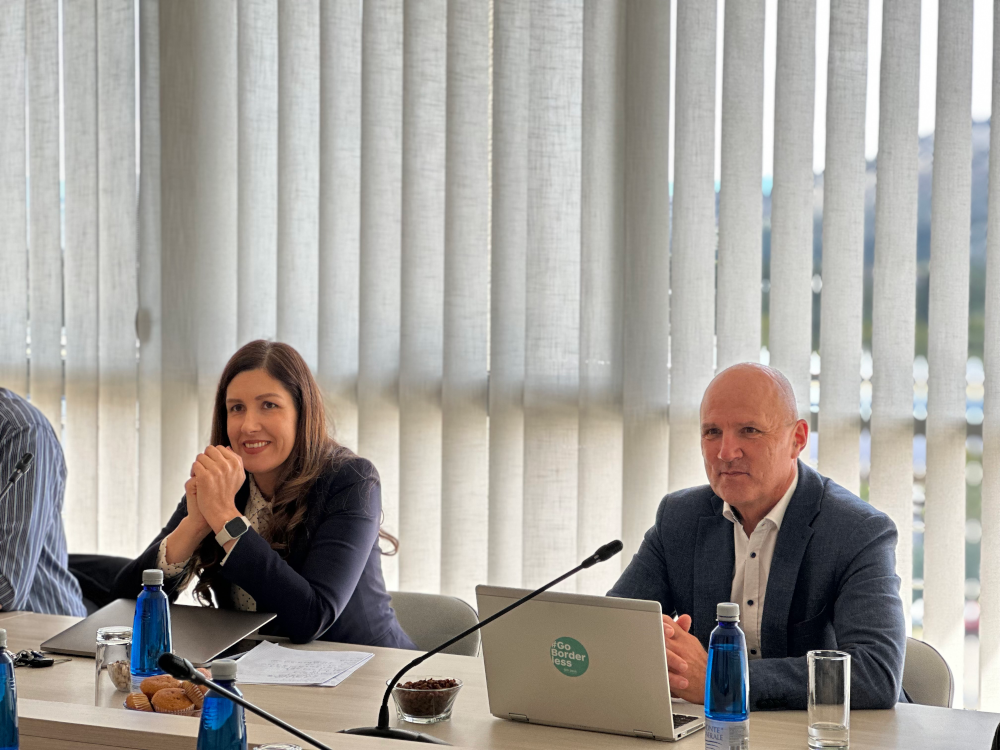
NCC Monteengro moderated the discussion

The second part of the workshop focused on the FFplus call Innovative studies for SMEs. FFplus is a successor to previous Fortissimo projects (Fortissimo, Fortissimo-2, FF4EuroHPC; 2013-2023). Both, NCC Montenegro and NCC Slovenia representatives, explaines and announce to the Montenegrin SMEs the Innovative studies call which will be open in December 2025. This call will support European SMEs and Start-ups already active in the field of generative AI technology, which lack the necessary computational resources to scale up.

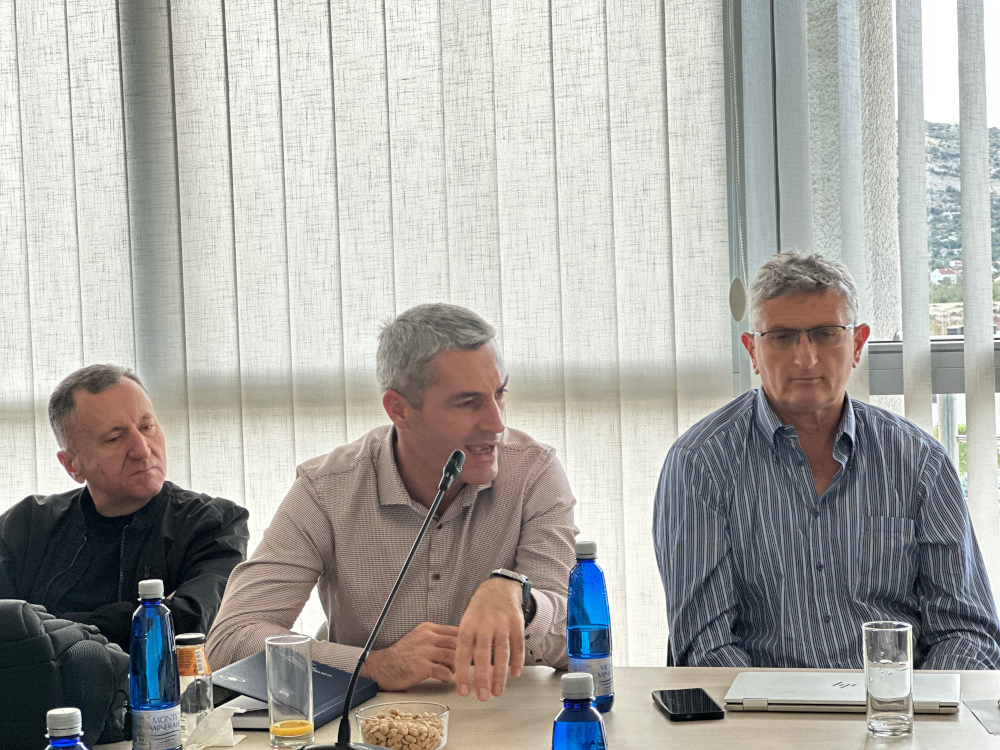
Representatives from NCC Montenegro

After the presentation, there were questions and answers sesion. During Q&A sesion representatives from SMEs shared their experiences and highlighted importance of cooperation with NCC Montenegro.

We had a good presence of SMEs interested in new EuroHPC and FFPlus calls
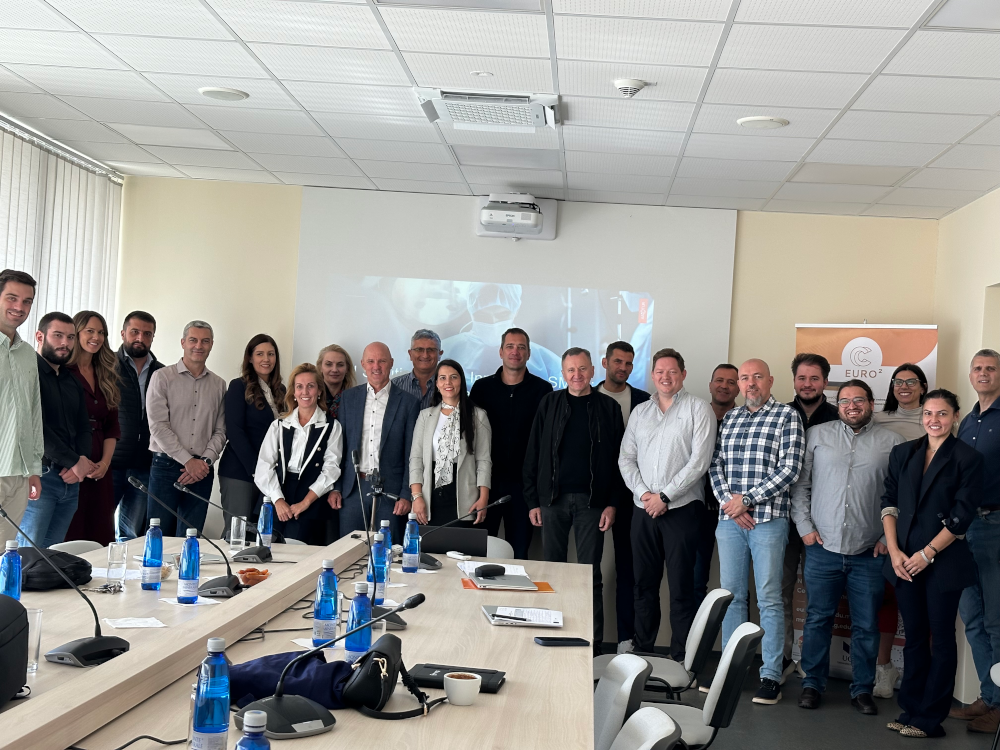
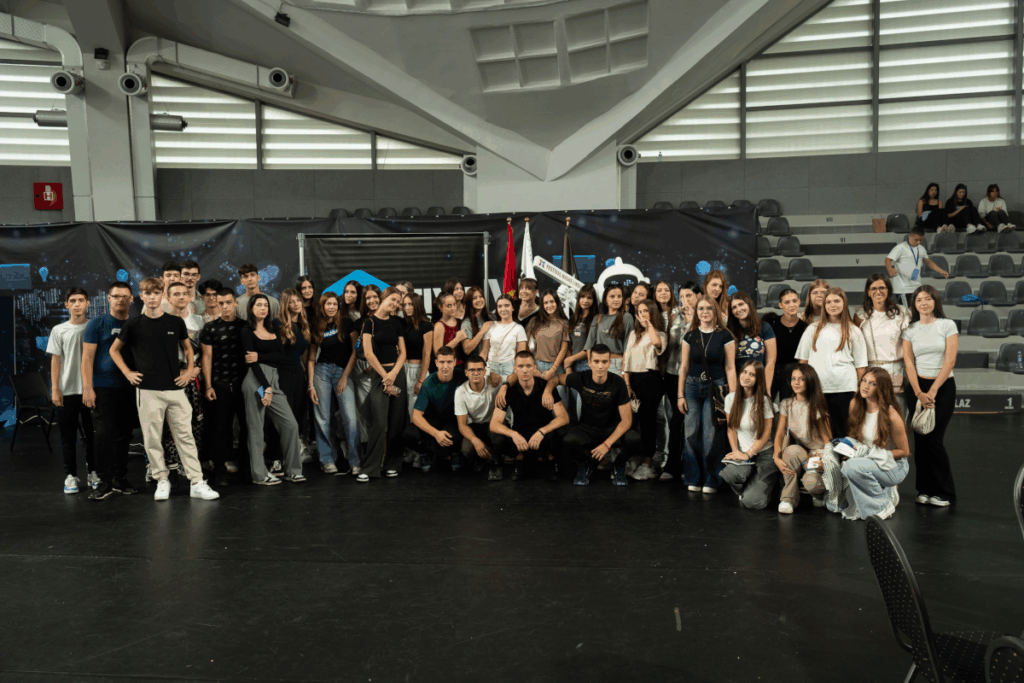
Group photo from the workshop

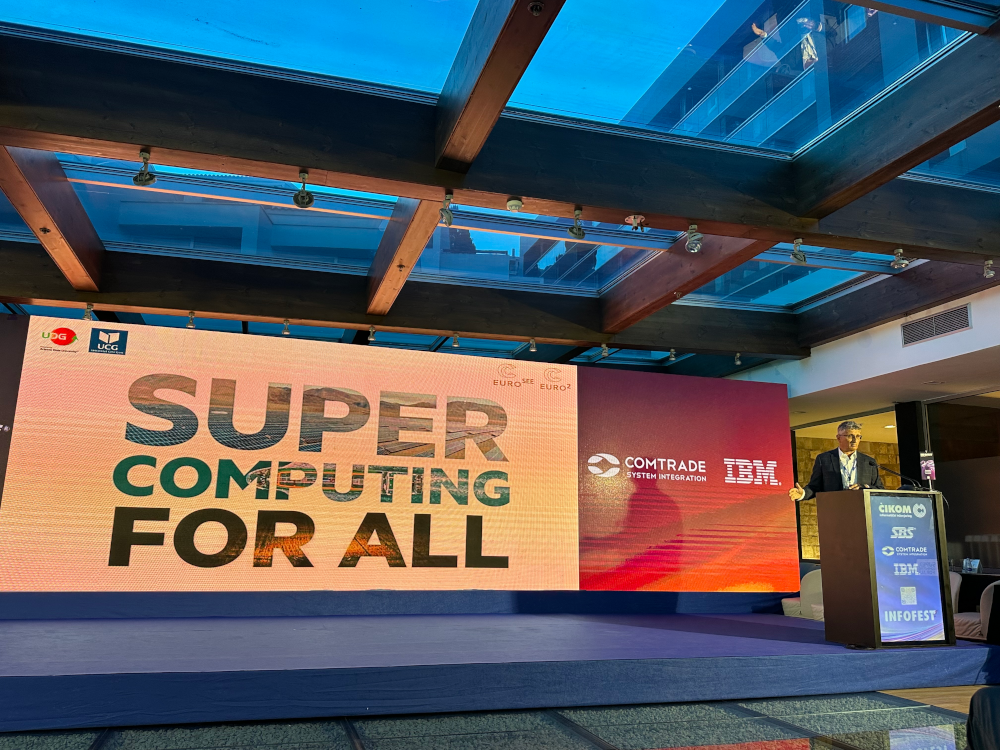
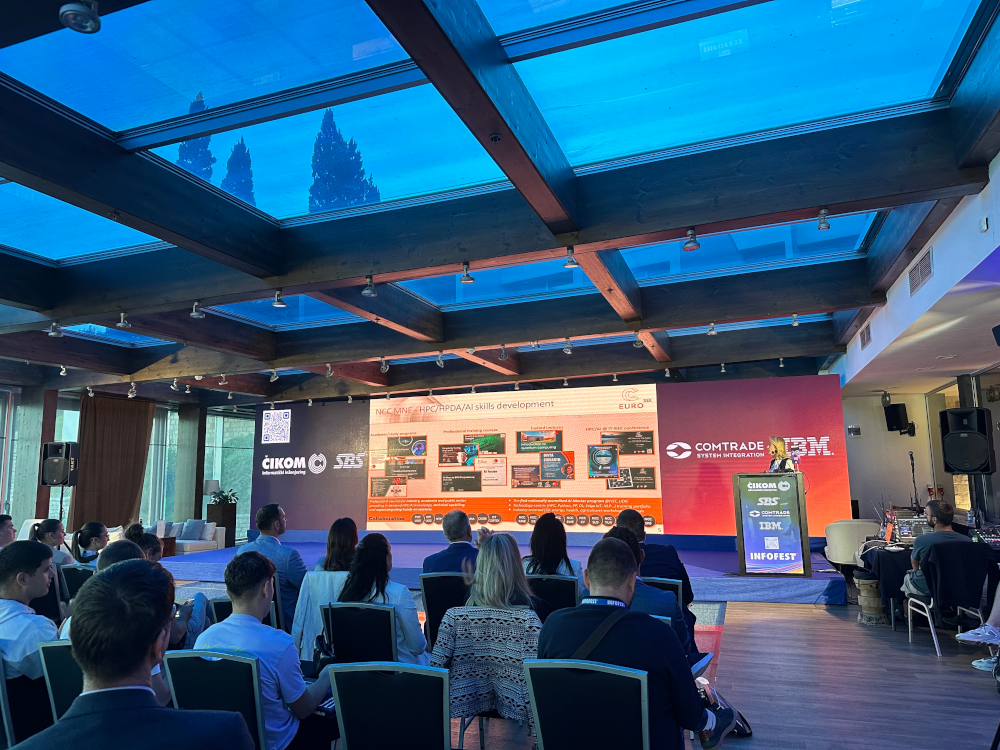
NCC Montenegro at Infofest 2025

Infofest (Festival of IT Achievements) is a traditional international event in the field of information and communication technologies, organized in Montenegro since 1994.

The aim of Infofest is to bring together experts from academia, industry, and the public sector, as well as technology companies, IT enthusiasts, and the media — to exchange knowledge, present innovative solutions, and initiate discussions on current challenges and perspectives of digital transformation.

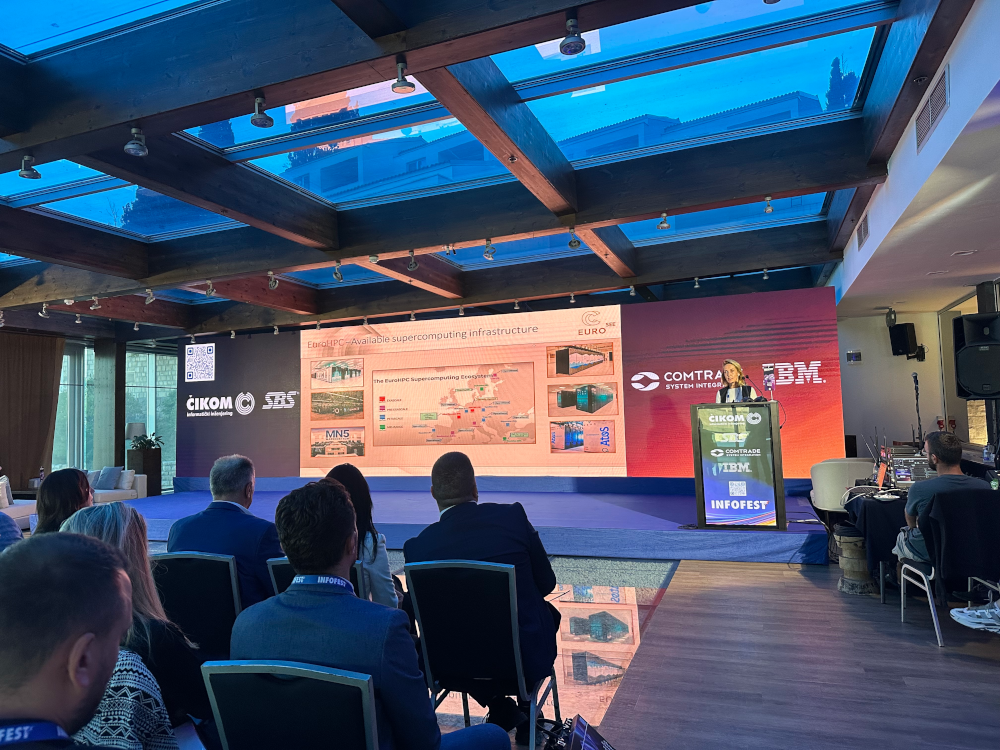
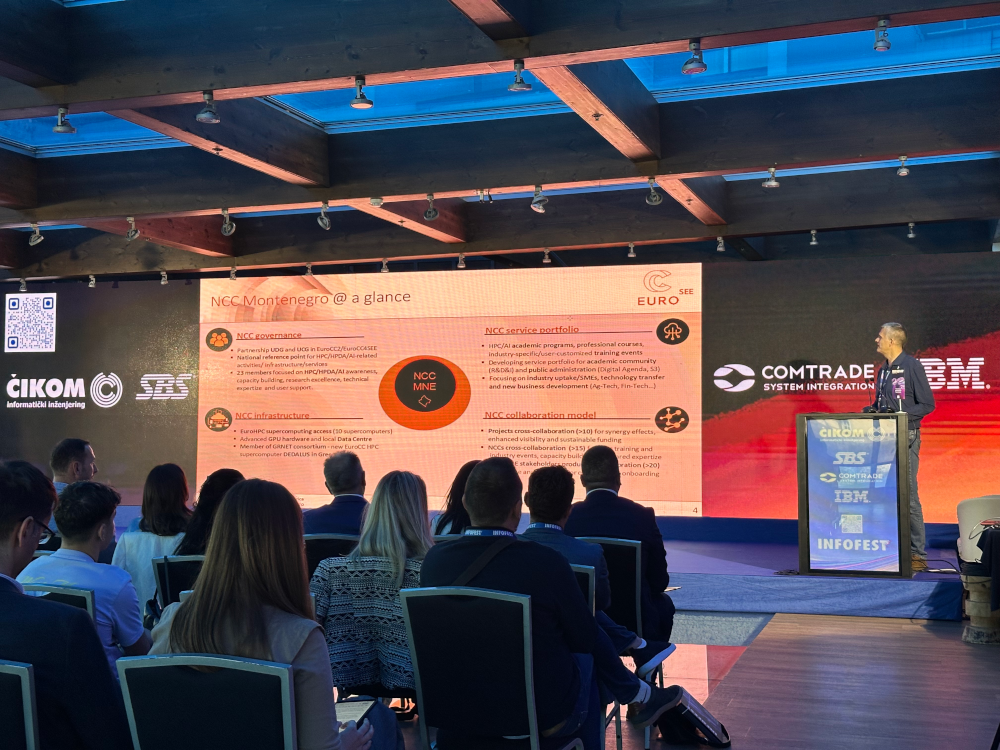
NCC Montenegro presenting activities and services offered

Over the years, Infofest has established a strong reputation as a festival that promotes the latest topics in the ICT sector, such as artificial intelligence, cloud computing, cybersecurity, digital transformation, regulation and ethics in technology, e-governance, and more.
Infofest 2025 was held in Budva, from September 28 to October 1, 2025.

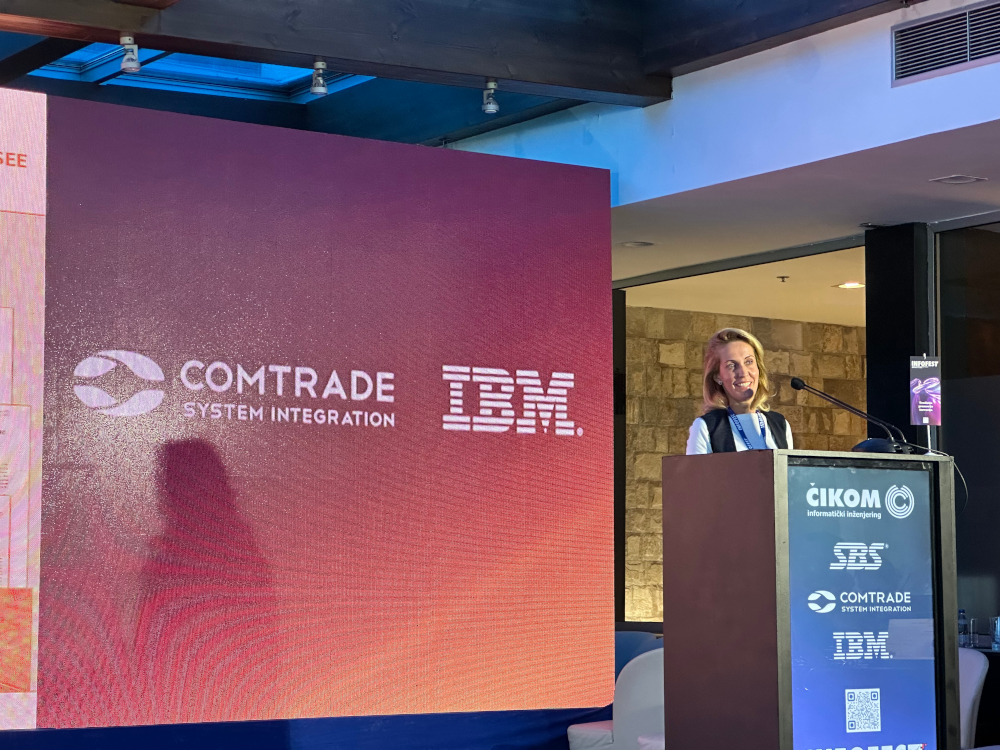
Dr Sandra Tinaj, NCC Montenegro, UDG

The National Competence Center for High Performance Computing – NCC Montenegro actively participated in Infofest 2025, presenting projects and services in the fields of supercomputing (HPC) and artificial intelligence (AI).

Dr Tomo Popovic, NCC Montenegro, UDG

Representatives of the University of Donja Gorica, Sandra Tinaj and Tomo Popović, together with Božo Krstajić from the University of Montenegro, delivered a presentation on the activities of NCC Montenegro, with a special focus on the services offered by the Center, as listed and described on the official platform.

Dr Bozo Krstajic, NCC Montenegro, ETF/UCG

During the event, bilateral meetings were held with representatives of IT companies and public sector institutions interested in collaboration and the implementation of HPC and AI solutions in their organizations.

Infofest was attended by the representatives from industry and academia (Montenegro and the region)

By participating in Infofest, NCC Montenegro further strengthens its role in the development of Montenegro’s digital economy and innovation ecosystem, connecting academia, researchers, and industry in a shared mission to advance knowledge and technological progress.

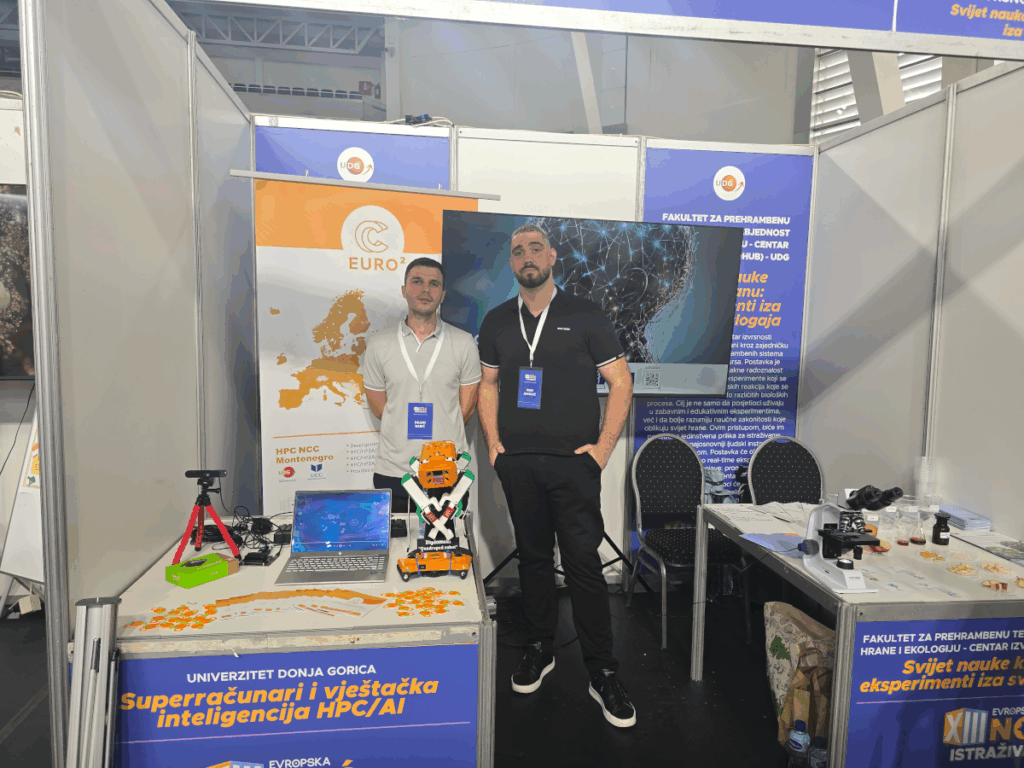
NCC Montenegro at the 13th Science Festival – Supercomputers and Artificial Intelligence

On Friday, September 26, at the Bemax Arena in Podgorica, the 13th Science Festival – “European Researchers’ Night” will take place, organized by the Foundation for the Promotion of Science PRONA (https://festival-nauke.me/).

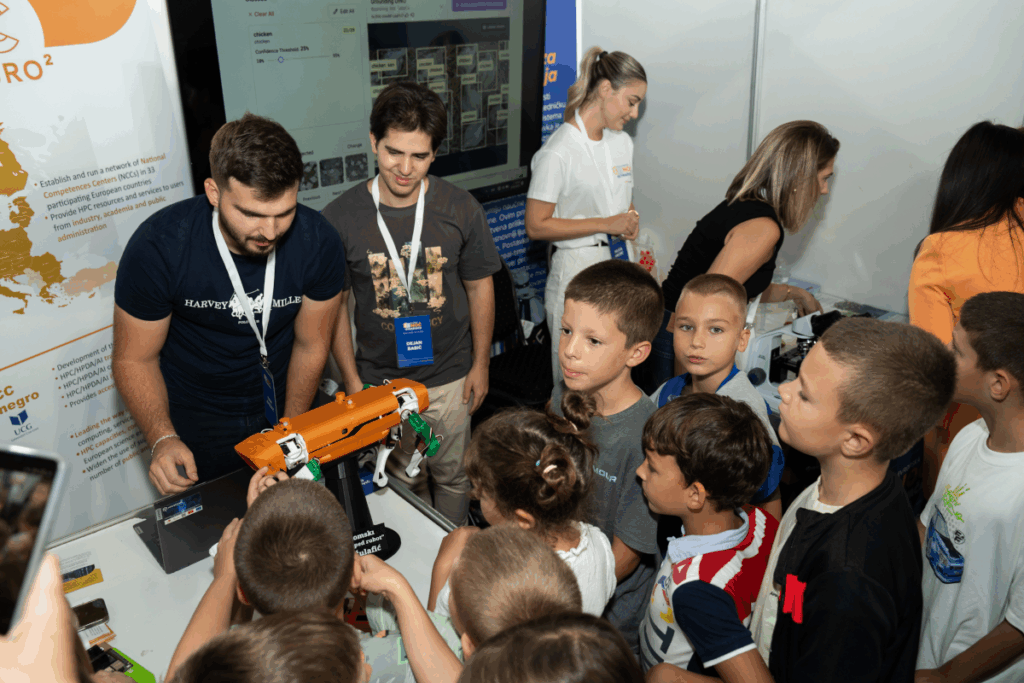
NCC Montenegro at the 13th Science Festival

The National Competence Center for High Performance Computing – NCC Montenegro (EuroCC2 and EuroCC4SEE), represented through the University of Donja Gorica, will participate in this largest event in Montenegro dedicated to the popularization of science and innovation.

Interaction with the youngest attendees

Through several projects and demonstrations, visitors will see how supercomputers and artificial intelligence (HPC/AI) are shaping the future:

  • Agriculture – the AIMHiGH project applies AI for real-time poultry disease and behavior analysis.
  • Human resources – AI tools for improving business processes and enhancing objectivity in decision-making.
  • Medicine – the AI-AGE project develops AI models for detecting biomarkers of aging from medical imaging.

This event is an opportunity to demonstrate how HPC and AI contribute to sustainable development and the digital transformation of society, while highlighting Montenegro’s active role in the European Research Area.

Through EuroCC2 and EuroCC4SEE, NCC Montenegro continues to build bridges between science and industry, supporting researchers and companies in developing new digital solutions, and positioning Montenegro as part of the European supercomputing and AI community.

Connecting science, innovation and society

The Science Festival once again confirms the importance of NCC Montenegro in connecting science, innovation, and society.

Visit to Deepmark startup company

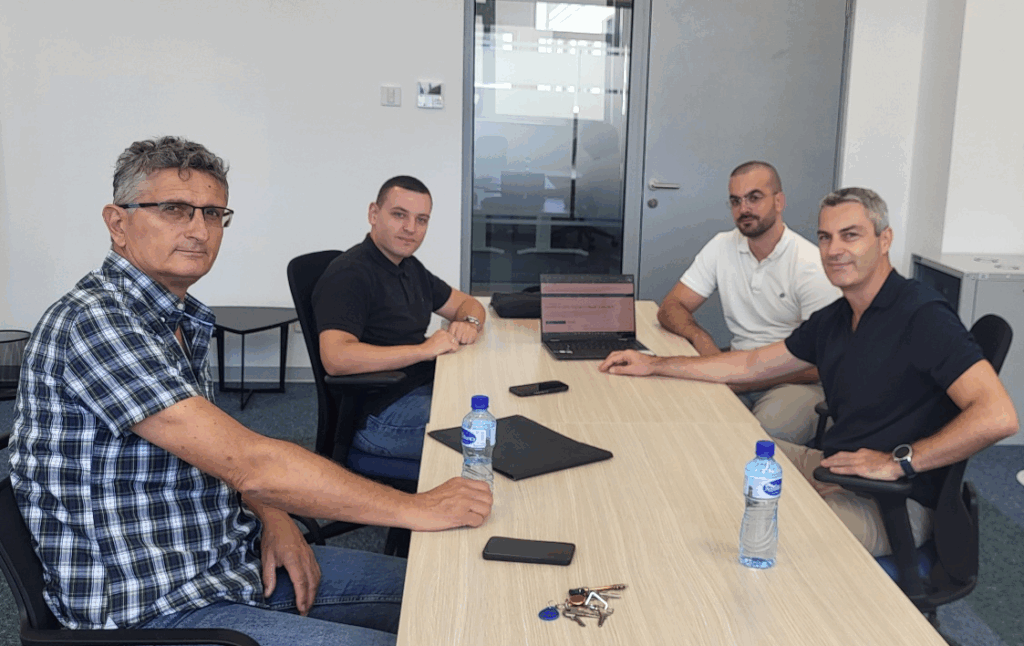
NCC Montenegro team from the University of Montenegro (UoM), prof. Božo Krstajić and prof. Enis Kočan has visited startup company Deepmark, co-founded by former researcher from the Faculty of Electrical Engineering – UoM, Slavko Kovačević, MSc. This startup company represents an example of how top-tier academic research transforms into real-world solutions.

DeepMark develops technology for invisible and permanent digital marks (watermarks) that can be embedded in images, audio, and video content without compromising quality. These marks enable proof of origin, ownership, and authenticity of content – which is becoming crucial in the era of artificial intelligence and generative media.

NCC Montenegro team visiting DeepMark startup

NCC team has presented the opportunities to access EUroHPC JU resources through different open calls, as well as to obtain financial support to realize ideas through FFplus calls. Deepmark company has already used HPC resources on a commercial basis and plans to prepare proposal to access EuroHPC JU resources.

NCC Montenegro at INFOFEST

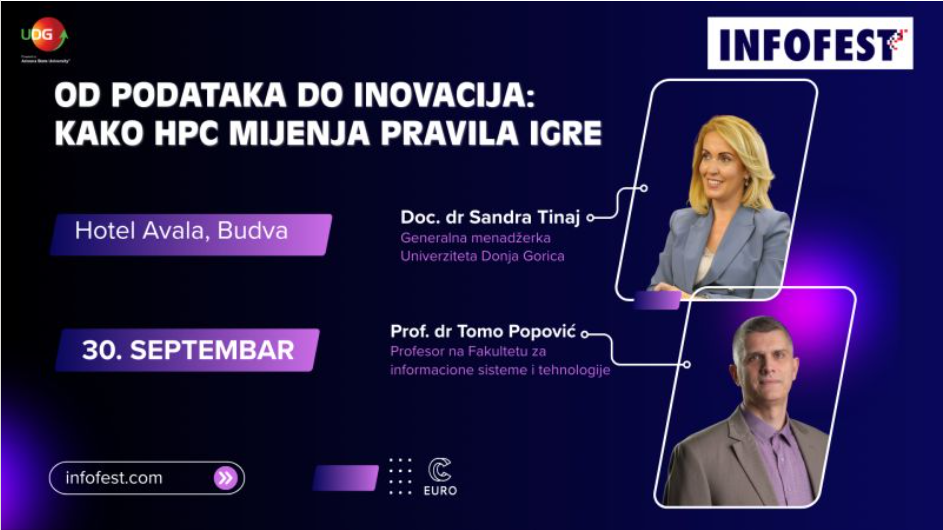
We are delighted to announce that our General Manager, Sandra Tinaj, and Professor Tomo Popović will take part in Infofest 2025 in Montenegro. They will present the EuroCC 2 and EuroCC4SEE project and discuss how supercomputing is opening new opportunities for science, innovation, and industry.

For more than three decades, INFOFEST has brought together leaders from academia, industry, and the public sector, and this year our team will contribute to the dialogue on the digital future.

NCC Montenegro will participate in this year’s INFOFEST with a presentation on 30 September
  • Agenda for INFOFEST [link]
  • learn more at INFOFEST website [link]

JUPITER — Europe’s fastest supercomputer and Europe’s first exascale system

In June 2025, the JUPITER supercomputer was inaugurated at Forschungszentrum Jülich (FZJ), through the Jülich Supercomputing Centre (JSC) and within the EuroHPC Joint Undertaking initiative. With this milestone, Europe has launched its first exascale system, which immediately became the fastest computer on the continent and ranked fourth on the global TOP500 list of supercomputers. JUPITER distinguishes itself not only with its performance but also as the most energy-efficient among the world’s top five fastest systems.

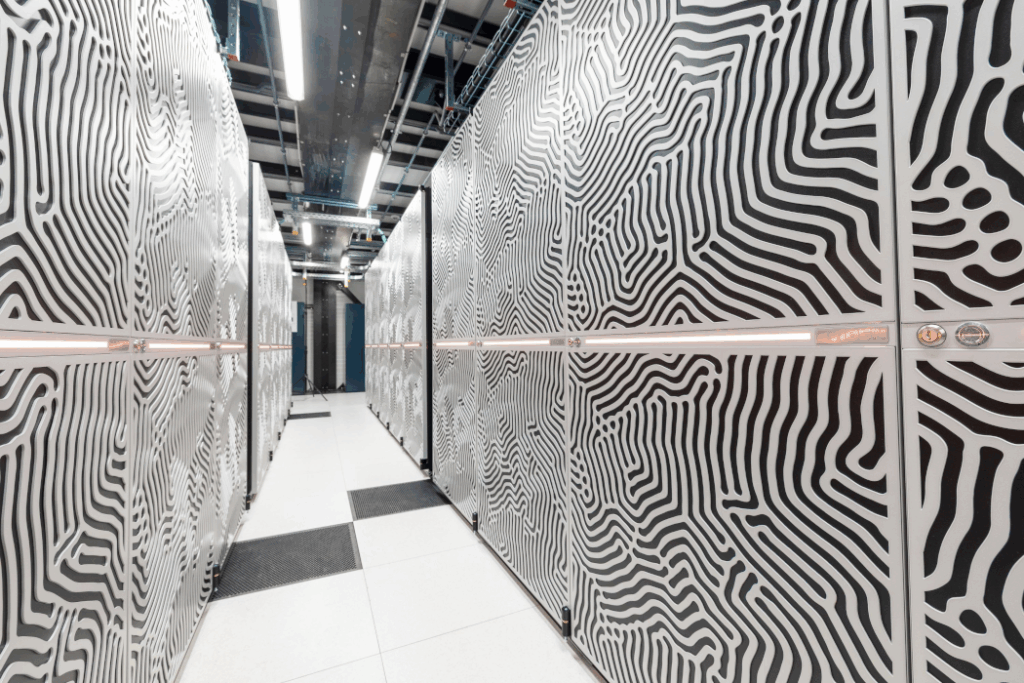
Between the racks of the JUPITER supercomputer (source: Forschungszentrum Jülich)

The system is based on a modular architecture and integrates around 24,000 NVIDIA GH200 “Grace Hopper” superchips, making it particularly suitable for highly parallel applications such as training large language models and running complex scientific simulations. JUPITER combines “Cluster” and “Booster” modules, reaching a total performance exceeding 1 exaflop per second, firmly positioning Europe in the exascale era. Sustainability has also been a priority: the system consumes around 15 MW of electricity, powered entirely by renewable sources, while its waste heat is reused for district heating across the Forschungszentrum Jülich campus.

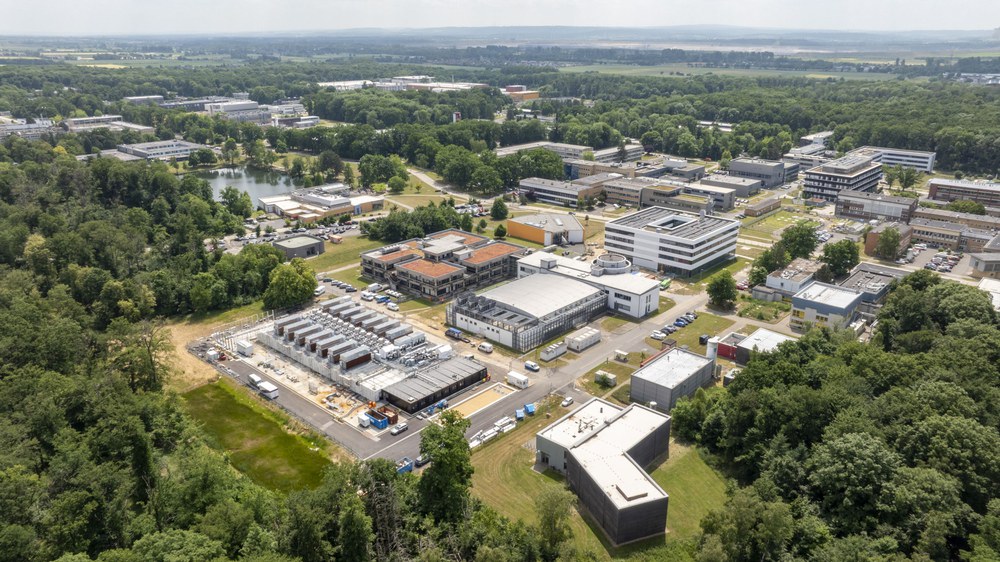
Aerial view of the Jülich campus (source: Forschungszentrum Jülich)

The significance of JUPITER is manifold. As a symbol of European technological independence, it strengthens digital sovereignty and provides researchers and industry across Europe with access to unprecedented computing capabilities. Its immense power is expected to accelerate progress in critical domains such as climate simulations, brain research, quantum simulation, and the training of advanced AI models. The project is the result of close collaboration between European institutions and industrial partners under the EuroHPC JU framework, standing as a prime example of successful synergy between the public and private sectors in support of science, innovation, and industrial development.

The JUPITER supercomputer is not only the fastest European system but also a symbol of Europe’s entry into the exascale era and its ambition to lead in high-performance computing and artificial intelligence. Learn more at [link].