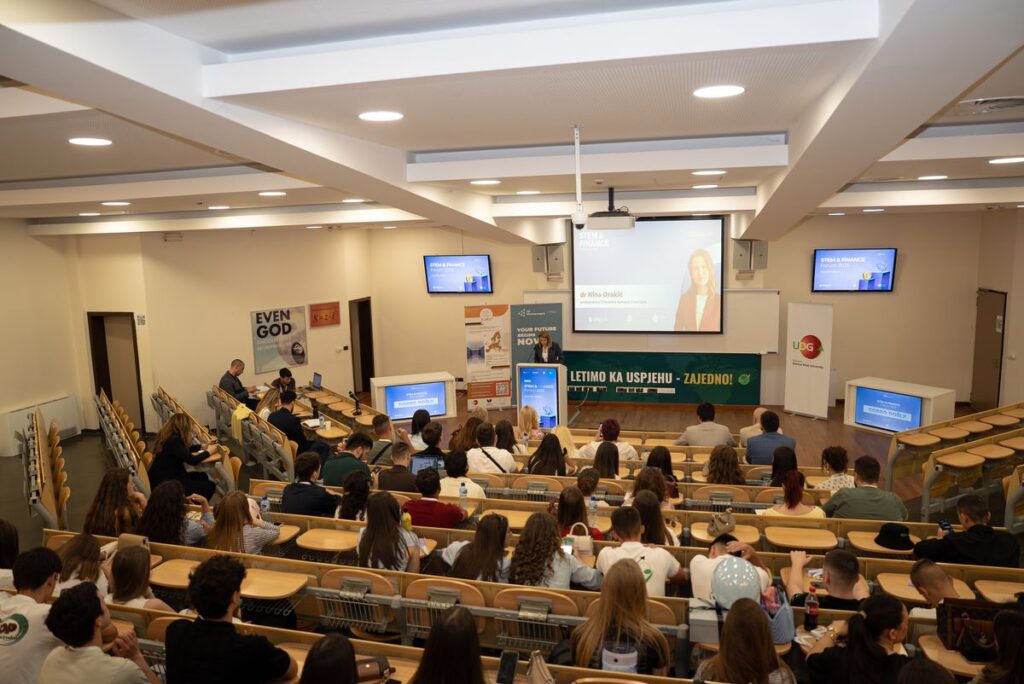
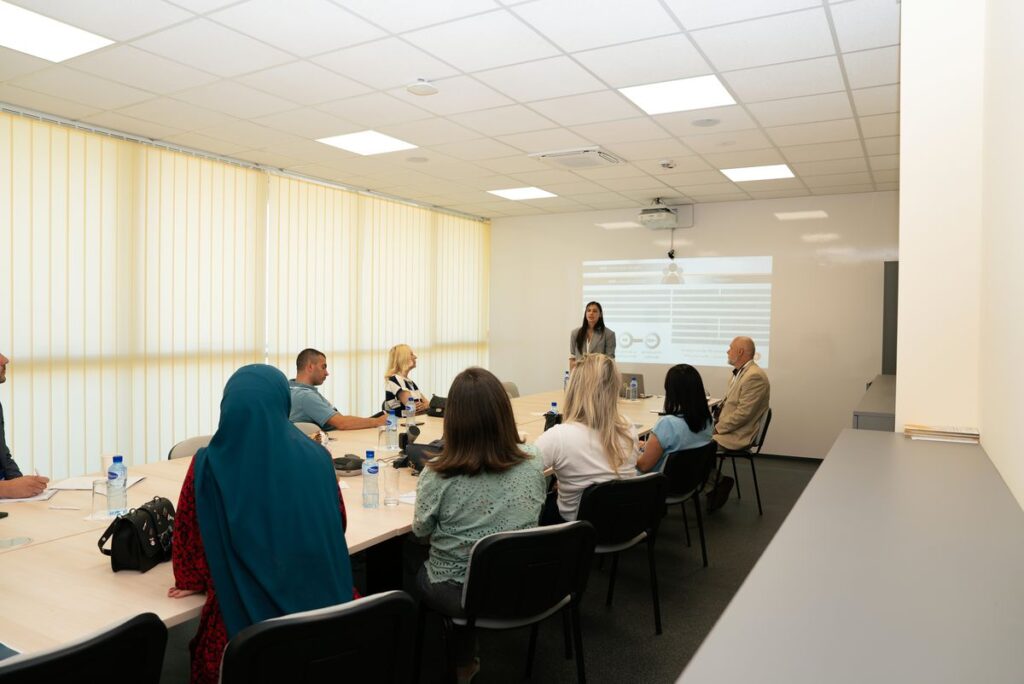
At the Montenegro STEM & Finance Forum 2026, successfully held on June 10th 2026 at the University of Donja Gorica, participants were introduced to the National Competence Centre of Montenegro (NCC Montenegro) within the framework of the international EuroCC3 project. The STEM & Finance Forum 2026 was an event dedicated to young innovators, entrepreneurs, and teams developing solutions in the fields of STEM (science, technology, engineering, mathematics), finance, circular economy, and social innovation.
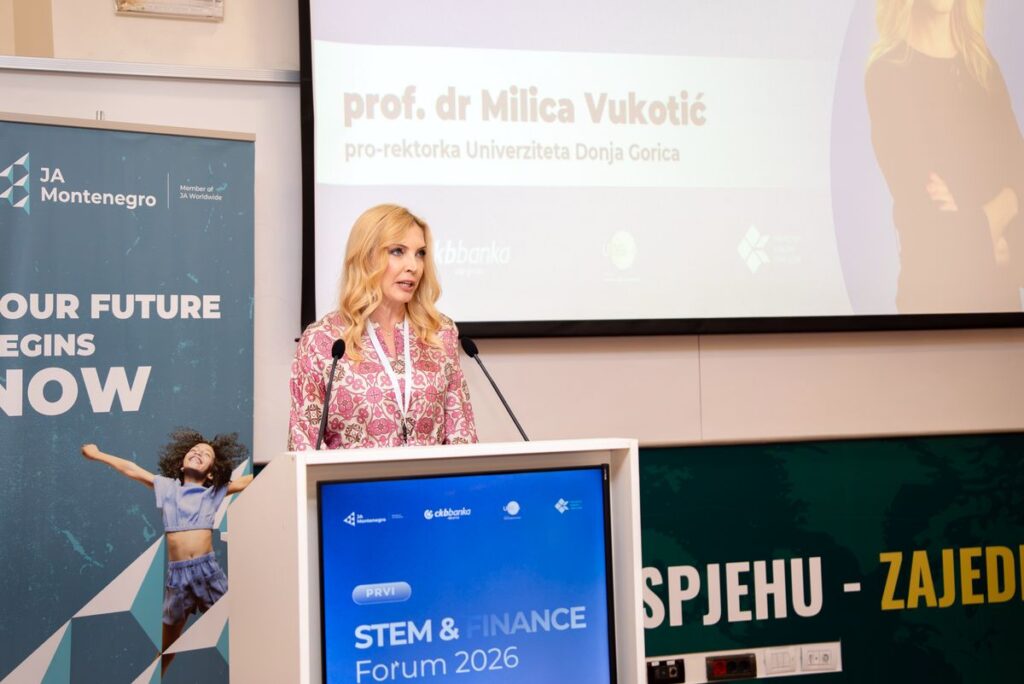
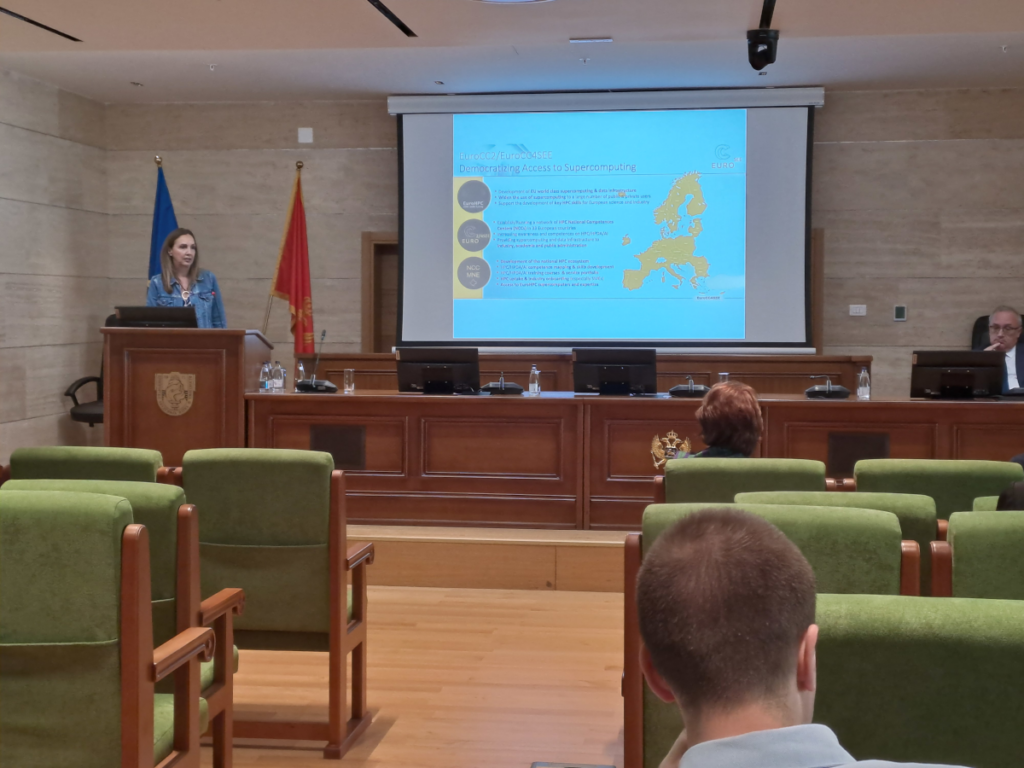
The presentation of NCC Montenegro and the EuroCC3 project was delivered by Prof. Dr Milica Vukotić, Vice-Rector of the University of Donja Gorica and the NCC Montenegro member, who highlighted the importance of developing advanced computing capacities and artificial intelligence as key drivers of Montenegro’s digital transformation.
NCC Montenegro represents a key infrastructure for the development of advanced computing technologies in Montenegro. Through the EuroCC3 project, the centre supports businesses, research institutions and the public sector in accessing high-performance computing (HPC), artificial intelligence and big data analytics. The establishment of NCC Montenegro opens new opportunities for innovation, digital transformation and increased competitiveness of the Montenegrin economy on the European and global market, while also strengthening the link between science and industry through the joint development of solutions based on the most advanced technologies.
The Forum was organised by Junior Achievement Montenegro in cooperation with Chamber of Economy Montenegro and CKB bank in Montenegro and brought together representatives from academia and the business sector.
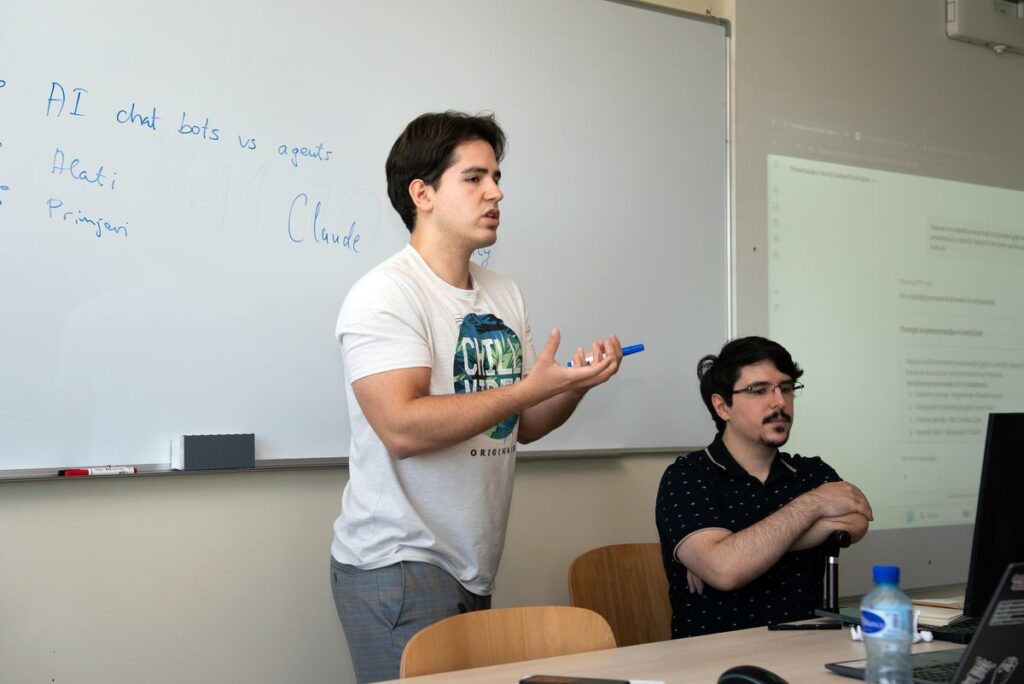
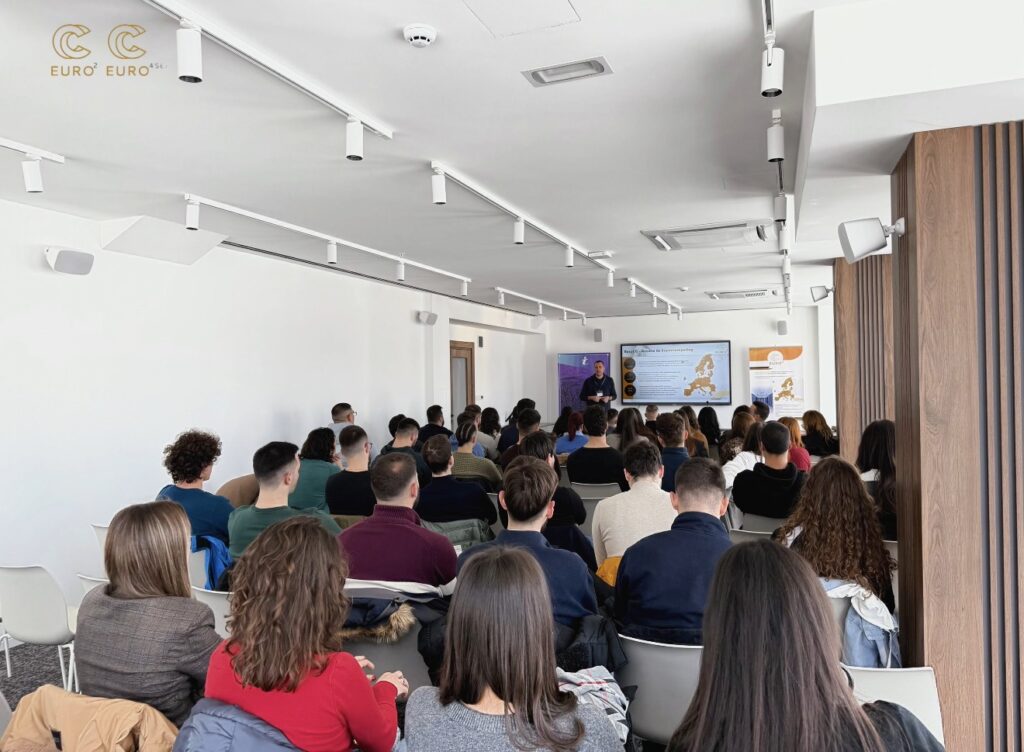
As part of the training programme, NCC Montenegro members, Arnad Lekić, Igor Ćulafić and Dr Stevan Čakić delivered a training session on the topic “The Use of AI Tools in Active Projects”, providing participants with insight into the practical application of artificial intelligence tools in real project scenarios and day-to-day work.
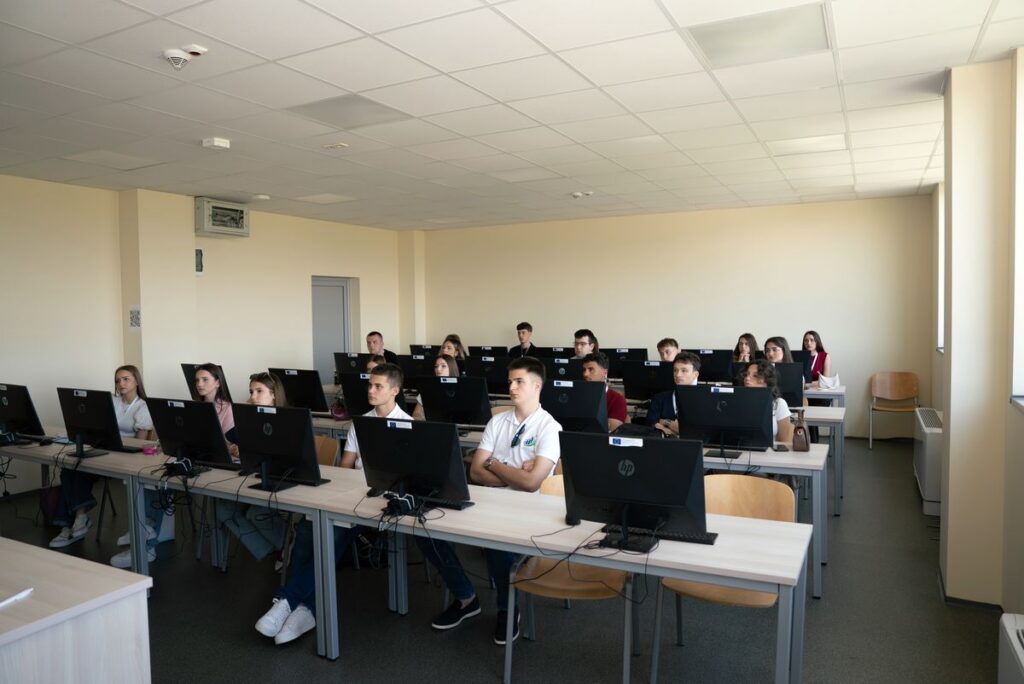
Dr Bojana Mališić delivered a training session on applying for EU projects, equipping participants with practical knowledge and guidance on accessing European funds and international financing programmes.
The presentation of NCC Montenegro at this event for young innovators and entrepreneurs reaffirms the University of Donja Gorica’s commitment to making advanced computing technologies and the outcomes of international projects accessible to the broader academic and business community in Montenegro.
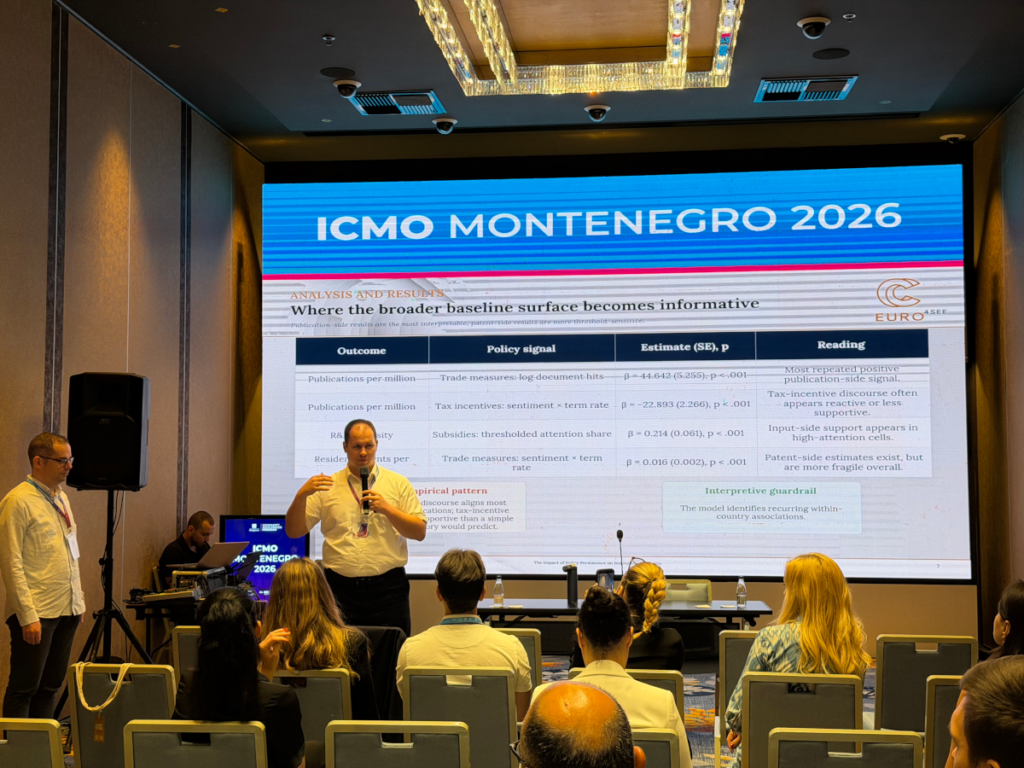
The National Competence Centre Montenegro (NCC Montenegro), operating within the EuroCC3 was presented at the ICMO 2026 International Conference on Management and Organization – “Sustainability by Design: Rethinking Strategy, People & Digital Futures”, held in Przno, Montenegro.
The conference brought together more than 300 participants from over 45 countries, with more than 30 keynote, invited, and editorial speakers, and a Scientific Committee comprising researchers from 46 countries, including representatives of all 27 EU member states. ICMO 2026 served as a high-level platform for the exchange of knowledge and experience between researchers, journal editors, doctoral candidates, institutional leaders, and business community representatives.
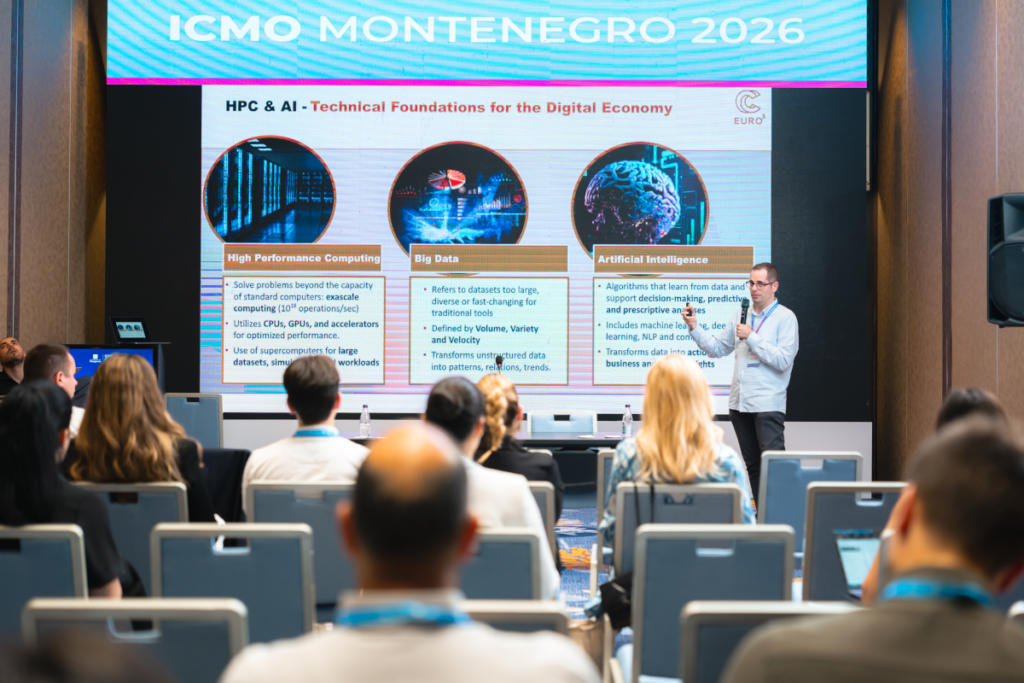
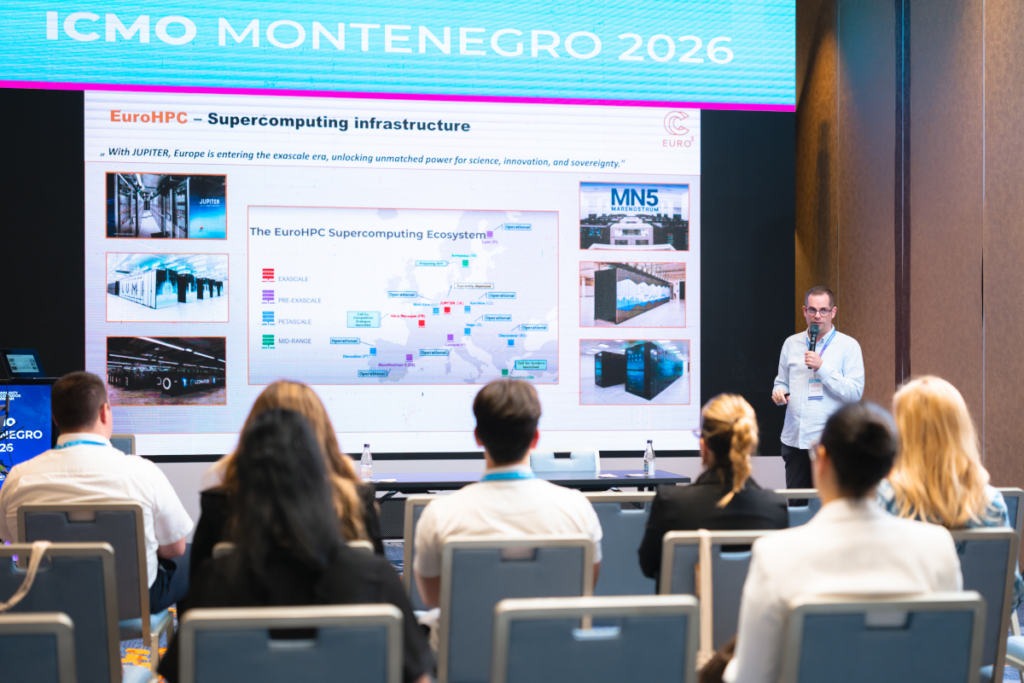
The EuroCC3 project and the activities of NCC Montenegro were presented by Stevan Čakić, member of the EuroCC3 project team, who outlined the role of the National Competence Centre Montenegro in building the national HPC and AI ecosystem, democratizing access to European supercomputing infrastructure, and supporting SMEs, academia, and public administration in adopting advanced digital technologies.
Special Training Session: HPC/AI for Business Competitiveness
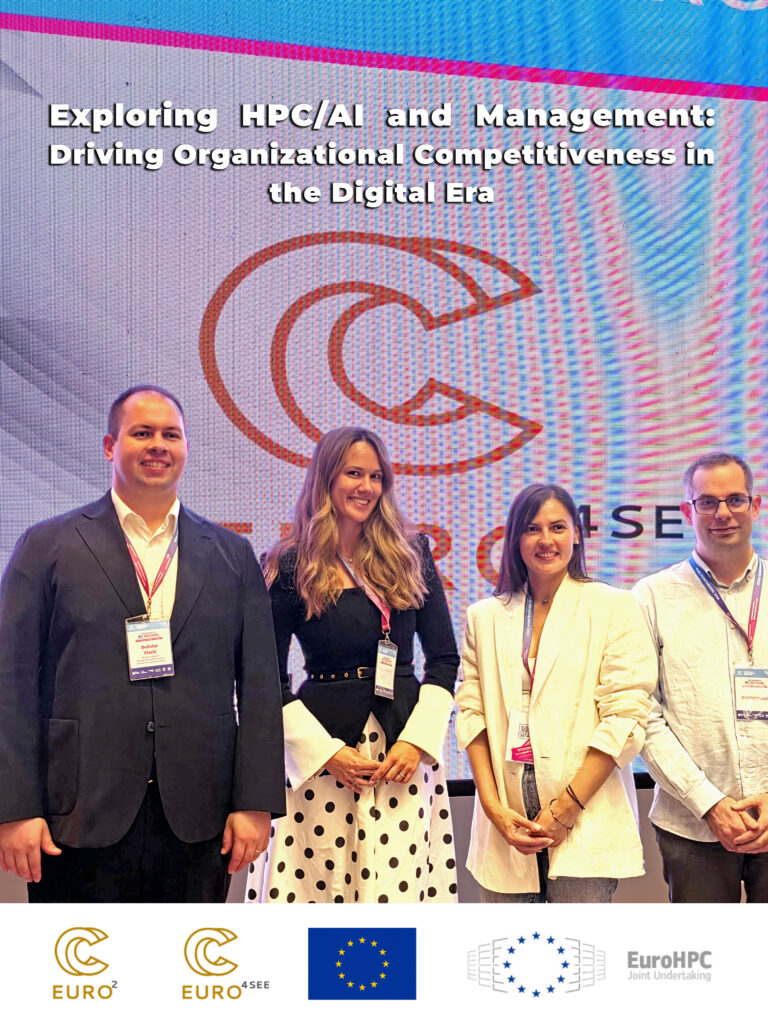
As part of the conference programme, NCC Montenegro organized a dedicated special session and training titled “Exploring HPC/AI and Management: Driving Organizational Competitiveness in the Digital Era”, specifically designed for SMEs and the wider business community.
The training addressed the growing need for small and medium-sized enterprises to leverage advanced digital technologies — including High Performance Computing (HPC), Artificial Intelligence (AI), and Big Data — as strategic tools for enhancing competitiveness, operational efficiency, and data-driven decision-making. Participants were introduced to key concepts and practical applications of HPC and AI in areas such as demand forecasting, financial modelling, predictive analytics, and data-driven business models, as well as the opportunities available through EuroCC3 and the EuroHPC Joint Undertaking, which provides free access to world-class European supercomputing infrastructure and expertise — including to SMEs and startups.
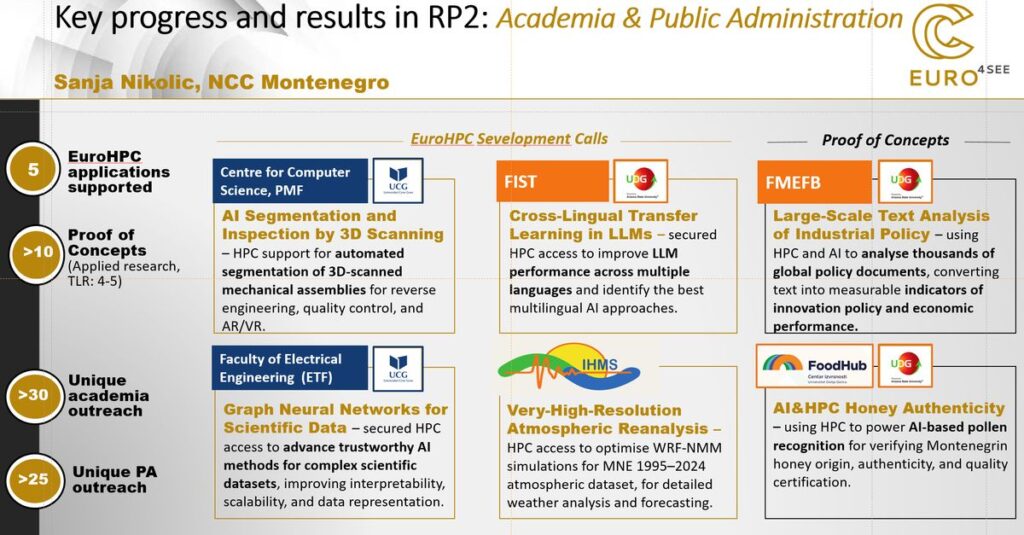
A particular highlight of the training was a real-world research use case titled “How the Institutional HPC Infrastructure Turned 50,647 Policy-Document URLs into a Reproducible Country-Year Research System”, presented by researcher, Bozidar Vlacic, from the and the Católica Porto Business School & CEGE, Universidade Católica Portuguesa and University of Donja Gorica. The use case demonstrated in concrete terms the transformative power of HPC for research and business analytics: using EuroHPC supercomputing infrastructure, the research team processed over 50,000 candidate policy-document URLs, successfully downloading and converting nearly 37,000 PDFs — totalling 92.6 GB of data — into a clean, analysis-ready country-year database spanning 55 countries over the period 2007–2021. A task estimated to take nearly 30 days on a standard laptop was completed in a single overnight cluster run of under 16 hours, compressing time-to-evidence dramatically and making a previously unfeasible large-scale empirical study operationally credible. The resulting research system examined how industrial policy signals in public documents relate to national innovation capability — measured through R&D intensity, scientific publications, and resident patents — delivering directly actionable insights for both policymakers and business analysts.
This use case illustrated to the business community how HPC is not only a tool for science and engineering, but a strategic enabler for data-driven management, policy analysis, and competitive intelligence.
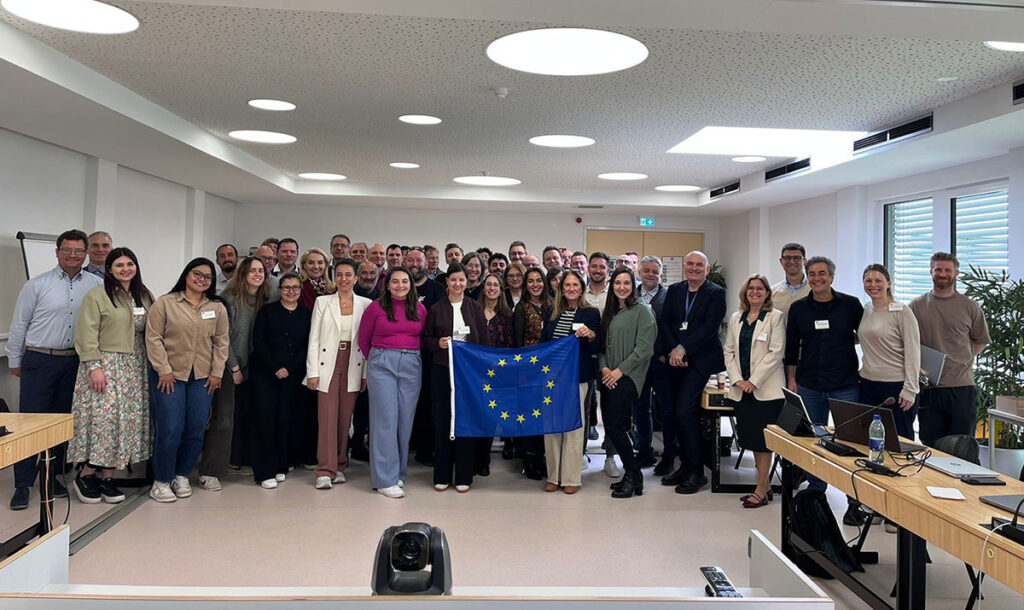
The National Competence Centre (NCC) for High-Performance Computing (HPC) in Montenegro participated in the final project review meetings of EuroCC2 and EuroCC4SEE, held at the EuroHPC Joint Undertaking premises in Luxembourg. The meetings brought together representatives of NCCs, project coordination teams, reviewers, and the European Commission Project Officer to assess the last phase (01.01.2025-31.03.2026) of project implementation, results, and future sustainability.
EuroCC2 and EuroCC4SEE group picture
The EuroCC2 Final Project Review took place on 20–21 May 2026, covering overall project management, financial and operational reporting aspects, 34 NCCs (countries) presentations, dissemination and exploitation results, as well as interactive discussions and final feedback from the reviewers. The EuroCC4SEE Final Project Review followed on 22 May 2026, featuring a dedicated session for NCC Montenegro, alongside the National Competence Centres of Türkiye, North Macedonia, Serbia, and Bosnia and Herzegovina.
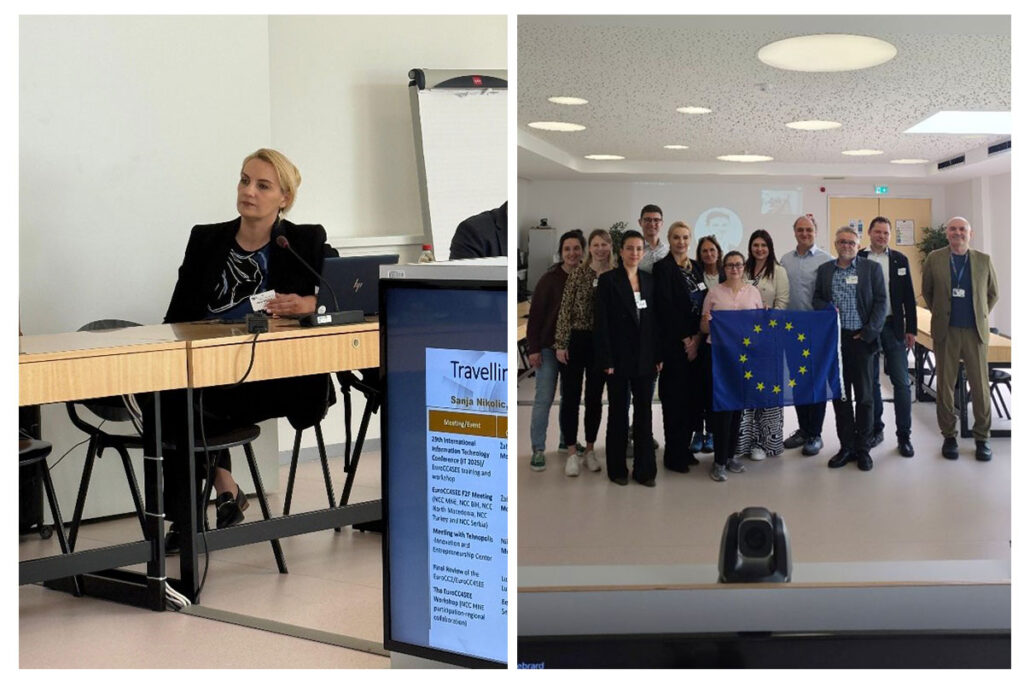
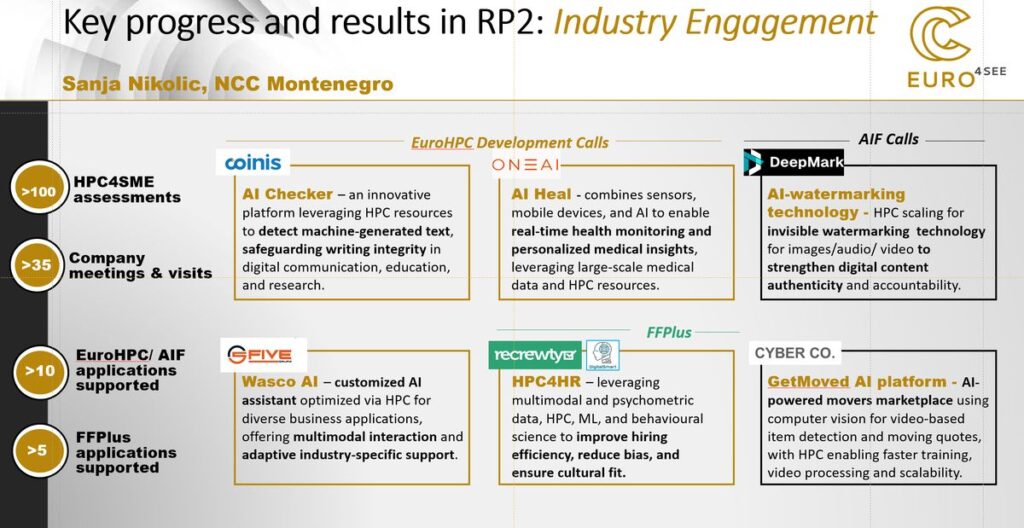
During the Montenegro presentation, NCC Montenegro highlighted its role as a national access point and service hub for HPC, HPDA, and AI, supporting companies, start-ups, academia, and public institutions in understanding and adopting advanced computing technologies. A key part of the presentation focused on Montenegro’s progress in user engagement and capacity building.
EuroCC4SEE country representatives, PMT managers EU policy officer at the Final Review 22.05.2026
The NCC reported overachieved results in engaging with SMEs, start-ups, academia, and public institutions, including over 100 HPC4SME assessments, more than 35 company visitsand technical consultations, and expert support for more than 15 EuroHPC access applications across diverse industrial use cases and research domains.
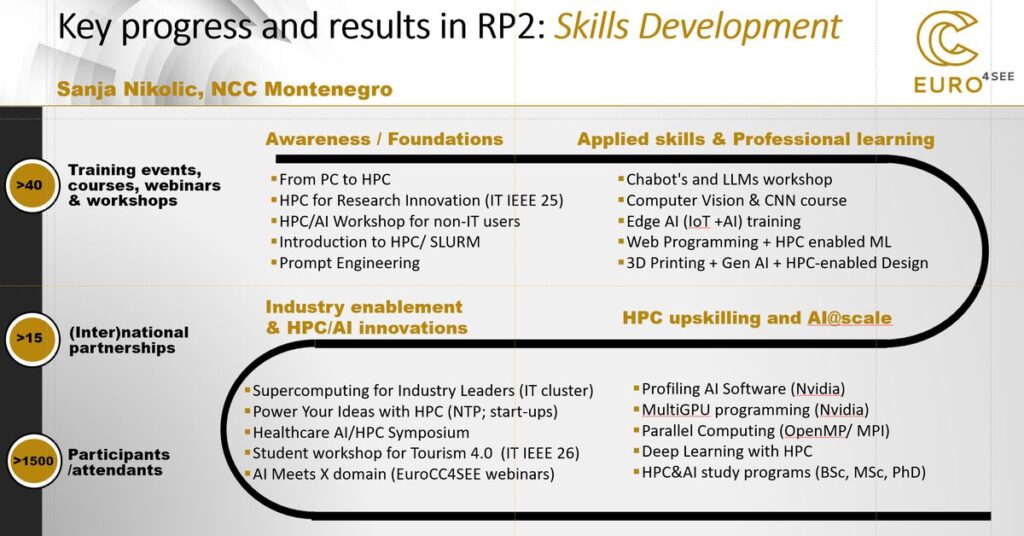
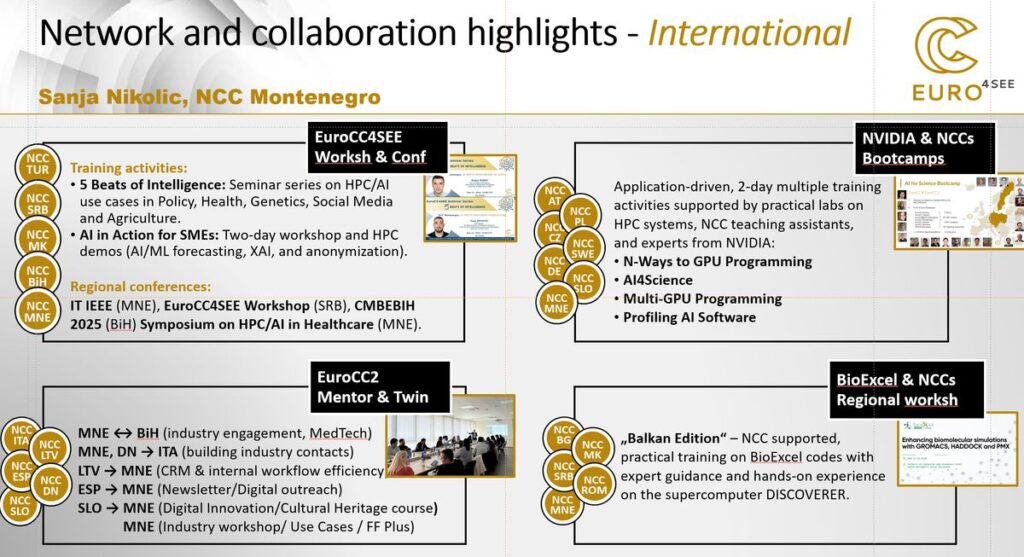
NCC Montenegro also presented its user-centric training portfolio, delivered in cooperation with more than 20 European NCCs and CoEs, industry partners such as NVIDIA, and key national stakeholders supporting the MNE innovation ecosystem. The portfolio included over 40 training events, industry workshops, hands-on boot camps, and webinar series, reaching more than 1500 participants and covering a broad range of HPC, HPDA, and AI topics.
The final review meetings confirmed the importance of NCC Montenegro as a bridge between European supercomputers and the national innovation ecosystem. Looking ahead, the NCC Montenegro will continue to support SMEs, start-ups, academia, industry, and public institutions by providing expert guidance, professional training, EuroHPC access support, and hands-on assistance in developing high-impact HPC and AI use cases.
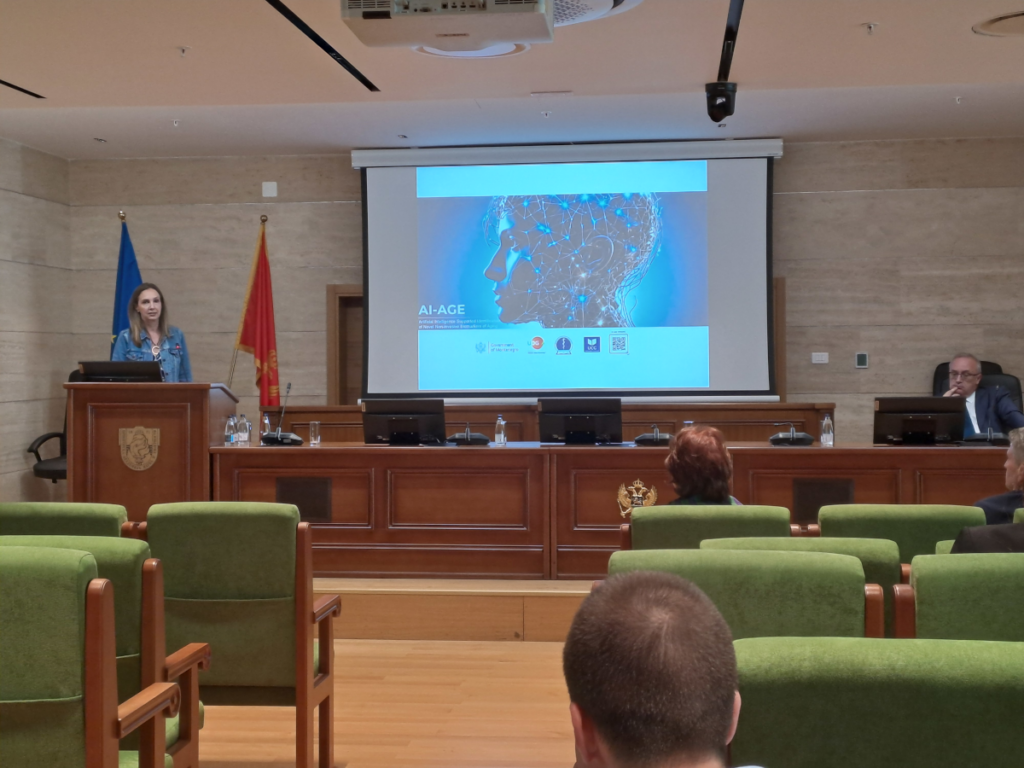
The AI-AGE project was presented at the round table “Artificial Intelligence in Healthcare – Challenges and Opportunities”, held on 24 April 2026 at the Montenegrin Academy of Sciences and Arts (CANU) in Podgorica. The event gathered experts from Montenegro and Bosnia and Herzegovina to discuss the role of AI in healthcare, including clinical applications, digital transformation, ethics, medical imaging, NLP, and AI assistants. We used this opportunity to promote the EuroCC4SEE and NCC Monteengro activity.
The round table was an opportunity to promote EuroCC 2 & EuroCC4SEE and NCC Montenegro support
AI-AGE was presented by Prof. Dr Nataša Popović, Faculty of Medicine, University of Montenegro, in the session dedicated to AI in clinical practice. The presentation highlighted key findings of the project and demonstrated how AI can support early detection and screening of chronic diseases, including examples related to colorectal cancer detection and the use of biomarkers.
The main presentation was focused on AI-AGE goals and results (cross-project collaboration)
The event was also an opportunity to promote EuroCC activities and the role of NCC Montenegro in strengthening national capacities in HPC, HPDA, and AI. Participation in this round table further positioned AI-AGE within the broader regional discussion on responsible and clinically relevant use of artificial intelligence in medicine.
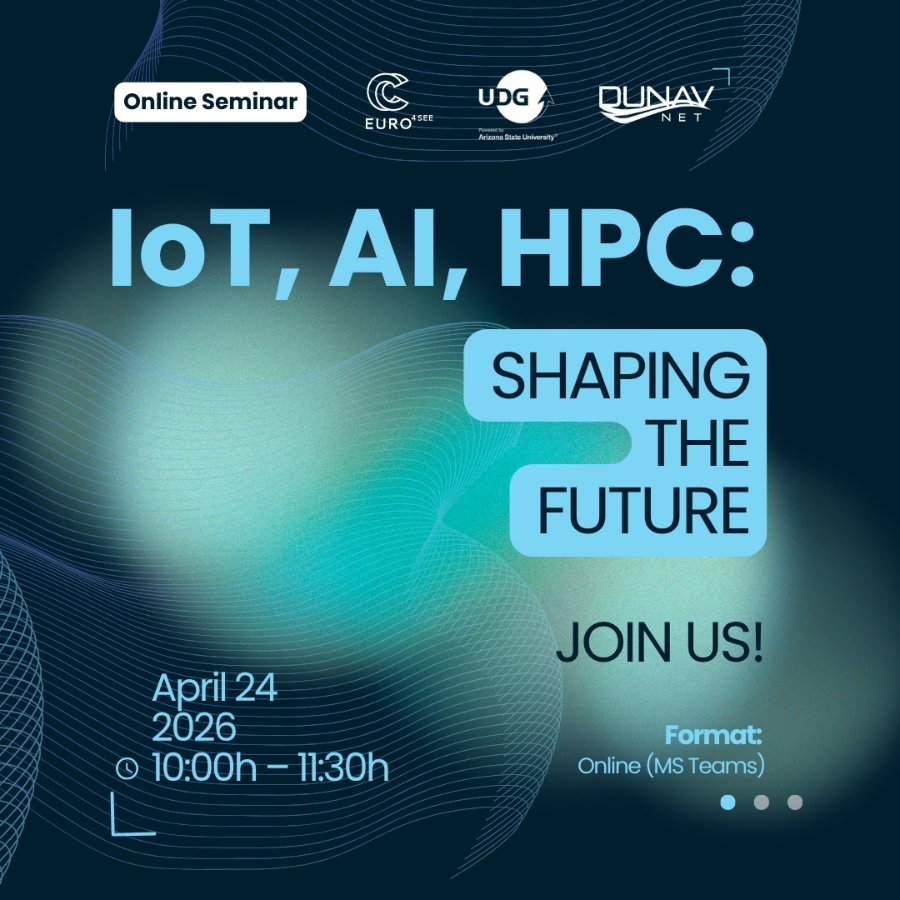
On the occasion of IoT Day 2026, an online seminar titled “IoT, AI, HPC: Shaping the Future” will bring together technologies that are redefining modern digital infrastructure. The event will focus on the practical application of Internet of Things (IoT), Artificial Intelligence (AI) and High-Performance Computing (HPC) in the development of modern digital systems.
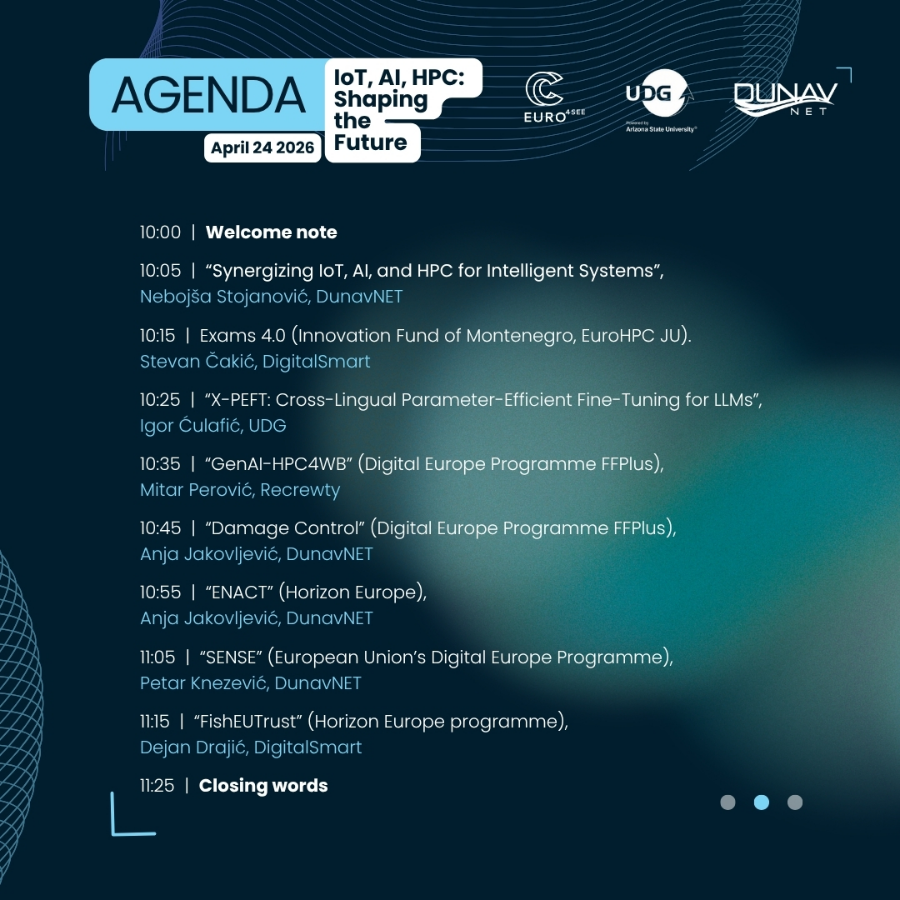
During the seminar, experts from DunavNET, DigitalSmart Montenegro, the University of Donja Gorica, and Recrewty will present the projects and solutions they are currently working on, with a special emphasis on real-world applications of these technologies and their importance for digital transformation.
The speakers include: Nebojša Stojanović, Petar Knežević, Dejan Drajić, Anja Jakovljević, Stevan Čakić, Igor Ćulafić, and Mitar Perović.
📅 April 24, 2026 🕙 10:00–11:30 AM 📍 Online seminar Organized by: EuroCC 2 & EuroCC4SEE, University of Donja Gorica, and DunavNET
The event is open to researchers, engineers, developers, and everyone interested in current trends and practical applications of IoT, AI, and HPC.
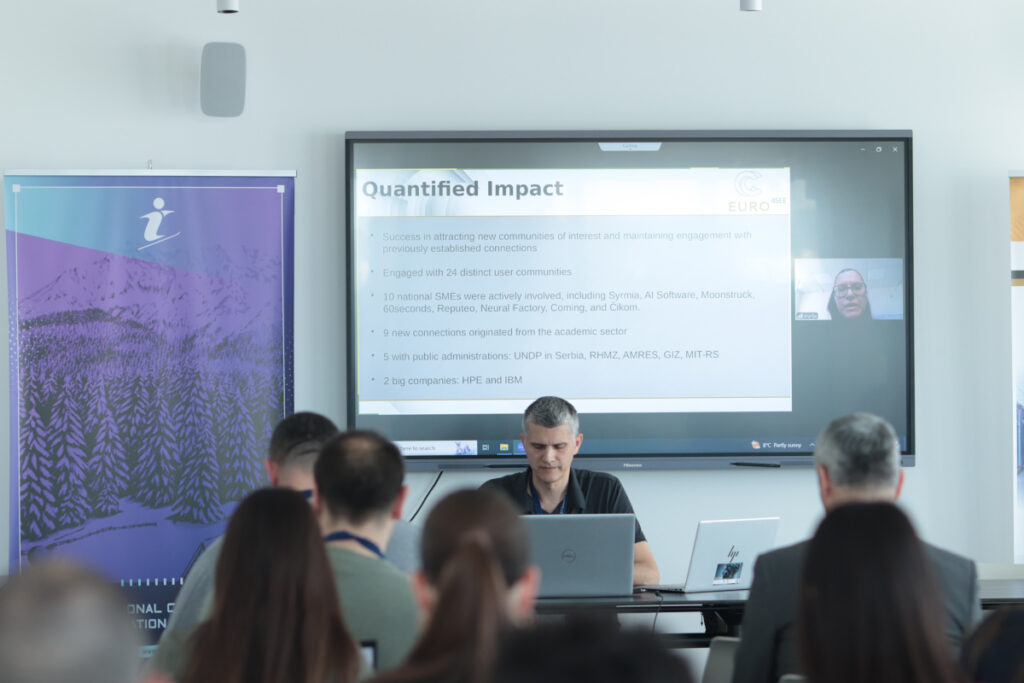
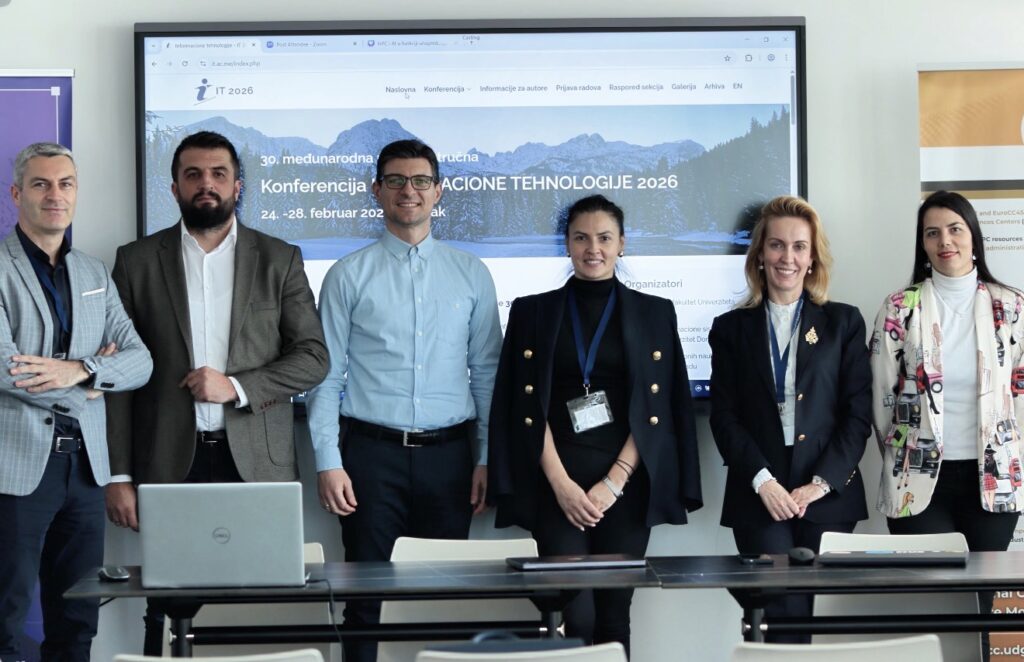
As part of the 30th anniversary of the International Conference on Information Technology – IT 2026, held in Žabljak, a three-day programme of activities dedicated to the application of high-performance computing (HPC) and artificial intelligence (AI) in science, industry, and digital transformation was organized. The event brought together researchers, representatives of National Competence Centres, IT companies, and international partners with the aim of exchanging knowledge, presenting project results, and strengthening collaboration between academia and industry.
EuroCC2 and EuroCC4SEE at the 30th anniversary edition og the IEEE Information Technology Conference – IT Zabljak 2026
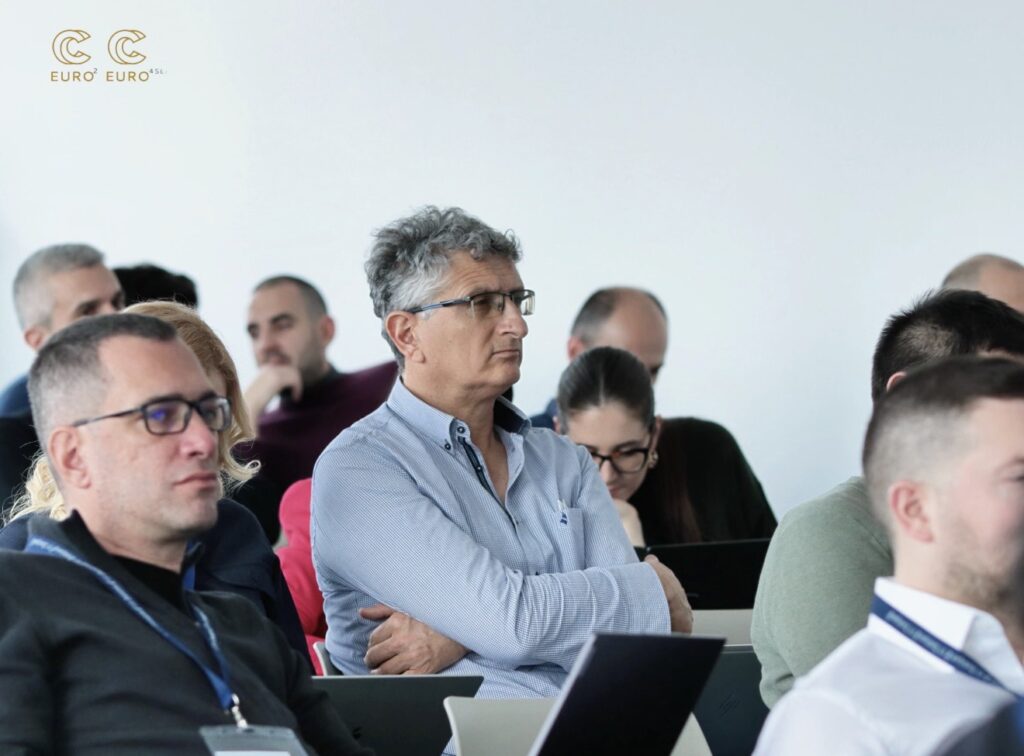
During all three days of the conference, morning sessions were dedicated to presentations of scientific papers, where researchers presented the results of their work in the fields of artificial intelligence, high-performance computing, data science, and digital technologies. These sessions enabled discussions on current scientific trends and the exchange of ideas between authors and conference participants.
Day one – scientific sessions, workshop, and project presentations
The programme of the first day began with a morning block of four parallel sessions, two held in conference halls and two organized in a virtual format. Within these sessions, scientific papers covering contemporary topics in AI, HPC, data analytics, digital transformation, and software engineering were presented, followed by active discussions between authors and participants.
Introduction to NCC Montenegro activities and preparation for the workshop
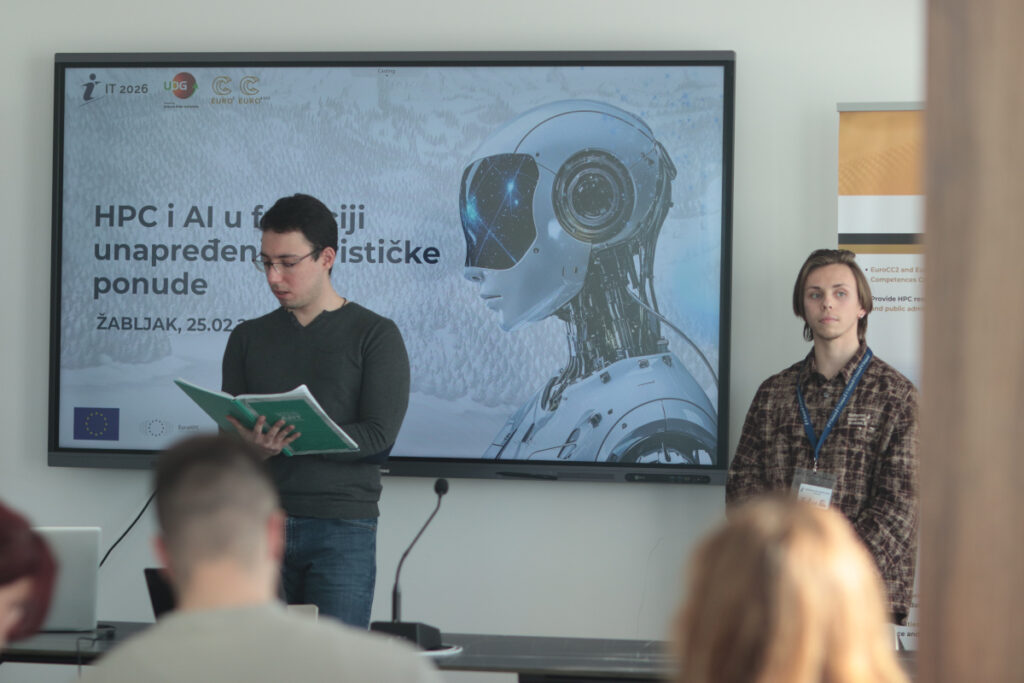
Later in the day, the workshop “Application of HPC and AI to Enhance the Tourism Offer” was held, focusing on the development of proof-of-concept solutions and the practical application of supercomputing and artificial intelligence to enhance the tourism offer.
Particular emphasis was placed on solutions integrating HPC infrastructure, demonstrating how advanced computing resources can support data analysis, personalization of tourism services, and optimization of tourism processes.
Wotkshop on HPC and AI applications aimed at tourism sector
Outside the scientific sessions, Wednesday was also marked by the event “Project trade fair & dissemination of results”, where projects and innovative solutions in the fields of AI and HPC were presented. Solutions such as GetMoved, PAID-T, Wasco AI, Generative AI Intelligent Process Automation Platform, DeepMark, and AI Heal were showcased, further strengthening the connection between the research and business communities and enabling the exchange of experiences between researchers and companies.
Day two – panel on the application of HPC technologies in science and industry
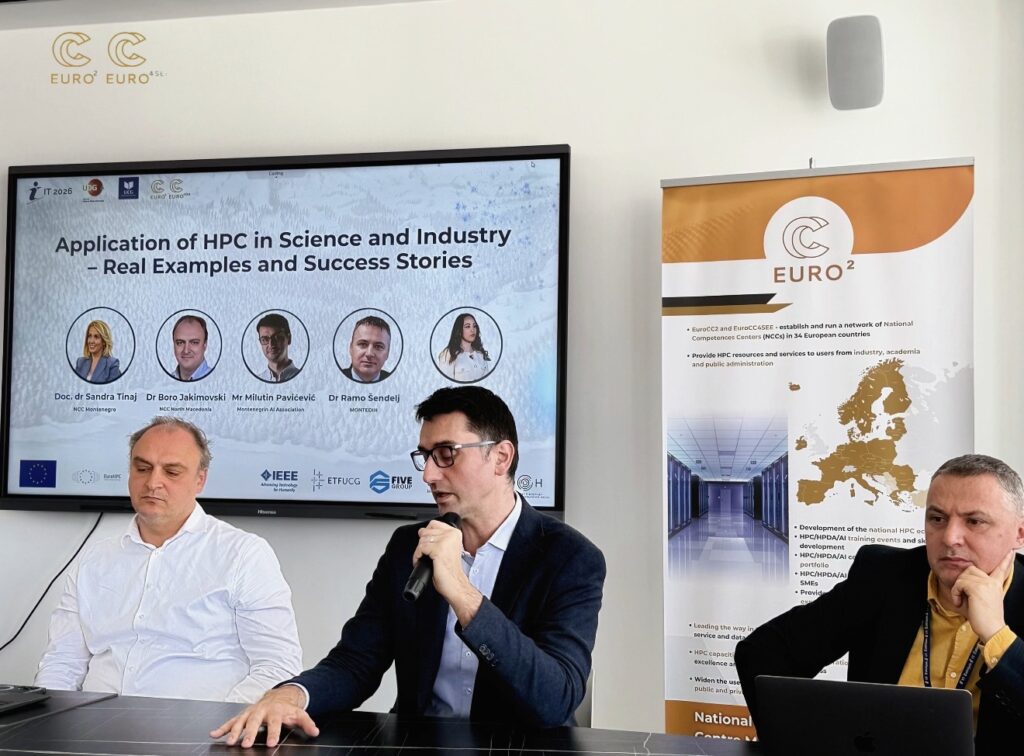
On the second day of the conference, the panel “Application of HPC in Science and Industry – Real Examples and Success Stories” was held and moderated by Sandra Tinaj (NCC Montenegro). The panel was organized in two parts.
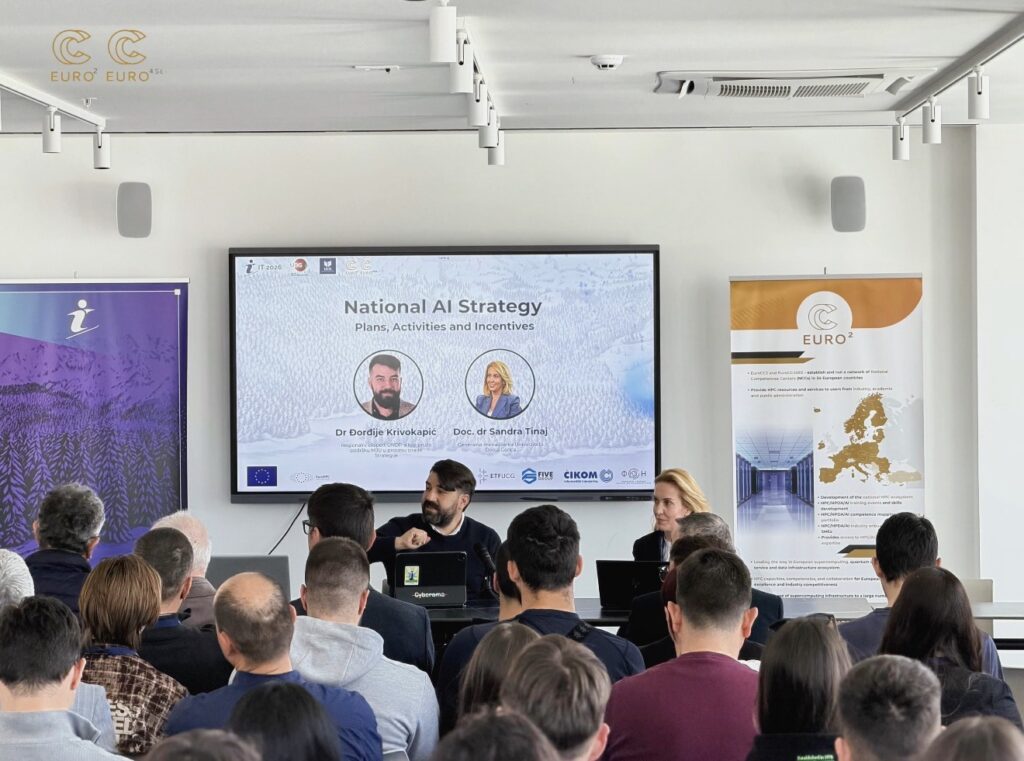
The first part focused on a discussion about the institutional framework and the strategic development of the AI and HPC ecosystem in Montenegro. The discussion involved Đorđe Krivokapić and Sandra Tinaj.
Discussing strategic development of the AI and HPC ecosystem in Montentegro
Đorđe Krivokapić presented the key elements of the National Strategy for Artificial Intelligence, including planned activities, infrastructure development, and support mechanisms for research and innovation. Special emphasis was placed on strengthening the institutional framework that enables the integration of HPC and AI technologies into various sectors of society, as well as creating an environment that fosters cooperation between government institutions, academia, and industry.
Sandra Tinaj presented the activities of the National Competence Centre for HPC in Montenegro (NCC Montenegro) within the EuroCC and EuroCC4SEE projects, including the organization of training activities, support for researchers and companies, and assistance in accessing European supercomputing resources through the EuroHPC initiative.
HPC applications through the work of NCCs and industry in SEE
The second part of the panel focused on presenting concrete examples of HPC applications through the work of National Competence Centres and industry.
Ana Lalović (Verlab) presented the activities of NCC Bosnia and Herzegovina, focusing on the use of HPC technologies in medical and biomedical research, including the analysis of medical data and the development of advanced diagnostic models. Boro Jakimovski presented the activities of NCC North Macedonia, with a particular focus on industrial applications of HPC technologies and cooperation with companies developing solutions based on AI and advanced analytics.
Sandra Tinaj presented the activities of NCC Montenegro through Proof of Concept projects, which enable companies and researchers to test and develop innovative solutions using HPC infrastructure and expert support.
Milutin Pavićević (Montenegrin AI Association) discussed the perspective of industry and the importance of cooperation between academia and companies. He particularly emphasized the competencies needed by young IT engineers in the context of HPC technologies, including knowledge of parallel programming, large-scale data processing, and the development of scalable AI solutions.
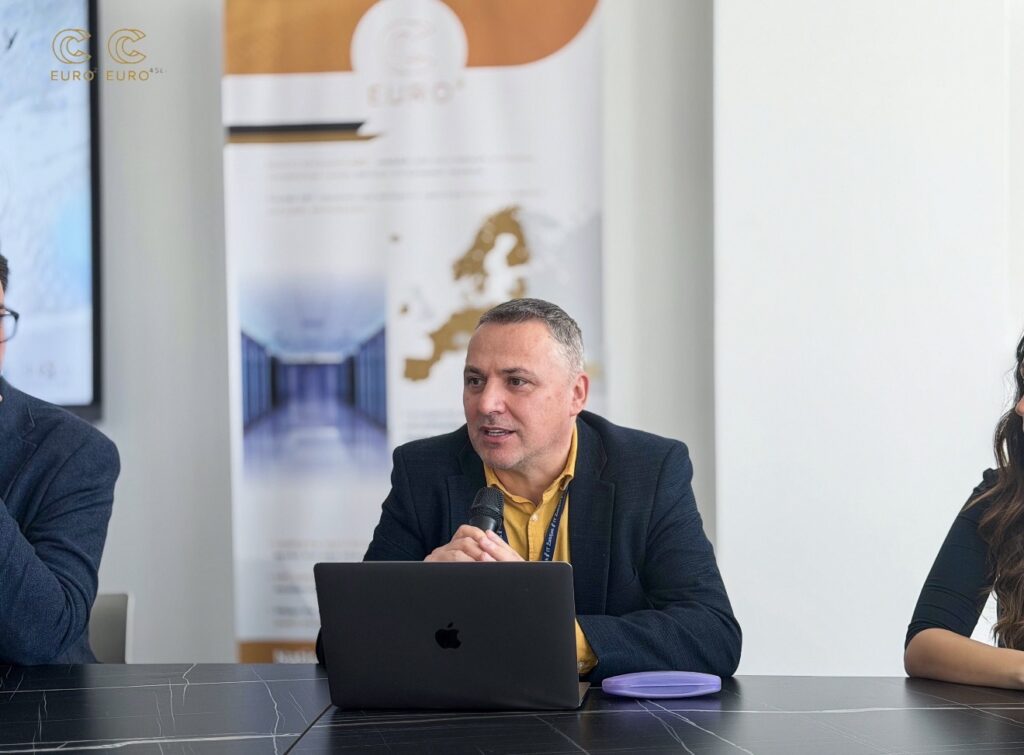
prof Ramo Sendelj from MontEDIH at the panel
Ramo Šendelj (MONTEDIH) also participated in the panel, speaking about the importance of cooperation between the MONTEDIH and EuroCC4SEE projects in supporting the digital transformation of companies and developing an innovation ecosystem based on HPC and AI technologies.
In addition, B2B meetings were held between NCCs, as well as between NCCs, companies, and researchers.
Day three – EuroCC4SEE session and experiences of National Competence Centres
On the third day of the conference, the session “EuroCC4SEE – What Have We Learned and Where Do We Go Next?” was held, dedicated to the results and experiences of National Competence Centres in the field of HPC.
The session was opened by Tomo Popović from NCC Montenegro, who presented the activities implemented within the EuroCC and EuroCC4SEE projects, including training activities, cooperation with companies, and support for accessing European supercomputers. NCC Montenegro has organized more than 30 training events attended by around 500 participants, collaborated with more than 15 companies, and provided support for more than 10 applications to the EuroHPC initiative, including practical work on European supercomputing clusters.
During the session, the activities of National Competence Centres from the region were also presented.
Session dedicated to EuroCC4SEE Lessons Learned with participation of industry representatives
Marija Mitrović Dankulov presented the activities of NCC Serbia, including the development of HPC infrastructure such as the Paradox cluster, the AI cluster, and the national data center in Kragujevac, which will support the EuroCC3 and AI Factory satellite projects. She also presented the results of the NCC’s work, successful HPC use cases, and experiences in cooperation with academia and industry.
Ozlem Sari from NCC Turkey presented the results achieved over the past three years, including numerous training activities, info days, proof-of-concept projects, and success stories developed in cooperation with academia and industry, as well as the HPC infrastructure and regional initiatives that contributed to spreading knowledge about HPC technologies.
Sarah Spahić presented the activities of NCC Bosnia and Herzegovina and the Verlab Institute, including training and workshops for academia and the public sector, consultations and support for research projects, and cooperation with companies such as Arti Analytics, Plastoflex, and Bosnalijek.
Gjorgji Madjarov presented the activities of NCC North Macedonia and an overview of activities implemented through the EuroCC and EuroCC4SEE projects, with a particular focus on cooperation with IT companies and organizations with domain expertise relevant for the development of AI and HPC solutions.
Several representatives presented their solutions and experiences with HPC and NCC support
In the second part of the session, projects of Montenegrin companies using HPC and AI technologies were presented. Companies showcased innovative solutions such as the AI doctor developed by OneAI, the Wasco AI assistant by Five G, the DeepMark platform for audio watermarking, as well as solutions from ITAS, Trid Tech, Uhura, and Paid MNE that use HPC infrastructure for simulations, AI model development, and optimization of complex processes.
At the end of the session, Ramo Šendelj emphasized the importance of cooperation between the EuroCC and MONTEDIH projects, highlighting opportunities for joint activities and support for Montenegrin companies in various areas of digital transformation.
Strengthening the HPC ecosystem through collaboration between science and industry
The three-day programme within the IT Žabljak 2026 conference highlighted the importance of collaboration between the research community, industry, and European initiatives in the development of HPC and AI technologies. Through scientific sessions, workshops, panel discussions, and project presentations, participants had the opportunity to exchange experiences, present innovative solutions, and identify new opportunities for cooperation.
There was over 20 representatives from comapnies that utilized EuroHPC HPC access
Activities implemented within the EuroCC4SEE project have further contributed to strengthening the regional HPC ecosystem and promoting the application of supercomputing and artificial intelligence in science, industry, and the public sector.
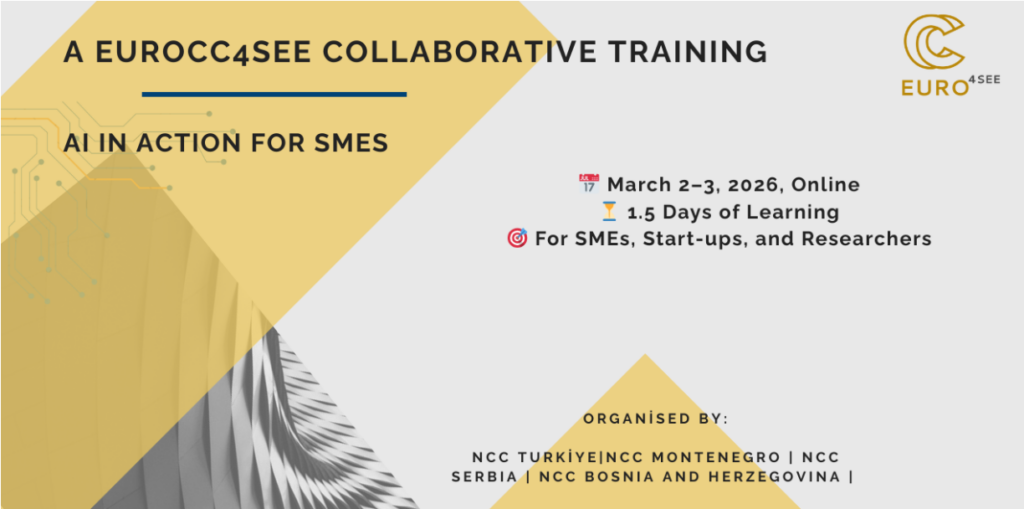
We are pleased to announce the upcoming “AI in Action for SMEs” training, organized within the EuroCC4SEE initiative by NCC Montenegro, NCC Serbia, NCC Bosnia and Herzegovina, and NCC Türkiye. This training will take place March 2-3, 2026.
Click on image for more info and registration
The 1.5-day online training is designed for SMEs, start-ups, technical leads, and researchers interested in practical adoption of Artificial Intelligence supported by High-Performance Computing (HPC).
The programme focuses on applied AI methods with live demonstrations and real-world use cases.
Day 1 covers Time Series Forecasting with AI & Machine Learning and Explainable AI (XAI), including HPC-enabled demonstrations and practical insights for business and healthcare applications. NCC Montenegro will actively contribute to the time-series and HPC session, presenting practical approaches relevant for SMEs.
Day 2 is dedicated to Applied Data Anonymization Techniques, addressing data protection challenges and practical anonymization approaches essential for responsible AI deployment
Invitation to Participants from Montenegro
As a co-organizer, NCC Montenegro will also present during the programme. We invite companies, researchers, and innovators from Montenegro to register and participate in this regional training.
This is an opportunity to:
Learn from hands-on AI & HPC demonstrations
Connect with regional NCC experts
Strengthen AI adoption capacity within your organization
Participation is free, and registration is open via the event page.
We look forward to strong participation from Montenegro.