

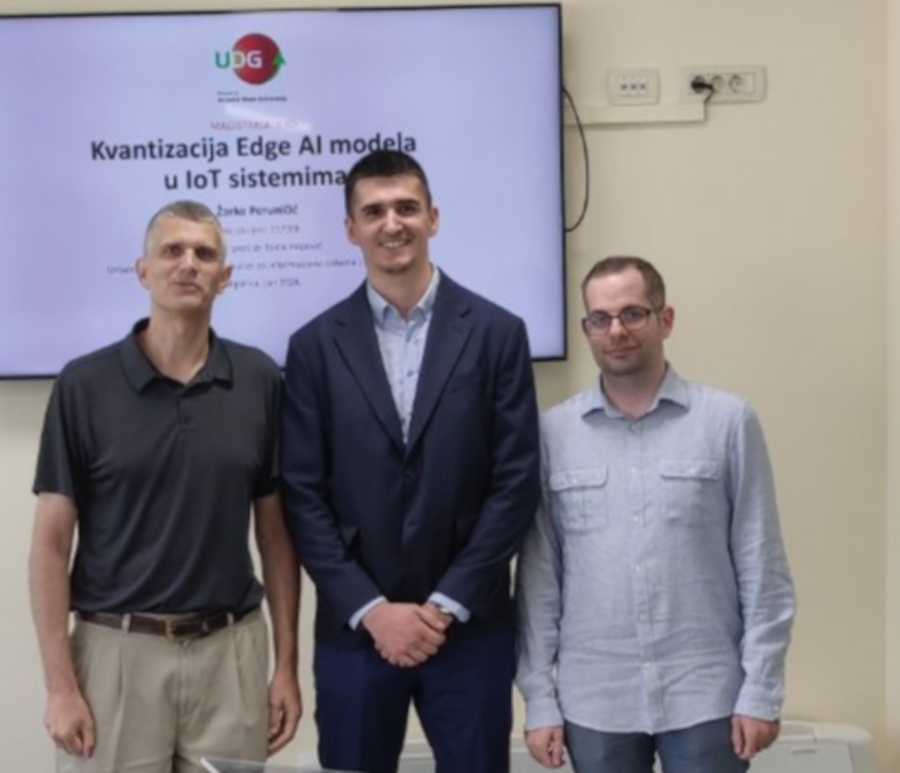
On June 29, 2026, an MSc thesis entitled “Quantization of Edge AI Models in IoT Systems” by Mr. Zarko Perunicic was successfully defended within the Artificial Intelligence Master’s programme at the University of Donja Gorica. Through its participation in the programme, mentoring activities, and support for practical research in AI, HPC, and IoT, NCC Montenegro contributes to developing advanced competencies in the efficient deployment of artificial intelligence models on resource-constrained devices. The thesis addresses an important Edge AI challenge by evaluating model quantization strategies for computer vision applications in IoT environments.
ABSTRACT – Edge AI systems in Internet of Things (IoT) environments require artificial intelligence models that are sufficiently small, fast, and reliable to operate on resource-constrained devices. This thesis examines how quantization, as a model optimization method, affects the performance of a computer vision model in the task of grape leaf disease classification. MobileNetV2 was used as the reference model, and its optimized variants were then prepared in the TensorFlow Lite environment using FP16 and INT8 quantization modes, including dynamic INT8 quantization, full INT8 quantization based on a representative dataset, and an INT8 variant obtained through quantization-aware training (QAT) on an additional, more challenging dataset. The experiments were conducted on cleaned and restructured subsets, following quality control of publicly available datasets and the removal of redundant and visually equivalent samples. Under controlled conditions, latency, execution stability, peak RAM usage, model size, and accuracy were analyzed.
On the more controlled dataset, full post-training INT8 quantization achieved the most favorable balance among efficiency, stability, and model size while preserving accuracy, whereas dynamic INT8 quantization, despite reducing model size, can measurably slow down model execution. On the more challenging field dataset, this pattern changed partially: although full INT8 quantization remained the fastest variant, the INT8 model obtained through QAT provided the most favorable overall balance between accuracy, model size, and latency. The results show that the effect of quantization depends not only on numerical precision, but also on data characteristics, the calibration procedure, and the compatibility of the model with the execution environment. It is therefore concluded that the choice of quantization strategy should be empirically validated for a specific application scenario rather than assumed in advance.