Uhura Solutions Awarded Extension and Additional HPC Resources on Leonardo Supercomputer

The Uhura Solutions project “Generative AI Intelligent Process Automation Platform” has received a positive evaluation and has been granted an extension, including 4,500 node hours on the Leonardo BOOSTER HPC system for a 12-month period. 

The additional HPC resources will support Uhura Solutions’ ongoing research and development in advanced Generative AI and Large Language Models (LLMs) tailored for the financial sector. Leveraging Leonardo’s state-of-the-art computing capabilities, the project will scale experiments from smaller open-source models to larger LLMs, enabling deeper research into optimization techniques such as parameter-efficient fine-tuning (PEFT), quantization, pruning, and model alignment.
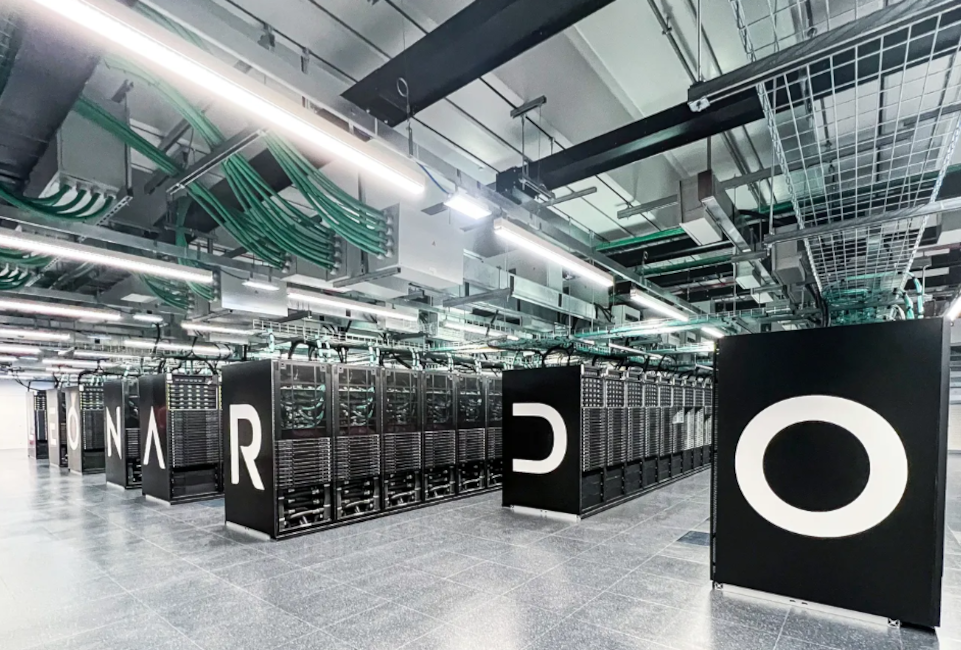
Leonardo HPC

The Generative AI Intelligent Process Automation Platform integrates fine-tuned LLMs, low-code development, and process automation workflows to significantly improve operational efficiency, reduce costs, and enhance customer experience in financial services. A key differentiator of the platform is its focus on industry-specific language and context, supported by carefully curated private datasets with strong attention to data quality, privacy, and compliance.

This extension and access to Leonardo BOOSTER represent a major milestone for the project. The additional computational power allows company to push the boundaries of financial-domain AI and accelerate the delivery of scalable, production-ready solutions for the European market
Multi-GPU AI Train the Trainer Workshop

The Train the Trainer course was organized from 30 January to 5 February as a series of full-day, intensive lectures, delivered alongside the standard AI and multi-GPU computing courses. This workshop complemented the strong technical focus of the regular course with a dedicated educational track. While the regular course concentrated on hands-on skills for building, scaling, and optimizing AI workloads across multiple GPUs, the Train-the-Trainer track was specifically designed to equip future instructors with the knowledge and pedagogical tools needed to teach these topics effectively. With only a few HPC and AI centres across Europe offering such specialized education, this programme helps expand the network of trainers and institutions capable of delivering high-quality AI and multi-GPU courses at both national and European levels.  Researchers from the National Competence Center (NCC) Montenegro participated in this course, further strengthening national capacities in advanced AI and multi-GPU training.

AI Train the Trainer Workshop

During the training event, participants developed a deep understanding of modern multi-GPU and distributed AI technologies, while also learning effective strategies for teaching these complex concepts. Guided by expert instructors, attendees explored state-of-the-art tools, frameworks, and best practices for scaling AI workloads, combined with pedagogical approaches, teaching materials, and hands-on experience tailored to support the delivery of their own courses. The lectures covered a broad spectrum of topics, including GPU architectures and access to HPC infrastructure; fundamentals of deep learning and the transition from CPU- to GPU-based workloads; distributed training with PyTorch (Distributed Data Parallel, model parallelism, PyTorch Lightning); large language models, fine-tuning techniques, and frameworks such as Hugging Face Accelerate and DeepSpeed; as well as computer vision, MLOps, Ray, Retrieval Augmented Generation (RAG), and hyperparameter tuning.

The training event was organised by NCC Poland, NCC Netherlands, NCC Hungary, NCC Belgium, NCC Italy, NCC Finland, NCC Sweden, all National Competence Centres for High-Performance Computing, CASTIEL2 and EuroCC2/EuroCC4SEE.

EuroHPC JU Call for Proposals: Enabling AI-Driven Scientific Discovery Across Europe

The EuroHPC Joint Undertaking (EuroHPC JU) has opened a call for proposals supporting AI-driven scientific research and collaborative EU projects that require large-scale high-performance computing (HPC) resources.

This access mode is designed for researchers, academic institutions, public sector bodies, and industry partners involved in EU-funded or nationally funded R&I projects, where Artificial Intelligence is a core enabler of scientific discovery—including machine learning, foundation models, generative AI, and large language models applied to real scientific challenges.

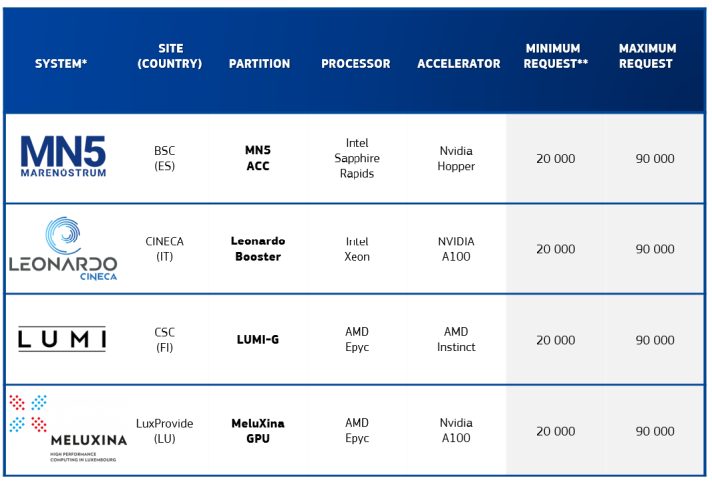
Available supercomputers to apply for (the resources shown in node hours)

What does the call offer?

Selected projects can receive access to Europe’s leading supercomputers (such as GPU-accelerated EuroHPC systems) for training, testing, and scaling advanced AI models. The call runs on a continuous basis with multiple cut-off dates, allowing flexible submission throughout the year.

Why it matters

Many AI-for-science use cases exceed the capabilities of local infrastructure. This call lowers the barrier to:

  • large-scale AI model training,
  • data-intensive scientific workflows,
  • cross-border collaboration using shared European HPC resources.

Support for Montenegrin applicants

NCC Montenegro actively supports Montenegrin researchers, institutions, and companies in preparing and submitting applications to this call.

NCC Montenegro can help with:

  • assessing project eligibility and fit with the call,
  • estimating HPC and GPU resource needs,
  • structuring proposals and impact sections,
  • connecting applicants with relevant EuroHPC systems and expertise.

If you are based in Montenegro and considering applying, we strongly encourage you to contact us early in the preparation process. Learn more at [link]

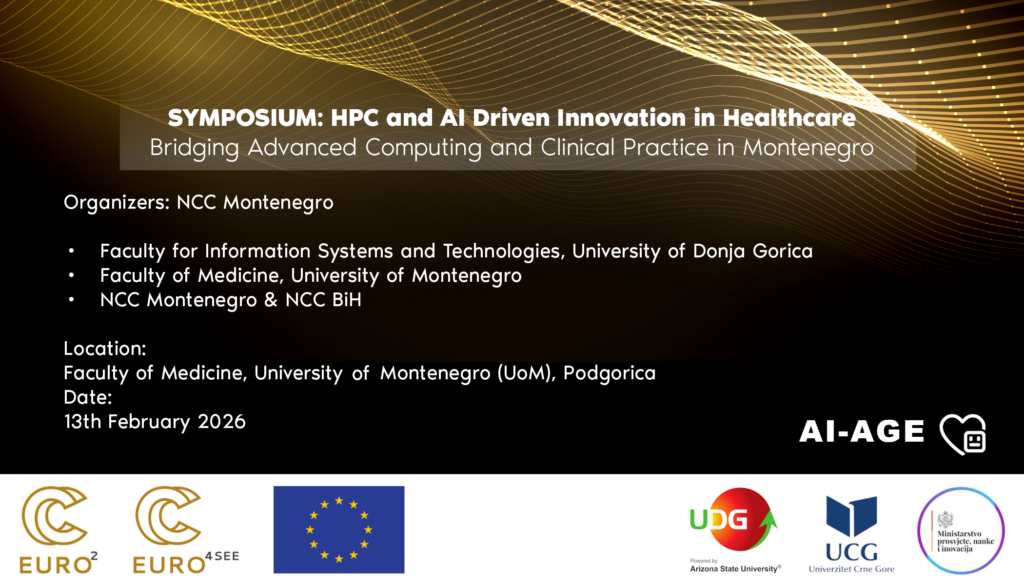
HPC & AI in Healthcare: From Research to Clinical Practice in Montenegro and SEE

High-Performance Computing (HPC) and Artificial Intelligence (AI) are increasingly moving beyond research laboratories into real clinical environments. Across Montenegro and the SEE region, promising AI solutions have been developed for medical image analysis, biomarker detection, and predictive diagnostics. The critical challenge today is ensuring their structured transition from research prototypes to validated, deployable tools within healthcare systems.

Please contact us for attendance, limited number of seats

This event addresses precisely that transition. It focuses on how HPC infrastructure, interdisciplinary collaboration, and coordinated ecosystem support can accelerate the integration of AI into everyday clinical practice. Particular attention will be given to available computational capacities, real-life use cases, and pathways toward sustainable deployment.

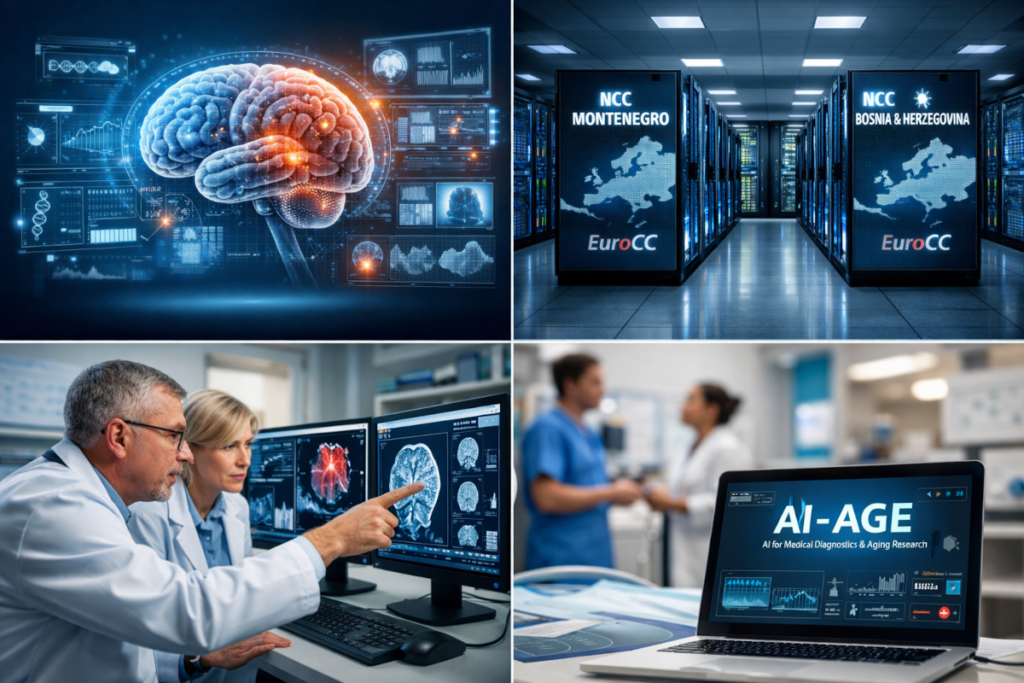
The event is organized as a joint initiative between NCC Montenegro and NCC Bosnia and Herzegovina, within the broader framework of EuroCC 2 and EuroCC4SEE. It also represents a form of cross-project pollination with the AI-AGE project, demonstrating how research-driven innovation can evolve into applied healthcare solutions through regional cooperation.

Collaboration between NCC Monteengro and NCC Bosnia and Herzegovina

Researchers, clinicians, innovators, and industry partners are invited to join the discussion, exchange expertise, and contribute to shaping the next steps for HPC- and AI-driven healthcare across Southeast Europe. The event is scheduled for Friday, 13 Feb 2026. Please contact us for further details.

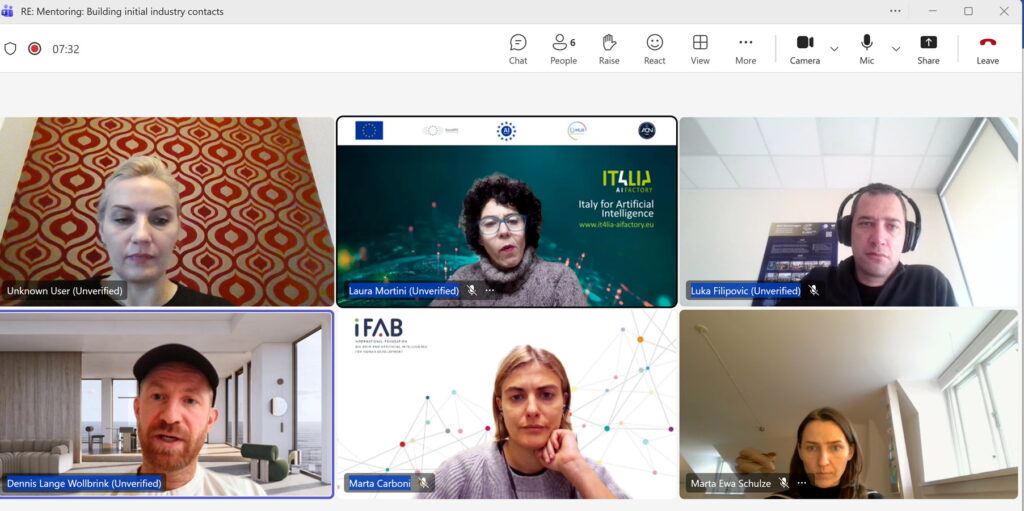
NCCs from Italy, Denmark and Montenegro Share Experiences on Strengthening Industry Engagement in HPC, HPDA and AI

NCCs Montenegro, Italy, and Denmark held an online mentoring and twinning session (30.01.2026) focused on sharing valuable experiences and good practices in building initial industry contacts in the fields of HPC, HPDA, and AI. The discussion centred on practical approaches and lessons learned in engaging companies—particularly SMEs—and on transforming NCC technical expertise and resources into attractive, demand-driven service offerings.

EuroCC mentoring and twinning session

The NCCs shared concrete examples of mapping local ecosystems and working with key national stakeholders, strategic partners and industry intermediaries—including chambers of commerce, industry clusters, digital agencies, science and technology parks, start-up incubators/ accelerators, etc., and European Digital Innovation Hubs (EDIHs)—to reach targeted companies and industry leaders. Collaboration models, including joint workshops, training activities, and project initiatives, were highlighted as effective means of promoting access to HPC and AI resources, expertise, and funding support.

The session also highlighted the importance of continuous visibility and coordinated outreach through channels such as LinkedIn, newsletters, and active participation in targeted conferences and networking events, as key enablers for promoting NCC services and strengthening industry uptake.

30th International Scientific and Professional Conference IEEE IT2026

We are pleased to invite you to the 30th International Scientific and Professional Conference INFORMATION TECHNOLOGIES 2026.

📌 Important notice for authors:
Upon authors’ request, the paper submission deadline has been extended to January 25, 2026.

🔹 Accepted papers may be presented in oral or poster sessions
🔹 Online presentations via ZOOM are also available

We invite the academic community, industry professionals, and the wider public to follow the Conference activities online, via videoconferencing links available on the official Conference website.

Welcome!

Click to open IT 2026 conference website

FFplus Open Call: Innovation Studies – Generative AI on European Supercomputers

The FFplus Innovation Studies Open Call is now open, offering European SMEs and start-ups a focused opportunity to develop and validate generative AI (GenAI) solutions using large-scale European supercomputing resources. The call opens on 3 February 2026 and targets early-stage, high-impact projects with a clear proof-of-concept orientation.

This image has an empty alt attribute; its file name is eurohpc.png
Click on image to open the link for application (image source: FFplus)

Coordinated by HLRS (High-Performance Computing Center Stuttgart), FFplus supports innovation at the intersection of AI and HPC, enabling companies to overcome computational barriers and scale beyond conventional cloud or on-premise infrastructures.

Key facts

  • Funding: up to €300,000 per project
  • Deadline: 25 February 2026 (or earlier if 250 proposals are submitted)
  • Eligible applicants: European SMEs and start-ups

Scope and impact

The call supports feasibility studies and PoCs for GenAI use cases such as:

  • Training or fine-tuning large language and multimodal models
  • Generative design, simulation, and optimization workflows
  • AI-driven data synthesis and advanced analytics across multiple sectors

Selected projects gain access to EuroHPC-class supercomputers, expert technical support, and increased visibility within the European innovation ecosystem. National Competence Centres within the EuroCC play a key role in supporting applicants.

Support from NCC Montenegro

The NCC Montenegro is available to support SMEs and start-ups from Montenegro during the proposal preparation phase, including:

  • Clarification of call scope and eligibility
  • Guidance on aligning use cases with HPC and GenAI requirements
  • Initial technical advice on suitable architectures and workloads

Apply here: https://www.ffplus-project.eu/en/open-call/innovation-studies/

Given the capped number of proposals, early engagement and submission are strongly encouraged.