IEEE IT2023: Vision-based Vehicle Speed Estimation Using the YOLO Detector and RNN

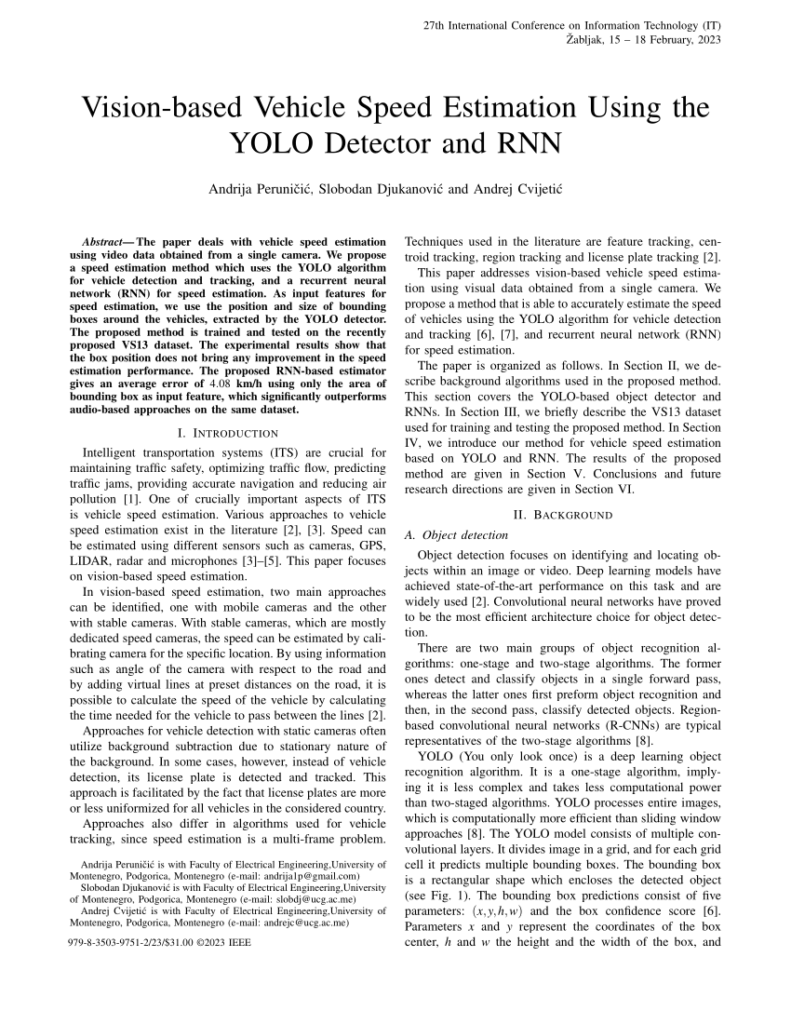
Researchers from NCC Montenegro presented a paper at the 27th IEEE Conference on Information Technology IT2023.  The paper is titled “Vision-based Vehicle Speed Estimation Using the YOLO Detector and RNN” and authored by Andrija Peruničić, Slobodan Djukanović and  Andrej Cvijetić

ABSTRACT : The paper deals with vehicle speed estimation using video data obtained from a single camera. We propose a speed estimation method which uses the YOLO algorithm for vehicle detection and tracking, and a recurrent neural network (RNN) for speed estimation. As input features for speed estimation, we use the position and size of bounding boxes around the vehicles, extracted by the YOLO detector. The proposed method is trained and tested on the recently proposed VS13 dataset. The experimental results show that the box position does not bring any improvement in the speed estimation performance. The proposed RNN-based estimator gives an average error of 4.08 km/h using only the area of bounding box as input feature, which significantly outperforms audio-based approaches on the same dataset.
Link : https://ieeexplore.ieee.org/document/10078639

IEEE IT2023: Deep learning-based vehicle speed estimation using the YOLO detector and 1D-CNN

Researchers from NCC Montenegro presented a paper at the 27th IEEE Conference on Information Technology IT2023. The paper is titled “Deep learning-based vehicle speed estimation using the YOLO detector and 1D-CNN” and authored by Andrej Cvijetić, Slobodan Djukanović and Andrija Peruničić

ABSTRACT : This paper addresses vehicle speed estimation using visual data obtained from a single video camera. The proposed method accurately predicts the speed of a vehicle, using the YOLO algorithm for vehicle detection and tracking, and a one-dimensional convolutional neural network (1D-CNN) for speed estimation. The YOLO algorithm outputs bounding boxes around detected objects in an image, which is, in our case, the vehicle whose speed is to be predicted. As input to our 1D-CNN speed estimation model, we introduce a novel feature based on the change of area of the bounding box around the vehicle. The feature, referred to as the changing bounding box area (CBBA), is obtained by calculating the area of the bounding box, frame-to-frame, as the vehicle approaches the camera. The shape of the CBBA curve remains closely the same for all vehicles, with differences conditioned by the value of the observed vehicle’s speed. The proposed method is trained and tested on the VS13 dataset. Experiments show that it is able to accurately predict the vehicle’s speed with an average error of 2.76 km/h, with the best performing vehicle having the average error of just 1.31 km/h. The proposed method exhibits the robustness as a key advantage, eliminating the need for prior knowledge of real-world dimensions such as the vehicle size, road width, camera distance and angle in relation to the road etc.

Link : https://ieeexplore.ieee.org/document/10078518

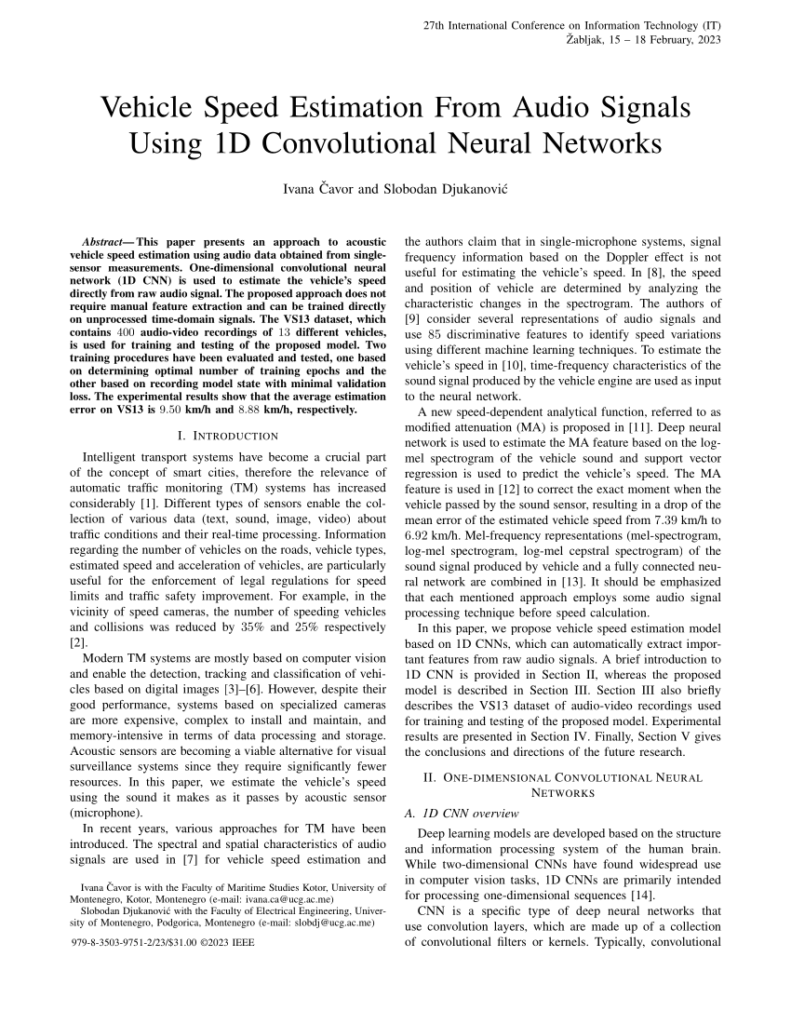
IEEE IT2023: Vehicle Speed Estimation From Audio Signals Using 1D Convolutional Neural Networks

Researchers from NCC Montenegro presented a paper at the 27th IEEE Conference on Information Technology IT2023.

The paper is titled “Vehicle Speed Estimation From Audio Signals Using 1D Convolutional Neural Networks” and authored by Ivana Čavor and Slobodan Djukanović.

ABSTRACT : This paper presents an approach to acoustic vehicle speed estimation using audio data obtained from single-sensor measurements. One-dimensional convolutional neural network (1D CNN) is used to estimate the vehicle’s speed directly from raw audio signal. The proposed approach does not require manual feature extraction and can be trained directly on unprocessed time-domain signals. The VS13 dataset, which contains 400 audio-video recordings of 13 different vehicles, is used for training and testing of the proposed model. Two training procedures have been evaluated and tested, one based on determining optimal number of training epochs and the other based on recording model state with minimal validation loss. The experimental results show that the average estimation error on VS13 is 9.50 km/h and 8.88 km/h, respectively.

Link : https://ieeexplore.ieee.org/document/10078724

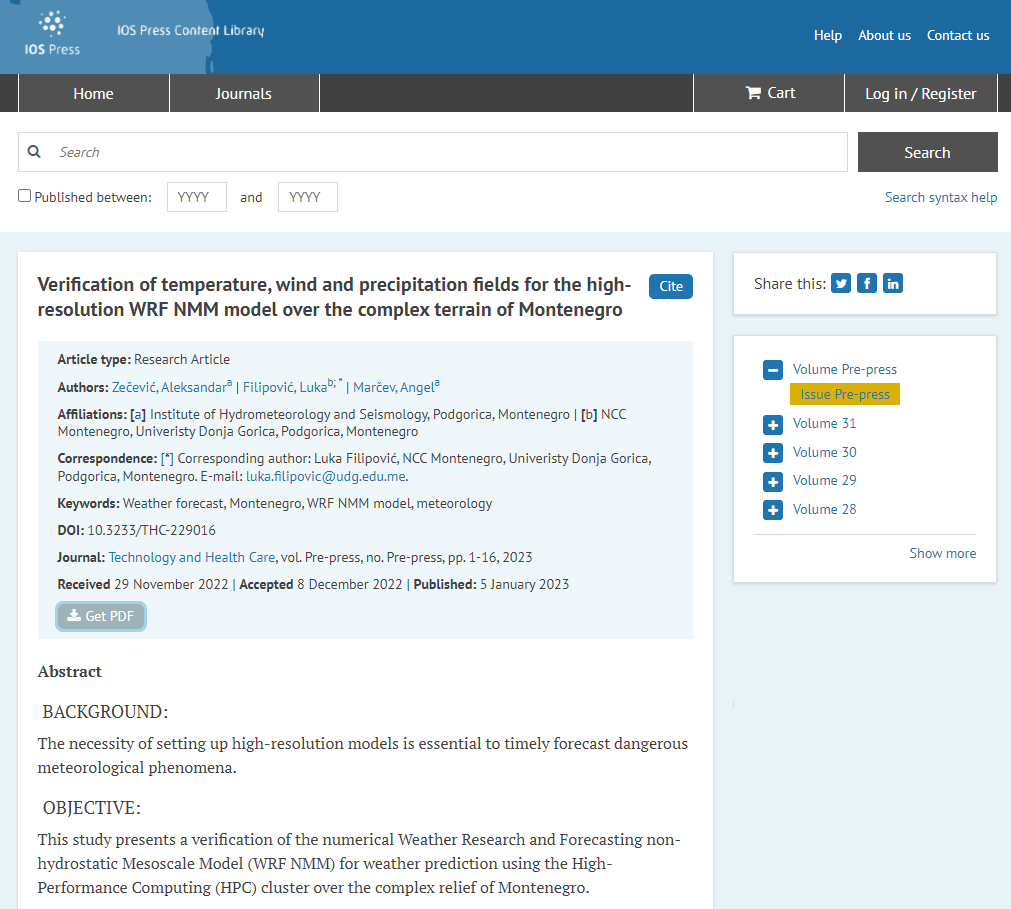
Journal Technology and Health Care: Verification of temperature, wind and precipitation fields for the high-resolution WRF NMM model over the complex terrain of Montenegro

Researchers from NCC Montenegro presented a paper at the “Special Issue for magazine Technology and health care: official journal of the European Society for Engineering and Medicine”.  The paper titled “Verification of temperature, wind and precipitation fields for the high-resolution WRF NMM model over the complex terrain of Montenegro” is written by Zečević Aleksandar, Filipović Luka and Marčev Angel.

ABSTRACT :

BACKGROUND: The necessity of setting up high-resolution models is essential to timely forecast dangerous meteorological phenomena.

OBJECTIVE: This study presents a verification of the numerical Weather Research and Forecasting non-hydrostatic Mesoscale Model (WRF NMM) for weather prediction using the High-Performance Computing (HPC) cluster over the complex relief of Montenegro.

METHODS: Verification was performed comparing WRF NMM predicted values and measured values for temperature, wind and precipitation for six Montenegrin weather stations in a five-year period using statistical parameters. The difficult task of adjusting the model over the complex Montenegrin terrain is caused by a rapid altitude change in in the coastal area, numerous karst fields, basins, river valleys and canyons, large areas of artificial lakes on a relatively small terrain.

RESULTS: Based on the obtained verification results, the results of the model vary during time of day, the season of the year, the altitude of the station for which the model results were verified, as well as the surrounding relief for them. The results show the best performance in the central region and show deviations for some metrological measures in some periods of the year.

CONCLUSION: This study can give recommendations on how to adapt a numerical model to a real situation in order to produce better weather forecast for the public.

Link : https://content.iospress.com/articles/technology-and-health-care/thc229016

A scientific paper at IEEE ACIT 2022 conference

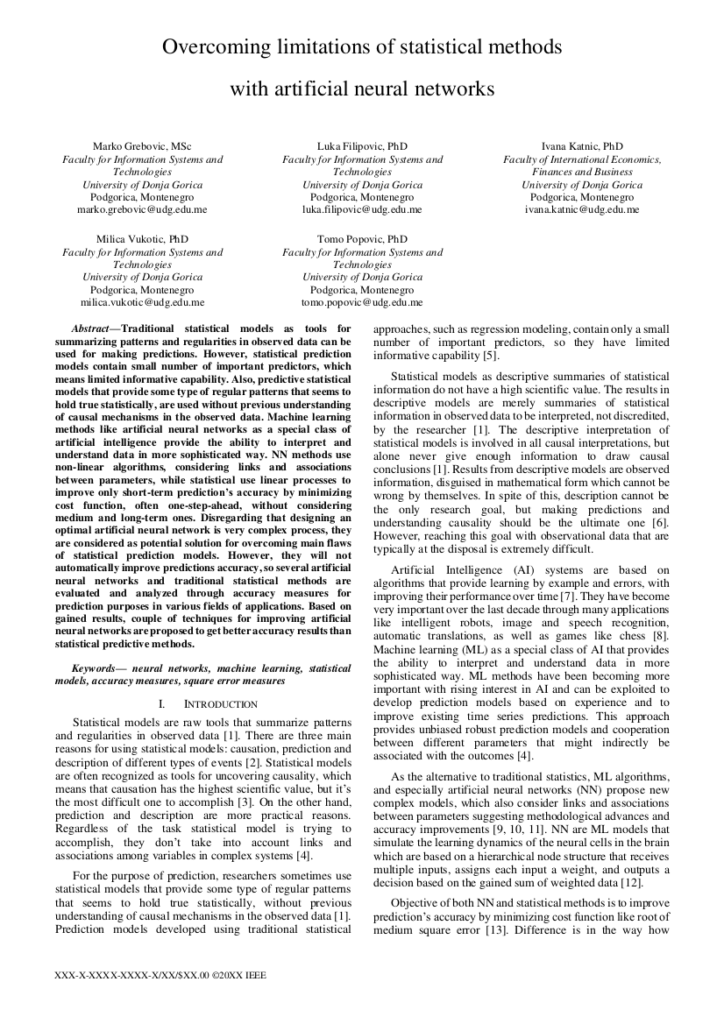
Researchers from UDG and NCC Montenegro presented a scientific paper at the 2022 International Arab Conference on Information Technology (ACIT). The conference took place at the Al Ain University – Abu Dhabi Campus on November 22-24, 2022. The paper “Overcoming Limitations of Statistical Methods with Artificial Neural Networks” was authored by M. Grebovic, L. Filipovic, I. Katnic, M. Vukotic, and T. Popovic. More information about the conference is available here. The paper is available at IEEE Xplore at the following link.

ABSTRACT – Traditional statistical models as tools for summarizing patterns and regularities in observed data can be used for making predictions. However, statistical prediction models contain small number of important predictors, which means limited informative capability. Also, predictive statistical models that provide some type of pseudo-correct regular statistical patterns, are used without previous understanding of the used data causality. Machine Learning (ML) algorithms as area in Artificial Intelligence (AI) provide the ability to interpret and understand data in more sophisticated way. Artificial Neural Networks as kind of ML methods use non-linear algorithms, considering links and associations between parameters, while statistical use one-step-ahead linear processes to improve only short-term prediction’s accuracy by minimizing cost function. Disregarding that designing an optimal artificial neural network is very complex process, they are considered as potential solution for overcoming main flaws of statistical prediction models. However, they will not automatically improve predictions accuracy, so several artificial neural networks and traditional statistical methods are evaluated and analyzed through accuracy measures for prediction purposes in various fields of applications. Based on gained results, couple of techniques for improving artificial neural networks are proposed to get better accuracy results than statistical predictive methods.

Click on image to open link to IEEE Xplore

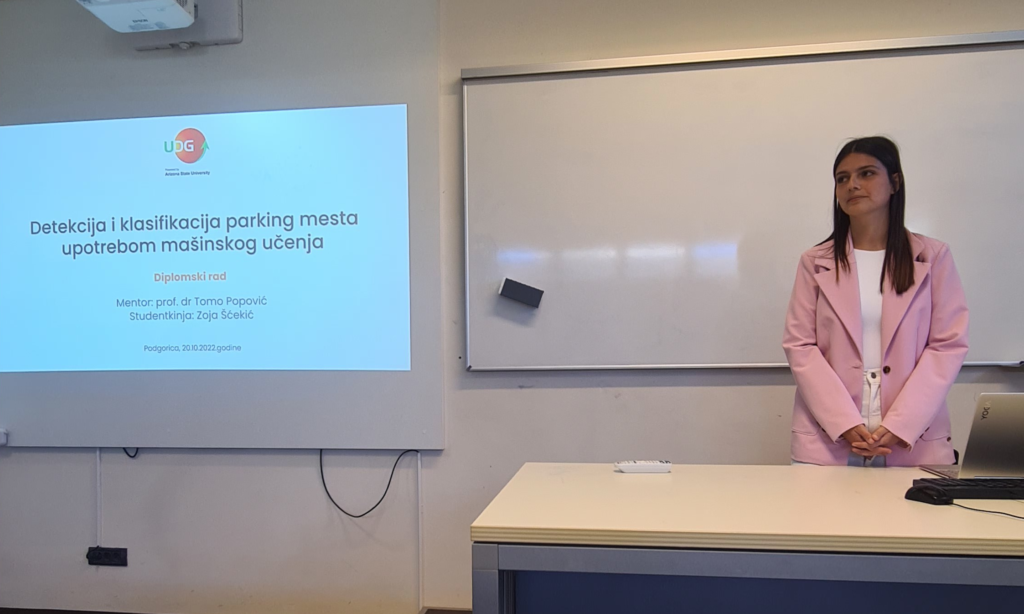
BSc Thesis: AI/ML Computer Vision for Smart Parking

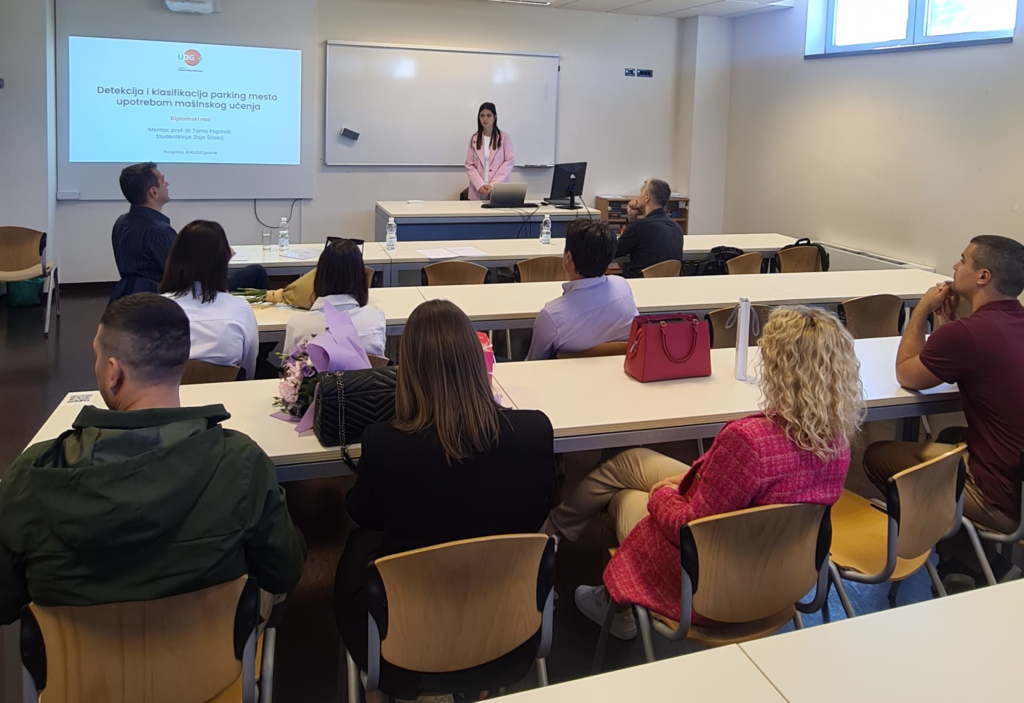
Ms Zoja Scekic, a student of the Faculty of Applied Sciences, defended her BSc Thesis in Electrical Engineering and Computer Science. The topic of the thesis work was the use of machine learning to detect and classify the parking spaces by processing images from camera sensors. Such a solution could find application in Smart city solutions. The work focused on the creation of a prediction model as well as validation with images collected at the UDG parking. She has done her thesis work under the supervision of prof. Tomo Popovic, PhD, and mr Stevan Cakic, MSc.

BSc Thesis – AI/ML Computer Vision for Smart Parking

ABSTRACT – Smart city is one area with the growing use of Internet of Things and Artificial Intelligence. The concept of smart cities relies on making quality of life better, and solving important problems, such as global warming, public health, energy and resources. Smart parking management is one of the smart city use cases. This paper describes the use of deep learning algorithms to process images of parking lots and determine their current occupancy. The development of prediction models was done using PKLot dataset with 12417 images, Detectron2 software library, and Faster R-CNN algorithm. The resulting models can be integrated into parking space sensors and used for building smart parking solutions, and thus lead to more efficient use of space in urban areas, reduced traffic congestion, as well as reducing parking surfing to minimum.

Another excellent graduate from the Faculty of Applied Sciences

IEEE COINS 2022: HPC and Deep Learning for Computer Vision in Smart Farms

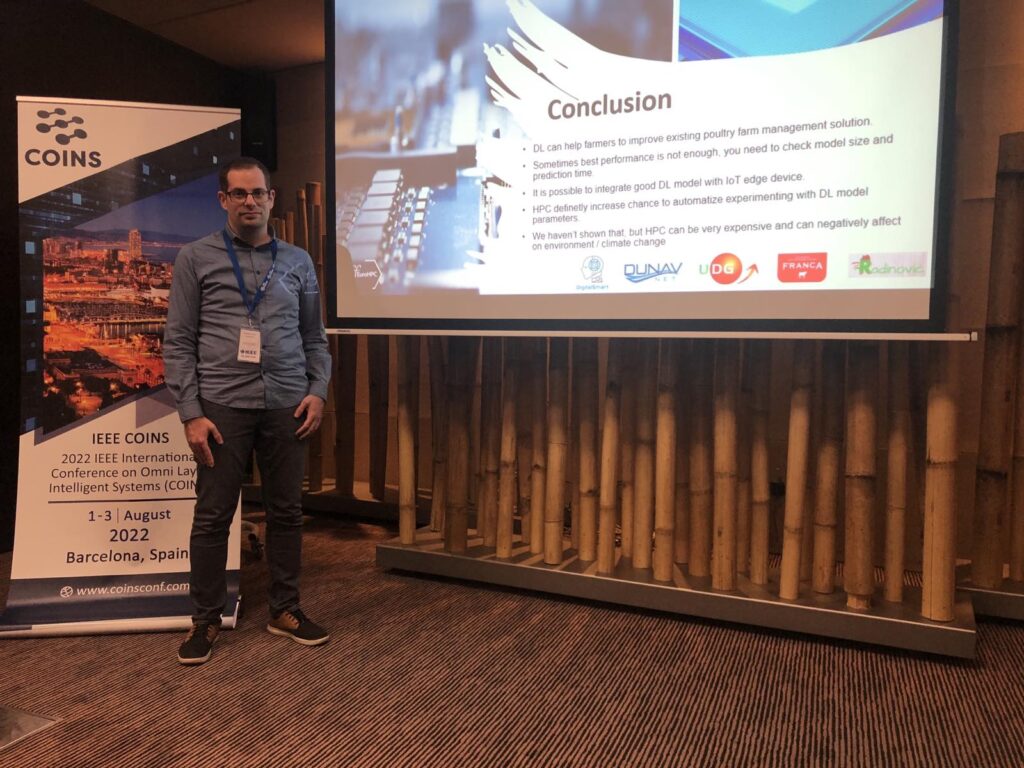
Researchers from EuroCC Montenegro presented two papers at the IEEE International Conference on Omni-Layer Intelligent Systems (COINS). IEEE COINS (link) is the right place to be. IEEE COINS brings together experts in Digital Transformation (from AI and IoT to Cloud, Blockchain, Cybersecurity, and Robotics) from around the globe. IEEE COINS includes a multi-disciplinary program from technical research papers, to panels, workshops, and tutorials on the latest technology developments and innovations addressing all important aspects of the IoT & AI ecosystem. The conference took place 1-3 August in Barcelona.

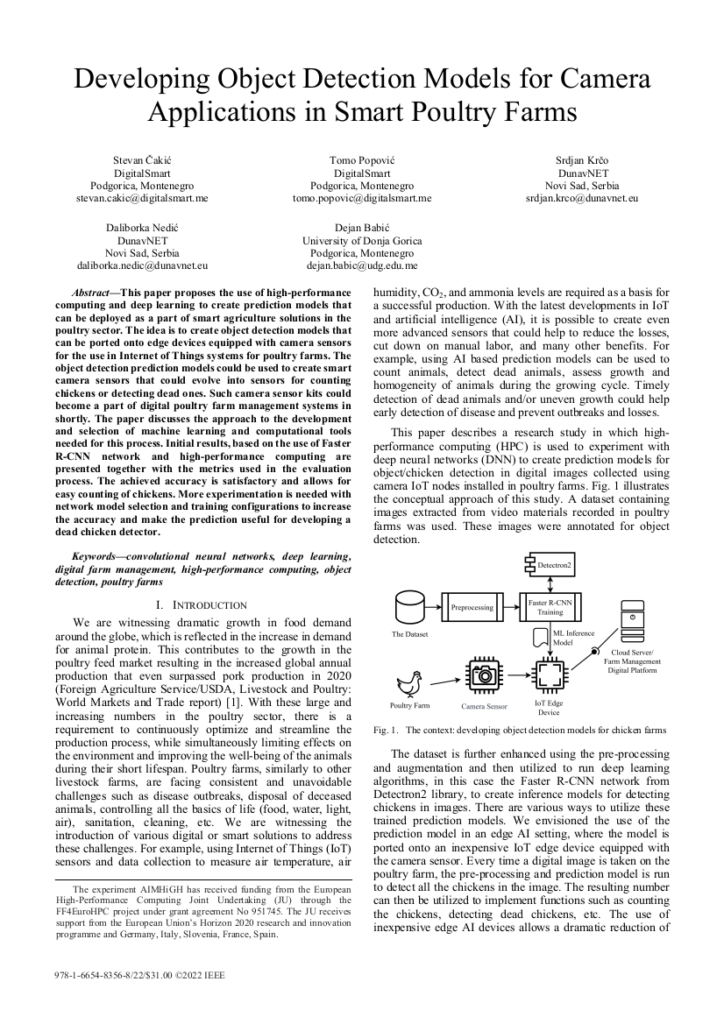
This paper was a result of the collaboration on FF4EuroHPC application experiment project called AIMHiGH that focuses on computer vision and the use of HPC to develop object detection prediction models for the use in smart agriculture, more specifically in the poultry sector. The title of the paper is “Developing Object Detection Models for Camera Applications in Smart Poultry Farms”.

ABSTRACT – This paper proposes the use of high-performance computing and deep learning to create prediction models that can be deployed as a part of smart agriculture solutions in the poultry sector. The idea is to create object detection models that can be ported onto edge devices equipped with camera sensors for the use in Internet of Things systems for poultry farms. The object detection prediction models could be used to create smart camera sensors that could evolve into sensors for counting chickens or detecting dead ones. Such camera sensor kits could become a part of digital poultry farm management systems in shortly. The paper discusses the approach to the development and selection of machine learning and computational tools needed for this process. Initial results, based on the use of Faster R-CNN network and high-performance computing are presented together with the metrics used in the evaluation process. The achieved accuracy is satisfactory and allows for easy counting of chickens. More experimentation is needed with network model selection and training configurations to increase the accuracy and make the prediction useful for developing a dead chicken detector. (link)

Click to open
Mr. Stevan Cakic in Barcelona