BSc thesis: AI and machine learning for cultural heritage preservation

Ms. Jovana Mitric defended her BSc thesis at the Faculty for information sciences and technologies on 3 October, 2024. The topoc was on AI and machine learning for applications in cultural heritage preservation. This research was done in the context of HPC4S3ME project and was supported by the NCC Montenegro team. The future work will explore the use of HPC and expanded datasets to refine and train better models for monuments detection and providing support for Montenegrin tourism development. This work was also successfully presented at the IEEE IT2024 conference.

ABSTRACT – This thesis presents research on artificial intelligence (AI) and machine learning (ML), and their potential application in the preservation of cultural heritage, with a special focus on Montenegro. Computer vision, as a specific field of artificial intelligence, was explored. The paper addresses the implementation of modern technologies, specifically computer vision, in the field of cultural tourism to enhance the visibility and preservation of cultural monuments. By using available tools such as the Roboflow platform for image annotation and Google Colaboratory for model training, a web application was developed using the Flask framework, which recognizes cultural
monuments based on images, powered by the YOLO v8 model. Additionally, the thesis discusses the broader context of AI applications in the preservation of cultural heritage and its promotion for tourism purposes, with particular emphasis on the potential for technological enhancement of Montenegro’s tourism offerings. The importance of digital transformation in tourism for Montenegro and its positioning in the global tourism market is highlighted.
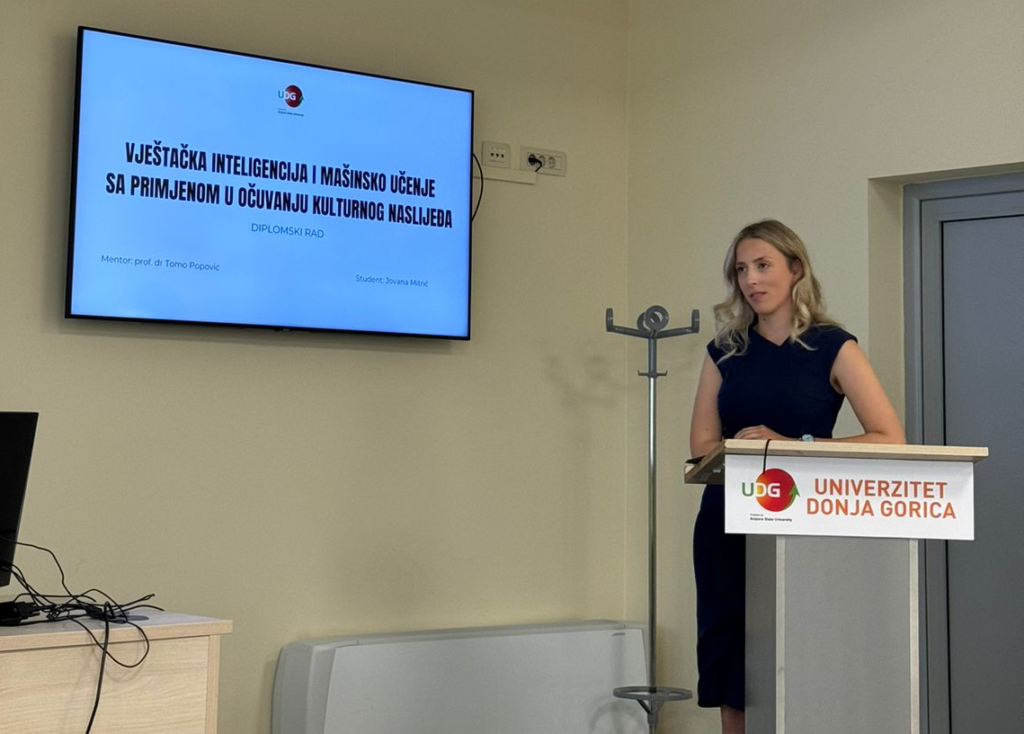
Ms Jovan Mitric defended her BSc thesis on AI and machine learning in ultural heritage preservation

BSc thesis: AI models for real estate pricing based on web scraped data

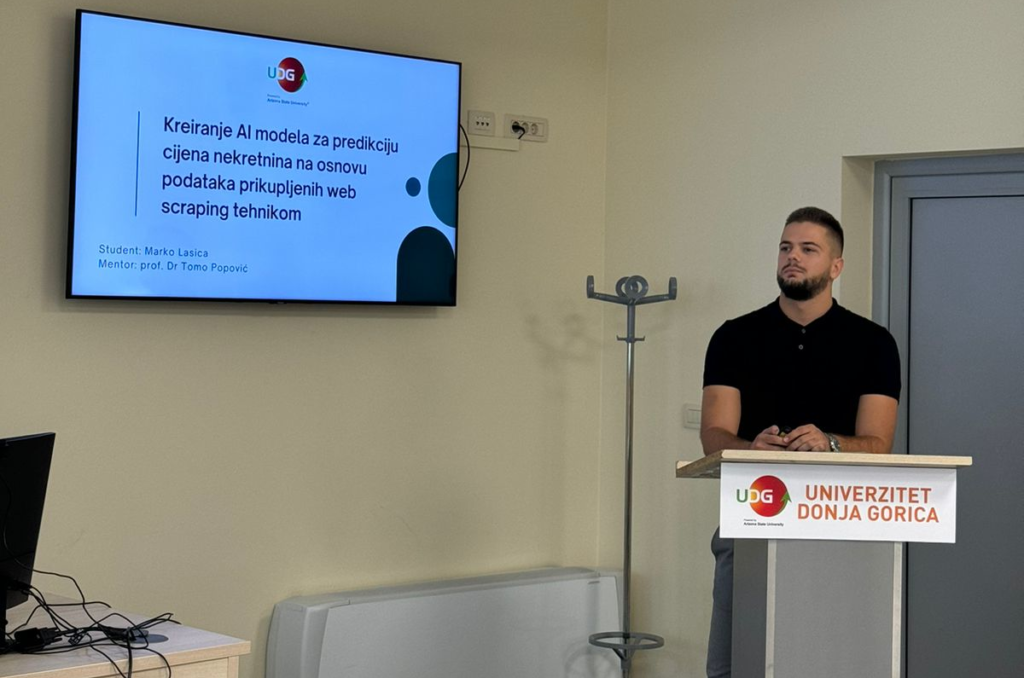
Mr Marko Lasice defended his BSc thesis on AI powered real estate pricing. The future work will include larger datasets and explorig the use of HPC and AI to train more precise price estimation models. The work was supported by the NCC Montenegro and HPC4S3ME team members.

ABSTRACT – The development of generative models and exponential progress in artificial intelligence have opened up new application possibilities in many areas of economic life. One of the possibilities is developing an AI model for predicting market prices based on data extracted from the web. This paper introduces the reader to the technique of automated downloading and grouping of data from the web, known as web scraping, and the development of a predictive model that, based on the collected data, would predict real estate prices. The paper presents the practical part of the work, the implementation of a predictive model developed using the decision tree technique. In conclusion, the work contributes to the understanding of how the combination of these techniques improves decision-making processes in the real estate market.

Mr Marko Lasice defended his BSc thesis on AI powered real estate pricing

BSc thesis on prompt engineering

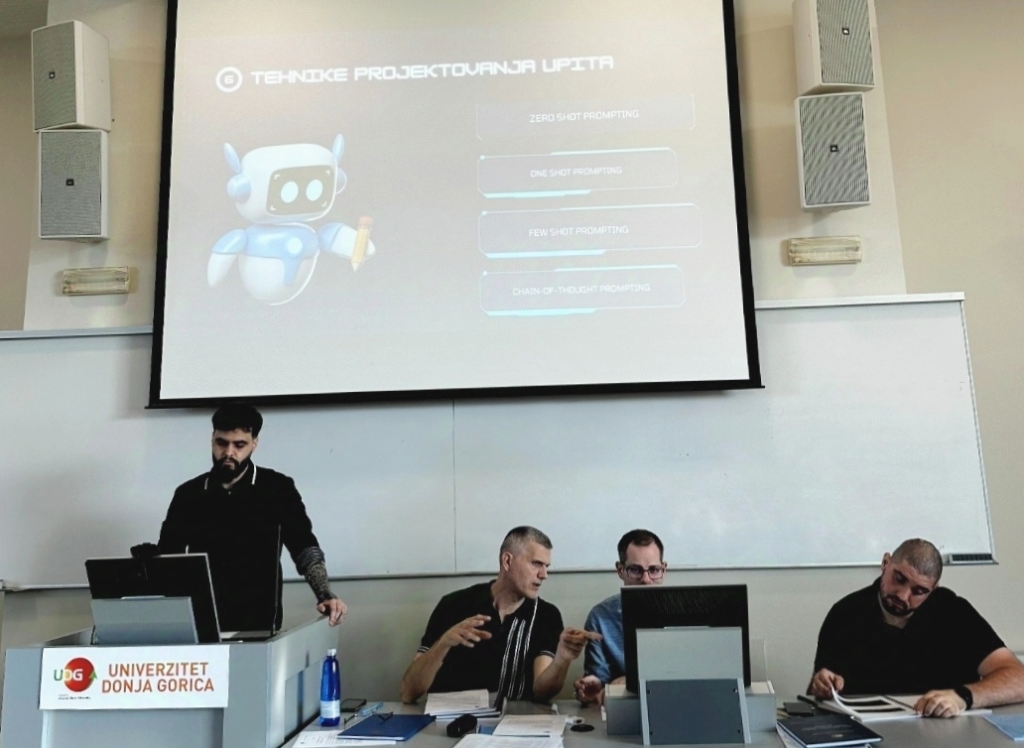
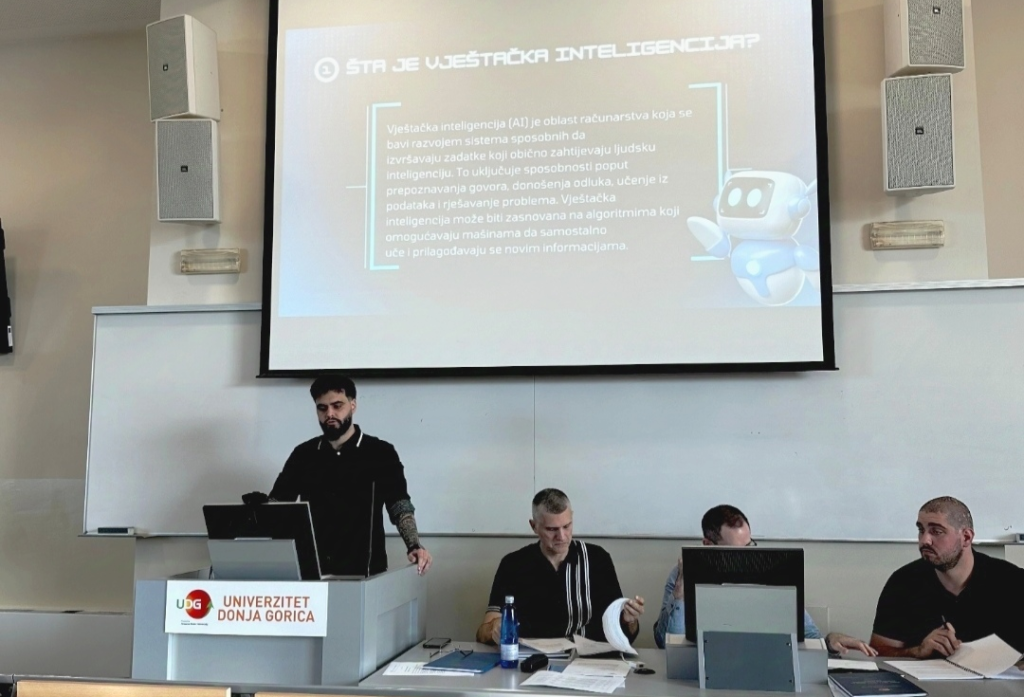
Mr. Veselin Andric defended his BSc thesis titleld “Prompt endineering for LLMs” at the Faculty for information systems and technologies. The devence took place on 2 Oct 2024 and it was done under mentorship of the EuroCC (NCC Montenegro) and HPC4S3ME teams’ members. This was a part of the effort to promote HPC and AI related technologies in the teaching curricula and research activities at UDG.

ABSTRACT – Prompt engineering is one of the primary areas of Natural language processing (NLP). It is a process that involves designing and improving inputs that are given to a language model such as ChatGPT, with a goal of getting wanted results. This dissertation investigates details of prompt engineering, it’s theoretical foundation, methodologies and practical uses in different tasks of NLP.

Mr. Veselin Andric defended his BSc thesis on Prompt Engineering
The provided an overview of NLP, LLMs and prompt techniques

HPC in Europe Podcast

Welcome to “Supercomputing in Europe” podcast from the EuroCC and Centre of Excellence network where we will talk about all things supercomputers.

Listen to stories by guests from all around Europe who talk about their work and give us interesting insights on the role of supercomputers in multiple fields such as life science, machine learning, engineering, data science, quantum computing, and more.

In the first episode, listen to EuroHPC Joint Undertaking (EuroHPC JU) executive director Anders Dam Jensen discuss with communication specialist Apostolos Vasileiadis (ENCCS, RISE Research Institutes of Sweden) about EuroHPC JU and the state of supercomputing in Europe and its future.

In the second episode listen to Marta García-Gasulla and Filippo Mantovani from Barcelona Supercomputing Center discuss with Sally Kiebdaj (Center of Excellence in Exascale CFD, HLRS – High-Performance Computing Center Stuttgart) about the European Processor Initiative and CEEC CoE.

Spotify: https://lnkd.in/dSHmk2Kx
Apple podcasts: https://lnkd.in/dyuBMFyM

New academic paper on Montenegro’s HPC ecosystem development

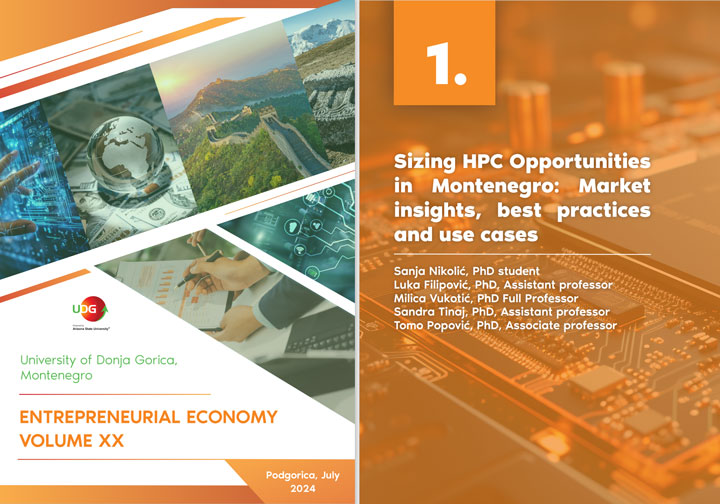
A new academic paper ‘Sizing HPC Opportunities in Montenegro: Market Insights, Best Practices and Use Cases’ has been published in the scientific journal “Entrepreneurial Economy“.

The paper highlights the pivotal role of HPC in addressing critical societal, scientific, and industrial challenges, and explores its growing impact on businesses through data-driven decision-making, workflow optimization or innovative product design. The study underscores the importance of HPC infrastructure, Cloud services, and AI applications in driving digital transformation and enhancing the industry competitiveness of SMEs.
The research also identifies key challenges in Montenegro including a shortage of HPC expertise, low demand for critical HPC performance, and certain concerns related to data security and IPR. Despite these challenges, market research revealed HPC opportunities related to high Cloud adoption, innovative product development and favourable business prospects. The paper also describe activities of the HPC National Competence Centre Montenegro, established through the EuroCC project, related to established HPC and AI related academic programs and training portfolio, and productive industry collaborations, demonstrated through successful use cases in smart agriculture, precise weather forecasting, and FinTech.

By harnessing both national expertise and international supercomputing resources, the NCC Montenegro has effectively integrated HPC technologies into research and business practices, driving technology innovations and smart growth.

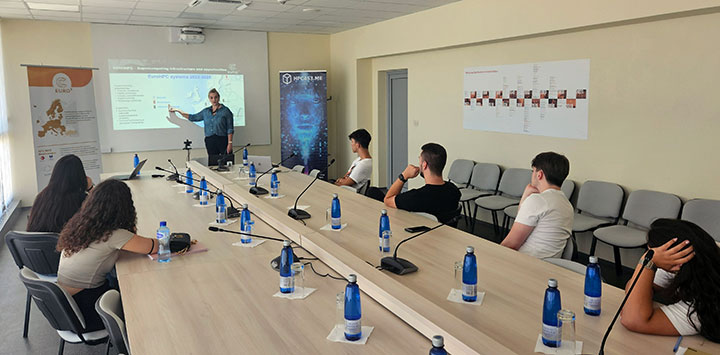
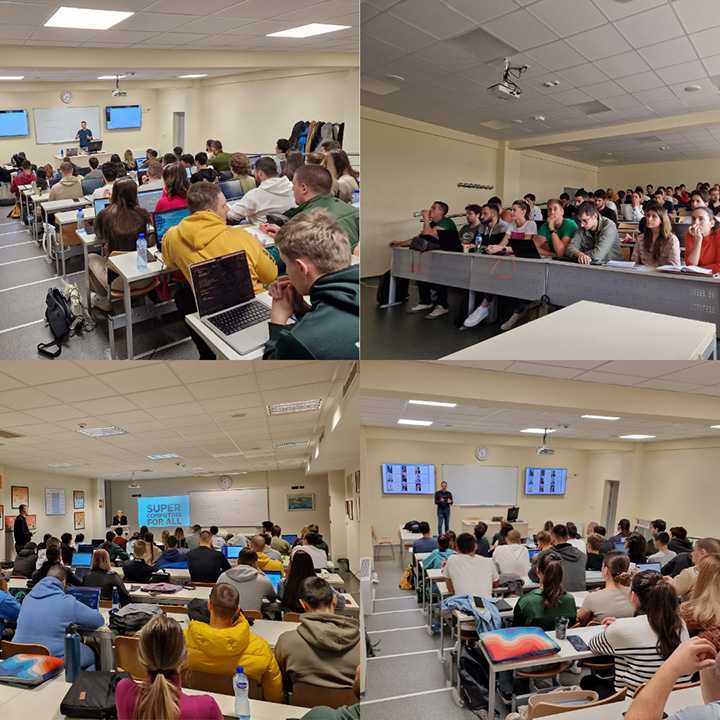
NCC Montenegro hosts Supercomputing Workshops for new UDG students

As a part of the orientation week for new students, the EuroCC National Competence Centre Montenegro has organized a Supercomputing Workshop aimed at introducing incoming university students to the exciting world of high-performance computing (HPC).

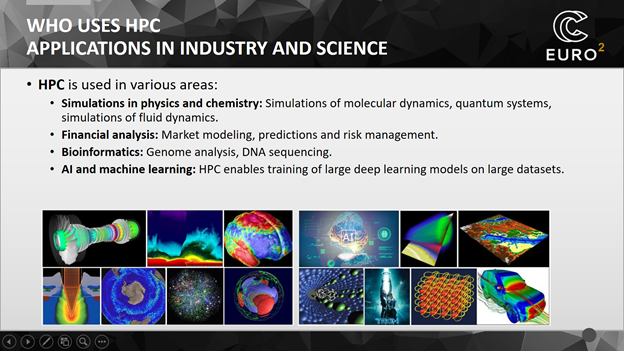
The workshop featured interactive sessions where students could get insights into cutting-edge technologies used in supercomputing, such as parallel processing, intelligent algorithms, and data analytics. Experts from the NCC guided the participants through the technical fundamentals of HPC systems, demonstrated real-world applications related to Big Data processing and advanced AI modelling, but also provided examples of academic study cases and industry use cases, including Montenegro’s success stories.

The aim of the workshop was also to provide brief overview on HPC/AI related academic programs, training portfolio and NCC activities, to show how students can leverage supercomputing resources for academic projects and scientific research, or even for startup ideas and potential industry collaboration.

By exposing new students to the potential of supercomputing early in their academic journey, the NCC aims to support students’ development in high-demand, tech-driven carriers, and to foster community of innovative thinkers prepared to tackle complex and critical challenges of the modern world.

AIFUSION – Artificial intelligence in agriculture, medicine and energy

The University of Donja Gorica, with the support of the Innovation Fund of Montenegro, as part of the program for the organization of education in the areas of smart specialization of Montenegro, organizes a three-month training called “AIFUSION – Artificial intelligence in agriculture, medicine and energy.” The course will be held in the period from the end of September (September 21) to the end of December (December 21) 2024.

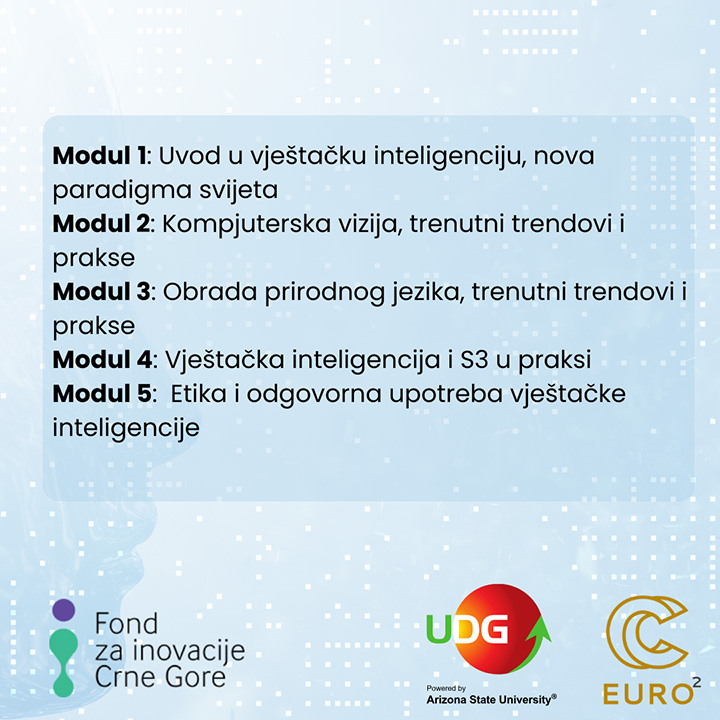
The education program is divided into 5 modules: Introduction to artificial intelligence, Computer vision, Natural language processing, Artificial intelligence and S3 in practice and Ethics and responsible use of artificial intelligence and work on the final project.

Apart from the fact that the participants will acquire enough knowledge and skills needed for further research in this very current field, they will have the opportunity to expand their network of acquaintances and meet young people with similar interests.

A detailed agenda is available at link.

To apply, you need to fill out the Google form found at the link https://forms.gle/f8Pc8ozu9U3tHKY98. Applications last until September 20 (11:59 p.m.), and the course is scheduled to start on September 21.

Image(s) from previous workshops