Deep Learning Course with HPC

The Deep Learning with High Performance Computing (HPC) course provides a comprehensive introduction to both the fundamental and advanced concepts of Deep Learning, with a special focus on applications in High Performance Computing environments.

Participants will explore neural networks, loss optimization, convolutional and transformer architectures, as well as unsupervised and generative models. Through a combination of lectures and practical sessions, attendees will gain both theoretical understanding and hands-on experience in efficiently training and deploying deep learning models on HPC systems.

The course is intended for students and researchers with prior knowledge of machine learning concepts, programming in any language, and a basic understanding of mathematics (functions, derivatives, linear algebra, and statistics).
The course is organized within the EuroCC project at the University of Donja Gorica, in collaboration with the Center for High Performance Computing and the Artificial Intelligence research team. All classes will be organized at the University of Donja Gorica, starting from 31st October, 2025, from 17:15h, in classroom S33 or S23 (3 floor).

Link for registration: https://forms.gle/dKH5WMc6egcikaF99
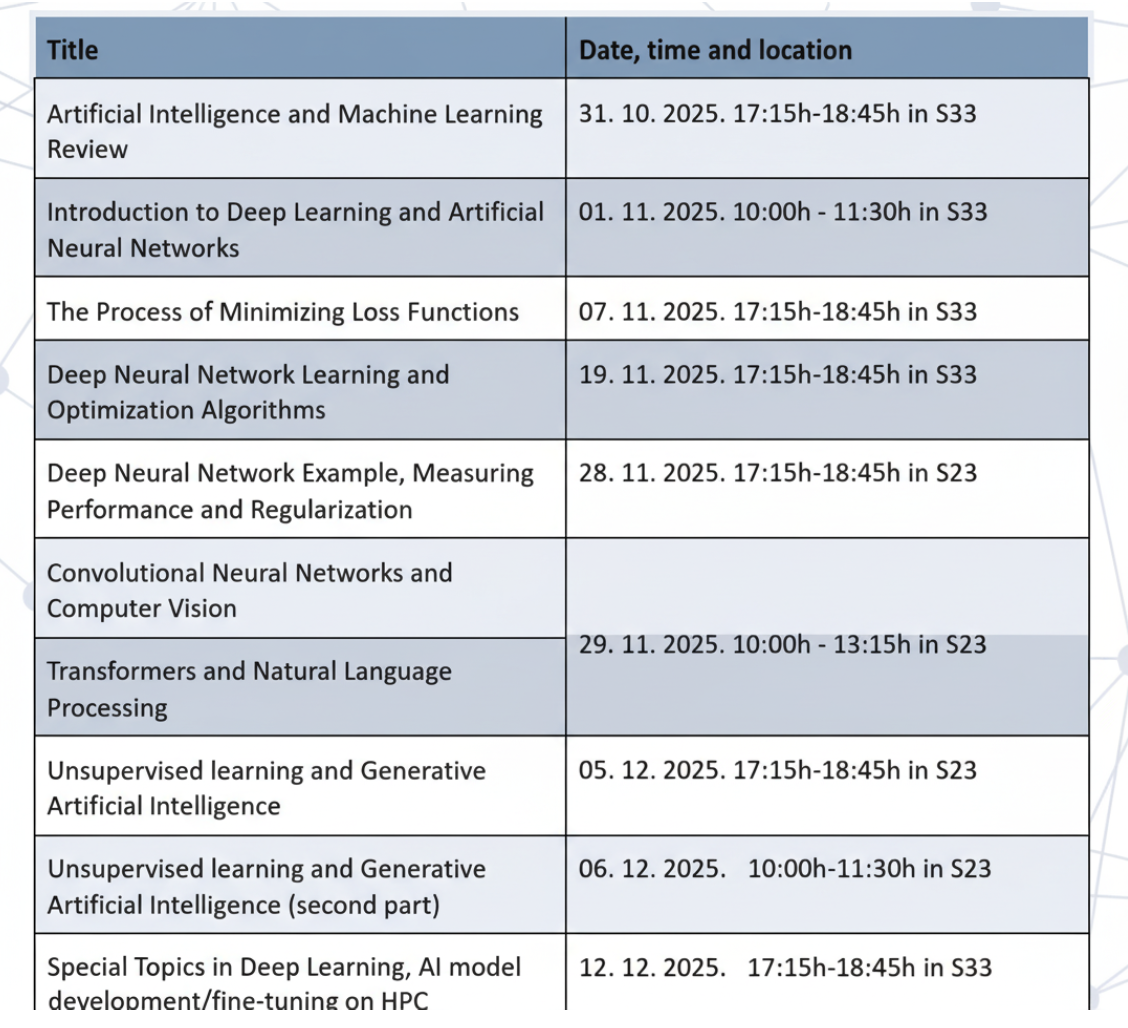
Schedule

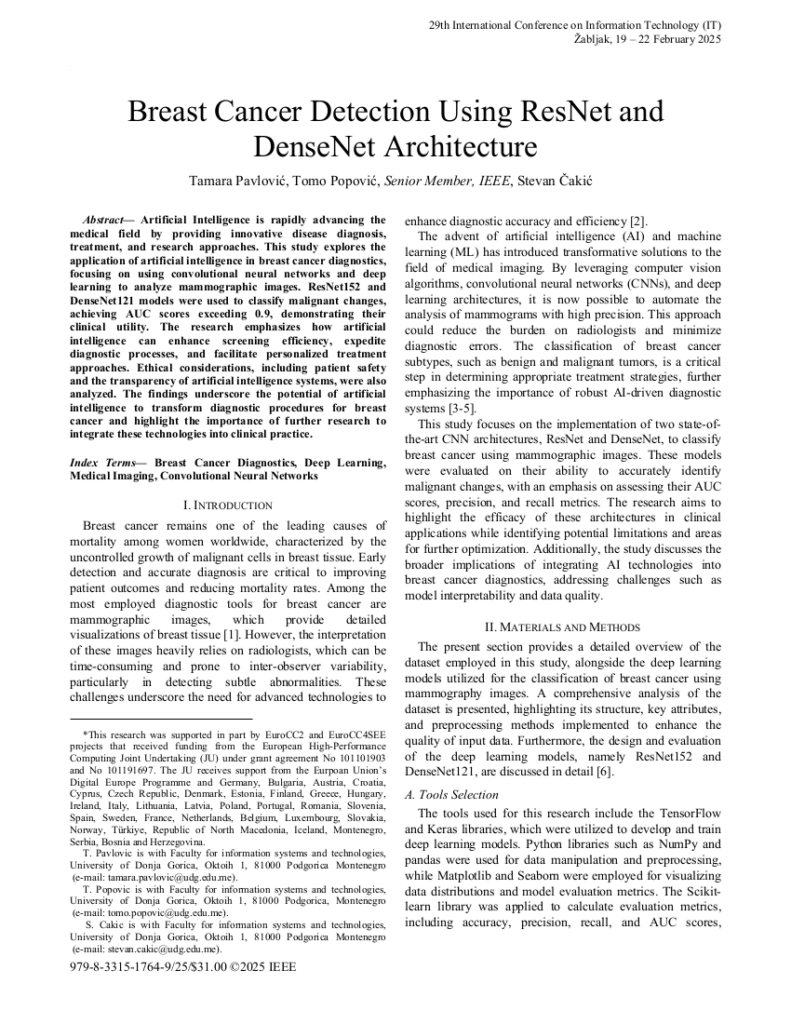
Scientific Paper on Breast Cancer Detection Using Deep Learning at IT2025

At the IT2025 IEEE conference in Žabljak, researchers from the University of Donja Gorica presented their latest study on the use of artificial intelligence (AI) for breast cancer diagnostics. The research explores the application of deep learning models, ResNet152 and DenseNet121, for analyzing mammographic images. In addition to clinical results, the study highlights the implications of using high-performance computing (HPC) infrastructure to optimize model training and evaluation. By transferring the experimental setup to HPC resources, the research opens pathways for faster development cycles, exploration of more complex architectures, and scalability for real-world implementation.

ABSTRACT – Artificial Intelligence is rapidly advancing the medical field by providing innovative disease diagnosis, treatment, and research approaches. This study explores the application of artificial intelligence in breast cancer diagnostics, focusing on using convolutional neural networks and deep learning to analyze mammographic images. ResNet152 and DenseNet121 models were used to classify malignant changes, achieving AUC scores exceeding 0.9, demonstrating their clinical utility. The research emphasizes how artificial intelligence can enhance screening efficiency, expedite diagnostic processes, and facilitate personalized treatment approaches. Ethical considerations, including patient safety and the transparency of artificial intelligence systems, were also analyzed. The findings underscore the potential of artificial intelligence to transform diagnostic procedures for breast cancer and highlight the importance of further research to integrate these technologies into clinical practice.