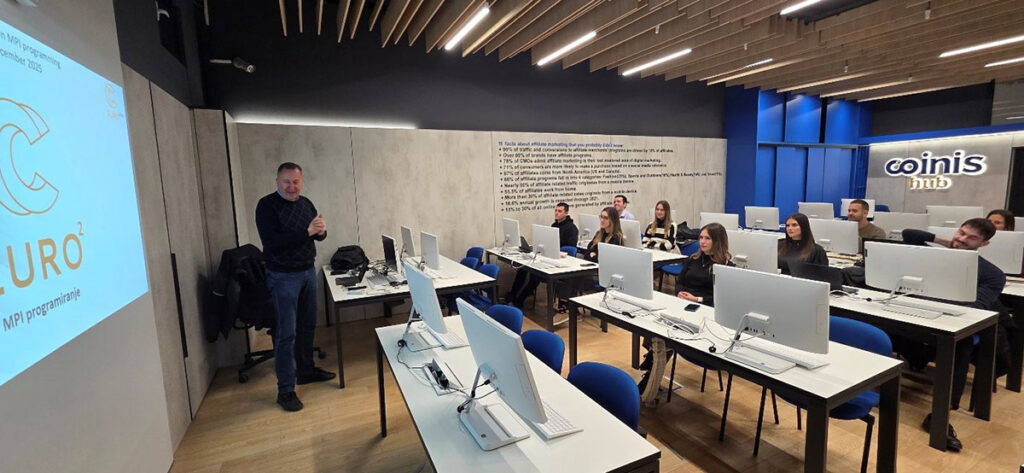
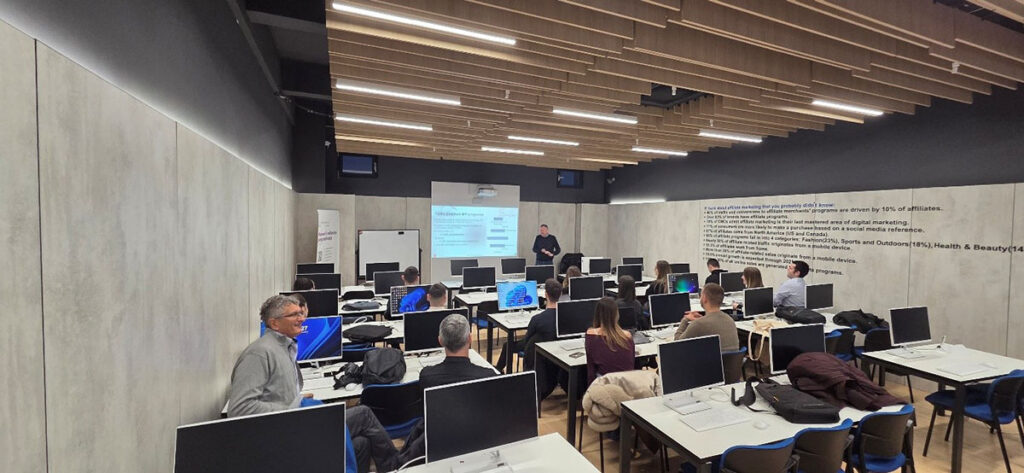
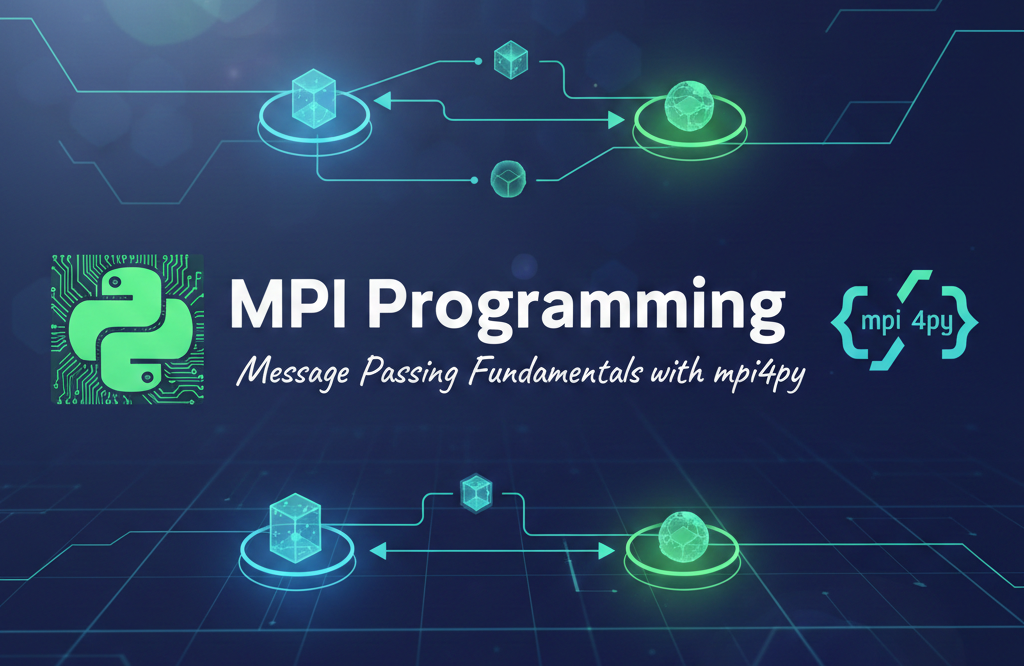
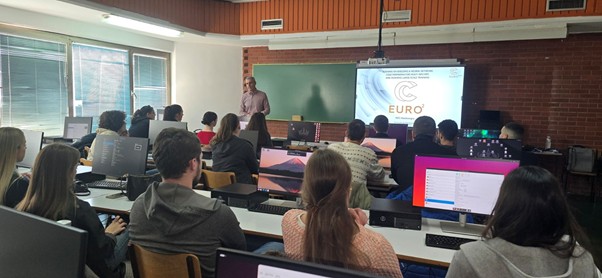
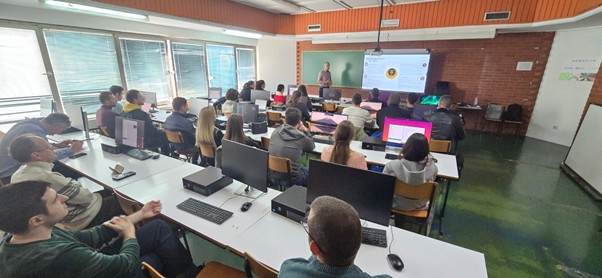
On 23 December 2025, at premises of the Faculty of Electrical Engineering, University of Montenegro, NCC Montenegro (EuroCC) successfully delivered a hands-on training session on MPI programming in Python using mpi4py. The event introduced participants to the fundamentals of the message passing paradigm for distributed-memory systems and explained how the MPI standard enables scalable parallel applications across multiple processes.
Hands-on training session on MPI programming in Python using mpi4py
The training combined concise theory with practical demonstrations. Core MPI concepts such as SPMD execution, communicators, process rank and size, and the basics of point-to-point communication using Send/Recv (including tags and common communication patterns) were covered. Participants also learned how to set up and run MPI programs with mpiexec, verify their environment, and interpret parallel output behaviour.
Hands-on training session on MPI programming in Python using mpi4py
A key part of the session was a step-by-step example of parallelizing a numerical computation using the trapezoidal rule for integration. Through this case study, workload partitioning across processes and collection of partial results were demonstrated, along with a discussion of typical performance considerations such as synchronization overhead and potential bottlenecks at the root process.
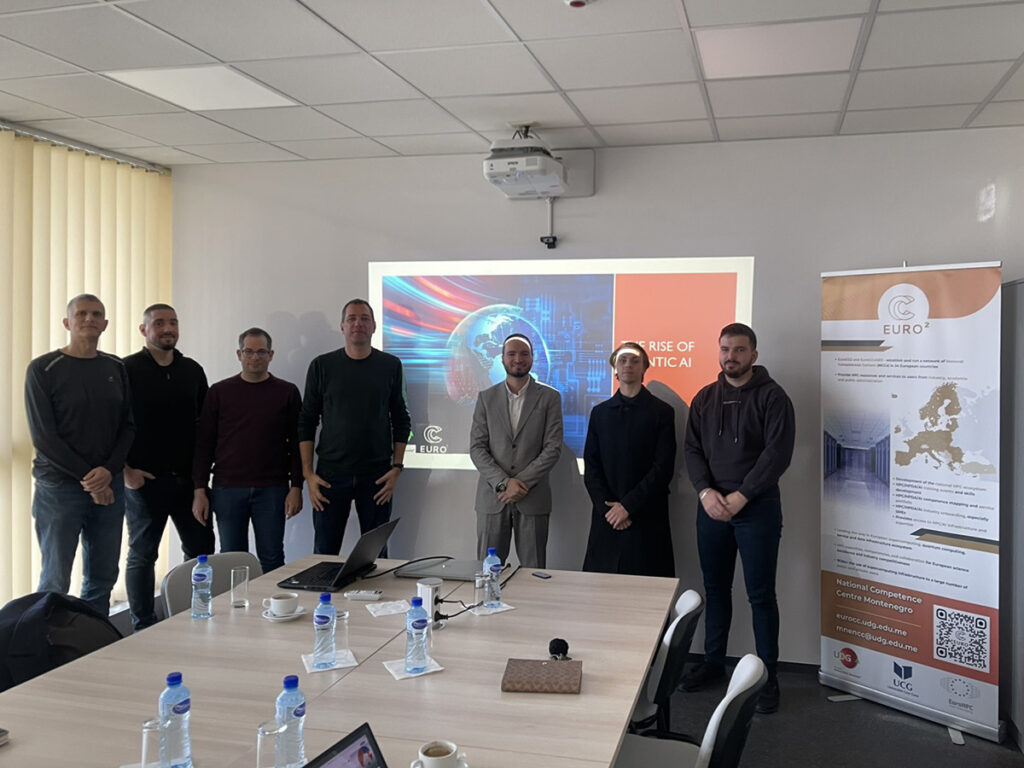
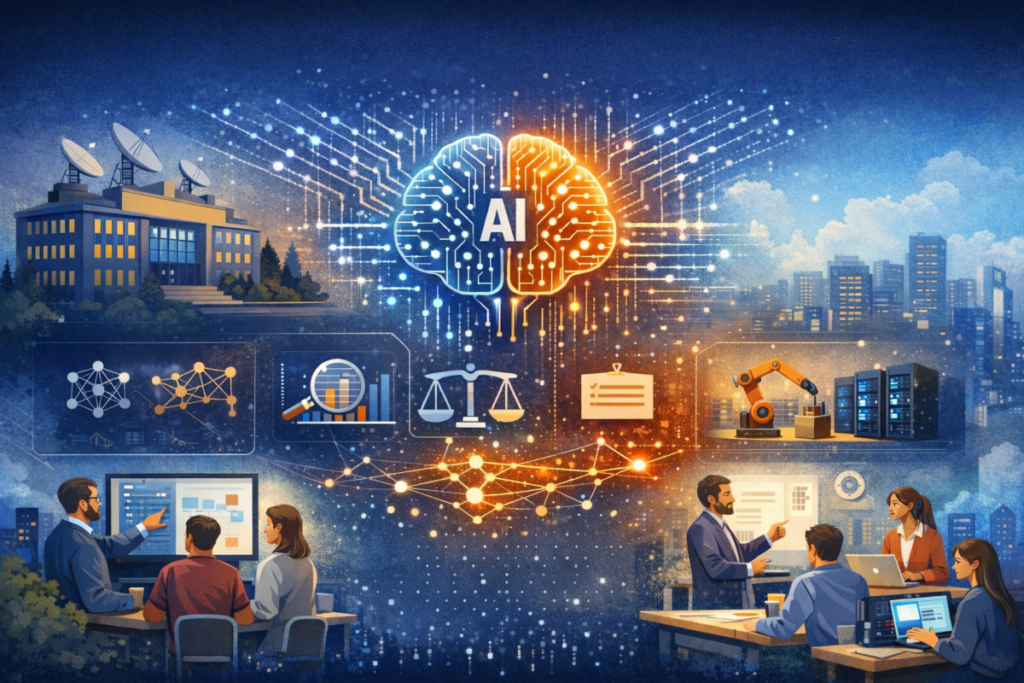
Agentic AI is emerging as a powerful enabler of next-generation digital transformation, business automation, and real-time decision-making. Unlike traditional AI solutions, Agentic AI systems operate as autonomous, goal-driven agents capable of planning, reasoning, and adapting over time, making decisions without continuous human intervention, and collaborating with tools, systems, and dynamic environments. Recognising its growing relevance, NCC Montenegro organised a Train the Trainers workshop for NCC members, focused on the application of Agentic AI within experience-driven industries.
Train the Trainers Workshop @ NCC Montenegro: Agentic AI
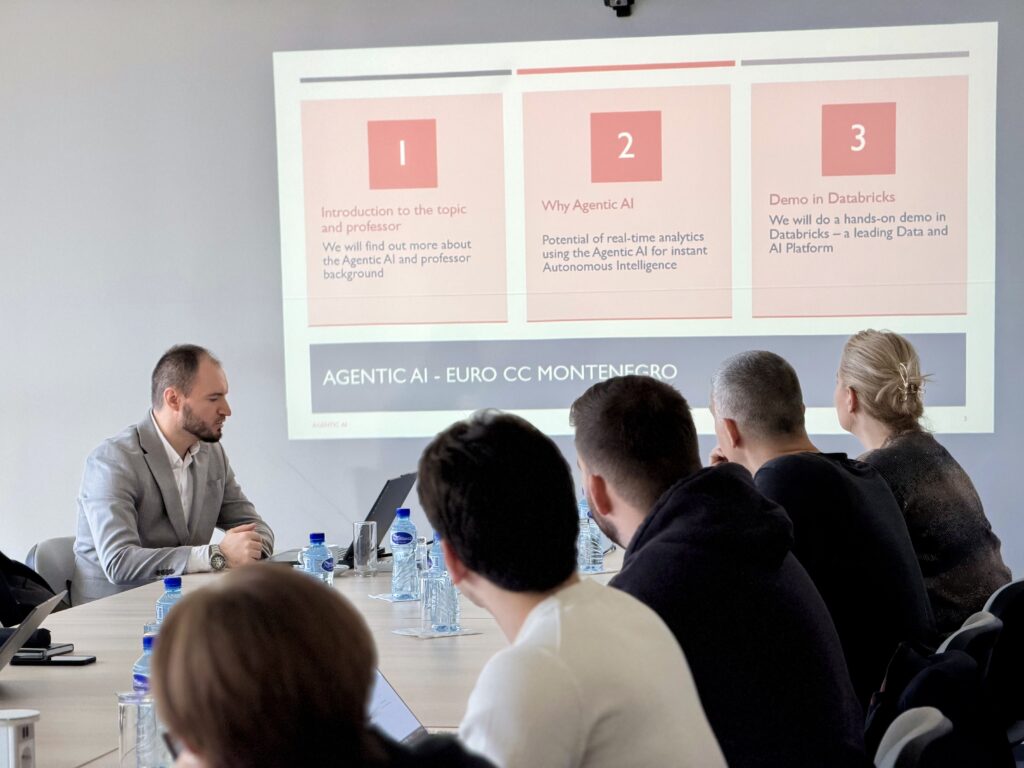
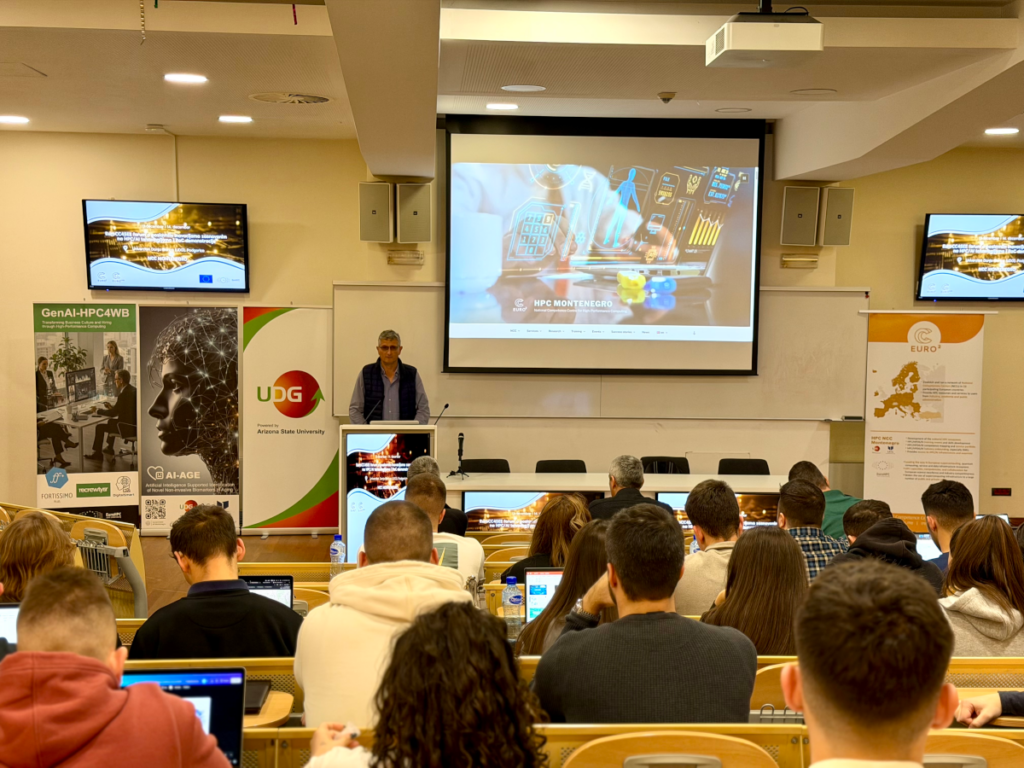
The workshop was delivered by the NCC representative, Dr Armin Alibasic, who combined academic and industry expertise with his international and interdisciplinary experience across the automotive, airline, and theme park industries. The session highlighted the potential of real-time analytics enabled by Agentic AI, demonstrating how autonomous intelligence can support instant, data-driven decision-making. These concepts were illustrated through real-life industry applications and a hands-on demonstration on Databricks, a leading Data and AI platform.
Presentation of Dr Armin Alibasic
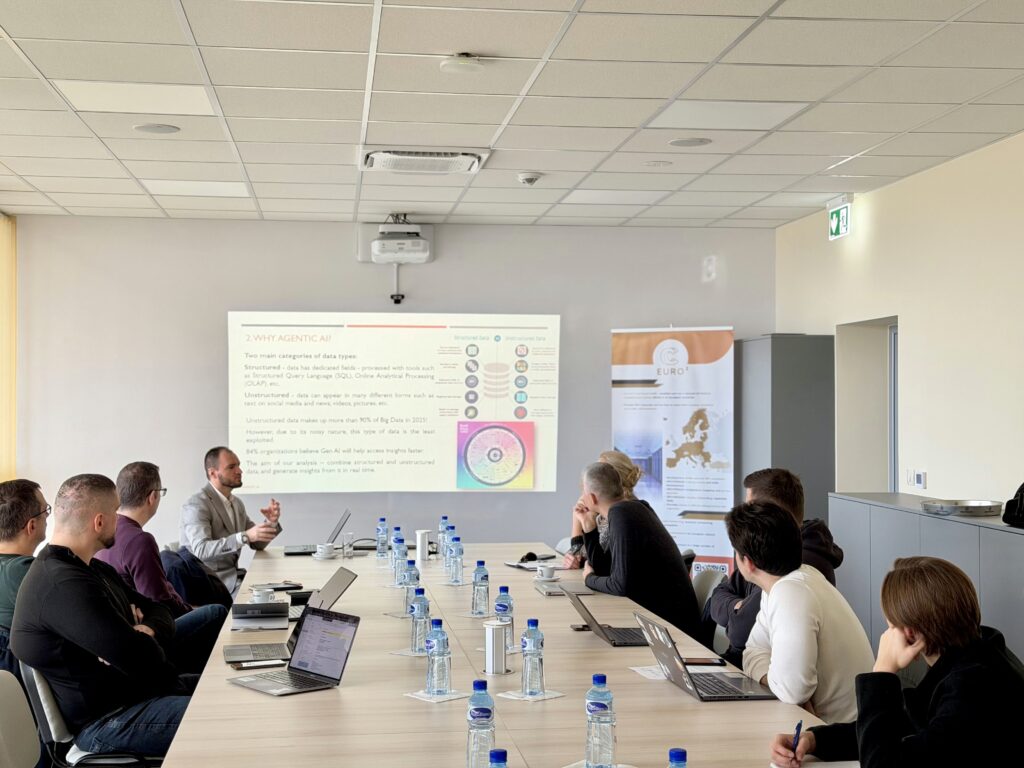
The Train the Trainers approach addressed two complementary dimensions. The first focused on capacity building, providing participants with a structured and in-depth understanding of Agentic AI concepts, system architecture, required skills and tools, as well as the key challenges associated with designing and deploying agent-based AI solutions. These foundations were reinforced through business-oriented use cases, ensuring a clear link between theoretical principles and real-world industry practice. The second dimension emphasized knowledge transfer, equipping participants with the competencies needed to design, adapt, and deliver high-quality training activities tailored to SMEs, complex organizational systems, and strategic decision-makers.
Why Agentic AI?
By empowering trainers with both deep technical insight and practical training capabilities, NCC Montenegro ensures that Agentic AI knowledge can be effectively disseminated, scaled, and transformed into business value for industry, SMEs, and the broader digital innovation ecosystem.
As part of the ongoing activities of the National Competence Centre for High-Performance Computing and Artificial Intelligence in Montenegro (HPC NCC Montenegro), a new undergraduate course entitled Artificial Intelligence has been successfully implemented during the current academic year. The course was delivered to students of the Faculty for Information Systems and Technologies (FIST) as well as the Faculty of Applied Sciences – Electrical Engineering and Computer Science programme, further strengthening the AI and HPC components within undergraduate curricula.
AI Education Bridging Academia and Industry
The course was designed as an introductory yet comprehensive overview of fundamental concepts, methods, and applications of artificial intelligence, aiming to provide students with a solid theoretical foundation alongside essential practical skills. The focus was placed on machine learning, data analysis and processing, decision-making algorithms, and the role of AI in digital transformation and real-world problem solving. In addition, ethical challenges and societal implications of AI technologies were explicitly addressed. The course content and learning outcomes were aligned with contemporary academic and industry standards, including hands-on use of tools recommended by the industry experts.
A distinctive feature of the course was its close collaboration with industry partners, fully aligned with the objectives of the EuroCC-2 and EuroCC4SEE projects, which promote strong links between academia, industry, and the HPC ecosystem. Representatives from Alicorn, BixBit, Inovativa, and DigitalSmart actively participated in the course delivery, contributing through guest lectures and weekly discussions with students. This collaboration allowed students to gain first-hand insights into how AI and HPC technologies are applied in real industrial environments.
Through direct interaction with industry professionals, students discussed concrete use cases of artificial intelligence in areas such as data-driven decision making, process automation, intelligent systems development, and scalable AI solutions supported by HPC infrastructures. These exchanges significantly enriched the learning experience, fostering critical thinking, practical understanding of market needs, and awareness of real-world constraints and opportunities.
The implementation of the Artificial Intelligence course represents a concrete example of how EuroCC initiatives contribute to the systematic enhancement of undergraduate curricula with AI and HPC content, while simultaneously strengthening cooperation with industry. In this way, students are not only equipped with fundamental technical knowledge but are also introduced to the broader European HPC and AI ecosystem, gaining a clear perspective on the role of AI and high-performance computing in modern research, innovation, and industry.
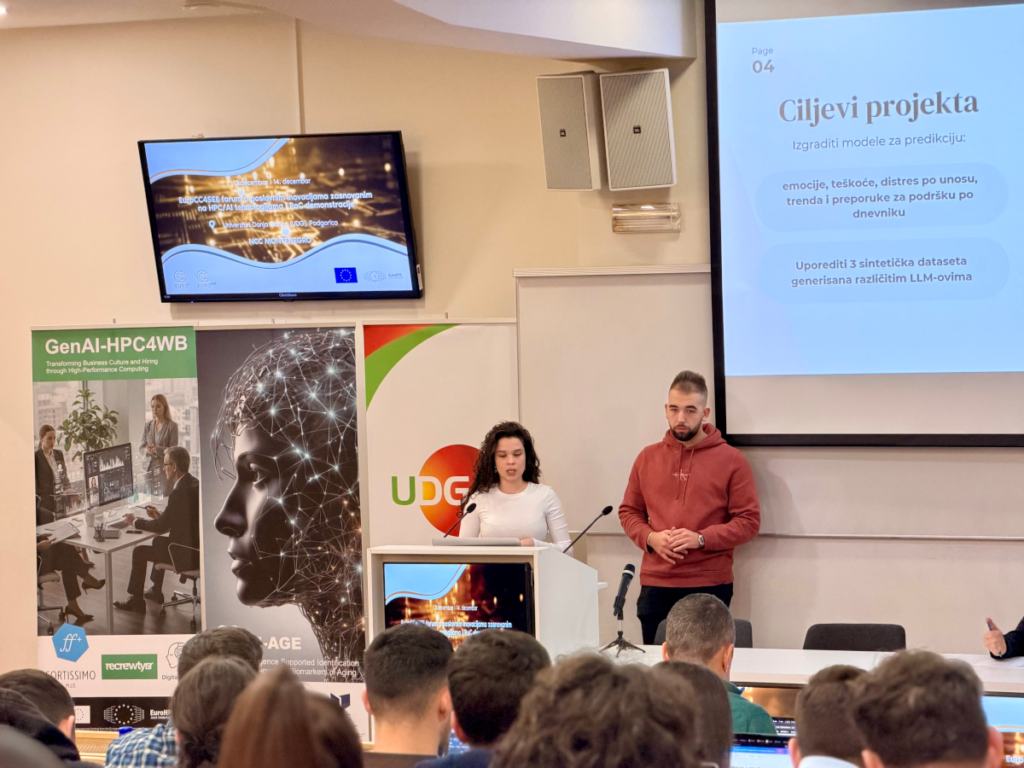
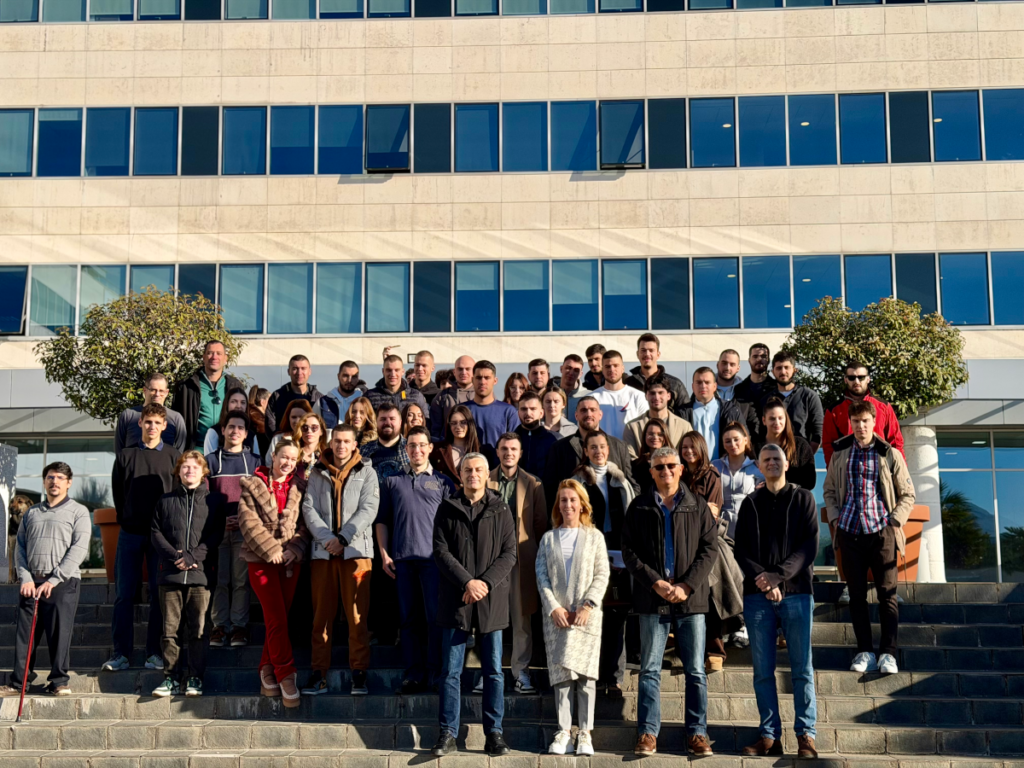
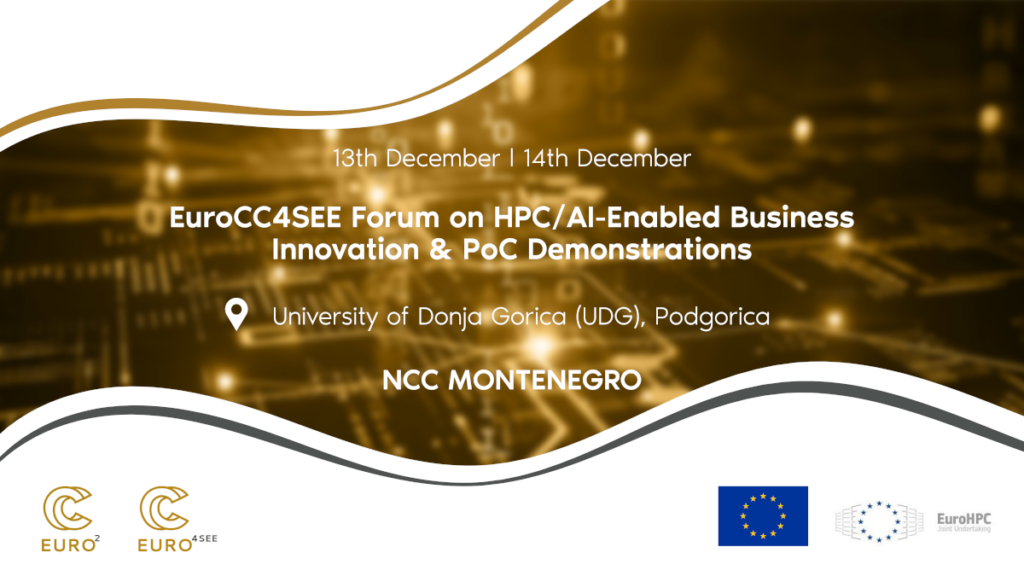
On 13–14 December, NCC Montenegro hosted the EuroCC4SEE Forum dedicated to business innovation supported by High-Performance Computing (HPC) and Artificial Intelligence (AI). The event brought together representatives from academia, industry, the public sector, and the startup ecosystem, with the aim of strengthening national capacities and supporting Montenegro’s digital transformation.
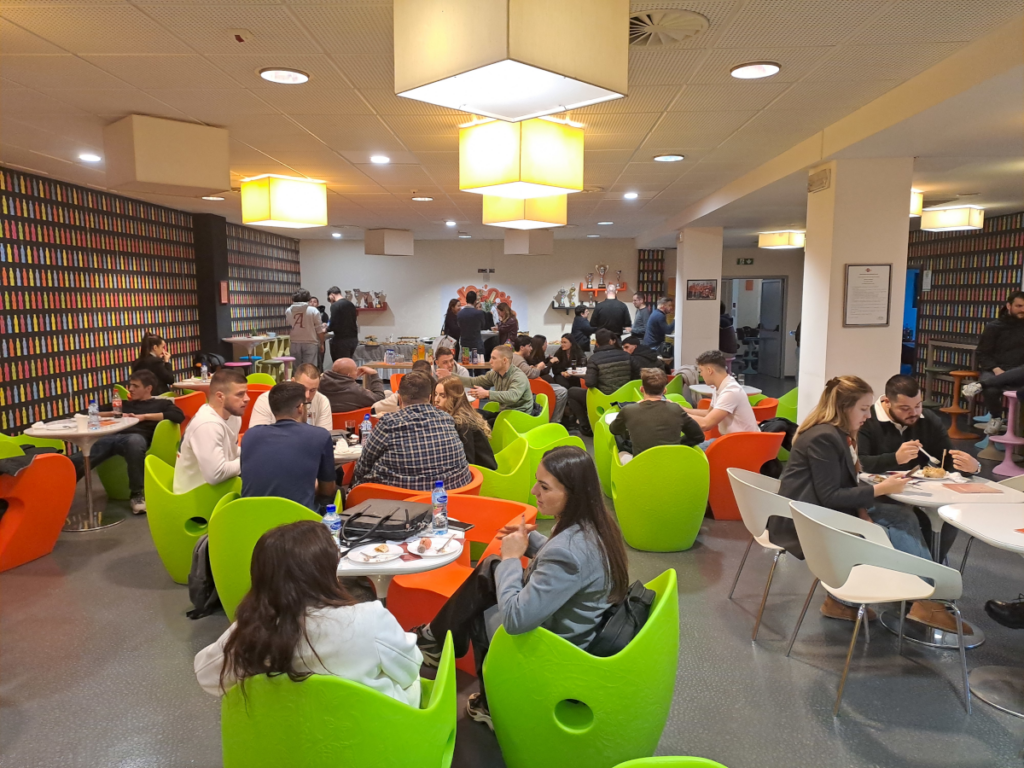
Welcome note from NCC Montenegro – prof. Bozo KrstajicWe organized networking activities during the breaks
During the two-day program, participants explored practical applications of HPC and AI through Proof-of-Concept demonstrations in the fields of energy, agriculture, health, and mobility, alongside discussions on innovation policies, MLOps approaches, skills development, and business–academia collaboration.
Discussions were focused on AI/HPC driven innovation in business and PoC demonstratorsPoC presentations were based on acamia-industry collaboration
The forum also highlighted the importance of regional and European cooperation, EU funding opportunities, and future activities within the EuroCC4SEE network, contributing to the strengthening of Montenegro’s position within the regional HPC/AI ecosystem. A proceedings booklet with brief elaborations of all covered topics will be made available on the project website.
This MPI programming training will take place on December 23, 2025, and is designed for anyone who wants a hands-on introduction to parallel programming on distributed-memory systems. The course covers the SPMD approach, communicators (COMM_WORLD), process rank/size, and point-to-point communication (Send/Recv, blocking and non-blocking). Through practical examples in Python (mpi4py)—including a simple parallelization demo such as numerical integration using the trapezoidal rule—participants will learn how to write and run MPI programs using mpiexec.
Date: December 23, 2025 Location: University of Montenegro, Faculty of Electrical Engineering Room: Coinis (L2) Time: 15h – 18h
On 12 December 2025, the University of Montenegro, as a member of the NCC Montenegro (EuroCC) team, successfully organized a short training titled “Building a Neural Network, Code Preparing for Multi-GPU HPC and Running Large-Scale Training” at the Faculty of Science and Mathematics.
The training gathered around 30 participants, including students, young researchers, and industry professionals, all interested in learning how to effectively use High-Performance Computing (HPC) resources in their research and development work.
The course combined theory and hands-on practice through a concrete use case. After an introduction by Prof. Enis Kočan, Prof. Igor Jovančević, together with his colleagues Velibor Došljak and Nikola Pižurica, led an informative, hands-on technical session. Participants first learned how to build a simple neural network for vision-based defect detection in manufacturing, with the goal of deploying it on an edge device with limited computational power. Optimizing the neural network requires many experiments, clearly demonstrating the need for HPC resources.
The focus then shifted to preparing a local development environment using Docker, transferring the environment to an HPC system, and finally running multiple training experiments on a multi-GPU HPC infrastructure.
Throughout the session, participants actively engaged in questions and discussions, particularly regarding the practical and technical aspects of applying for and using HPC resources. The training inspired participants to plan several applications to open calls for HPC resources, particularly in the context of master’s theses and startup projects.
An important takeaway from the training was that the EuroCC2 / NCC Montenegro team provides continuous support — not only during the application process for HPC resources, but also during their actual usage, including environment setup, code adaptation, and performance considerations. This event confirmed strong interest in HPC and AI-related topics and highlighted the importance of hands-on, application-oriented training in bridging the gap between local development and large-scale HPC execution.
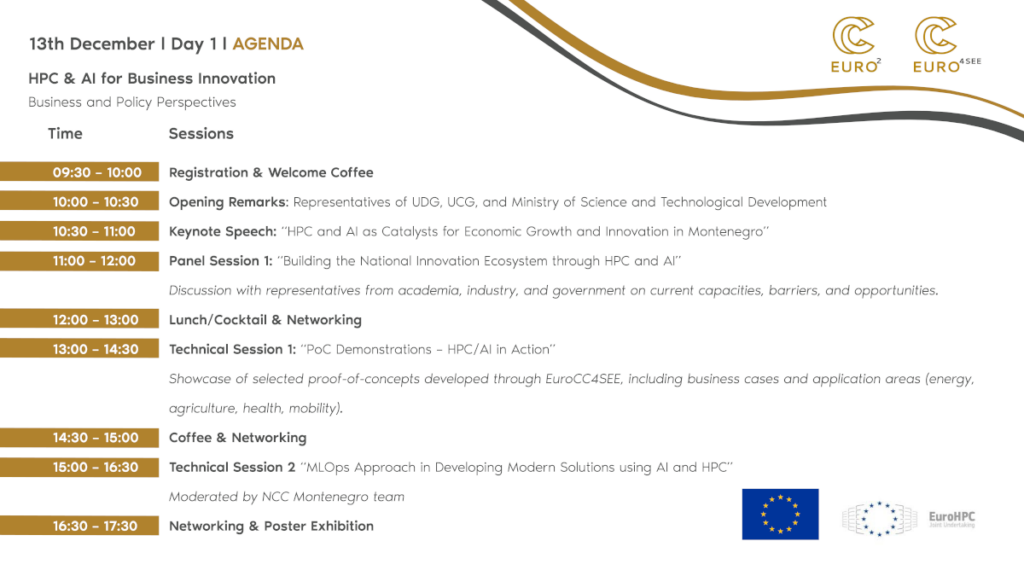
NCC Monetenegro will host the EuroCC4SEE Forum on HPC/AI-Enabled Business Innovation & PoC Demonstrations on 13–14 December, bringing together representatives from academia, industry, government, and the startup community. The two-day event will highlight how High-Performance Computing (HPC) and Artificial Intelligence (AI) can accelerate innovation, strengthen national capacities, and support Montenegro’s digital transformation.
Day 1 will focus on business innovation and policy perspectives, featuring opening remarks from national institutions, a keynote on the role of HPC and AI in economic growth, and a high-level panel on building Montenegro’s innovation ecosystem. The program will also include technical sessions, with PoC demonstrations developed through EuroCC4SEE in sectors such as energy, agriculture, health, and mobility, followed by a session on MLOpsapproaches moderated by the NCC Montenegro team. A networking and poster exhibition will showcase student work and local startup projects.
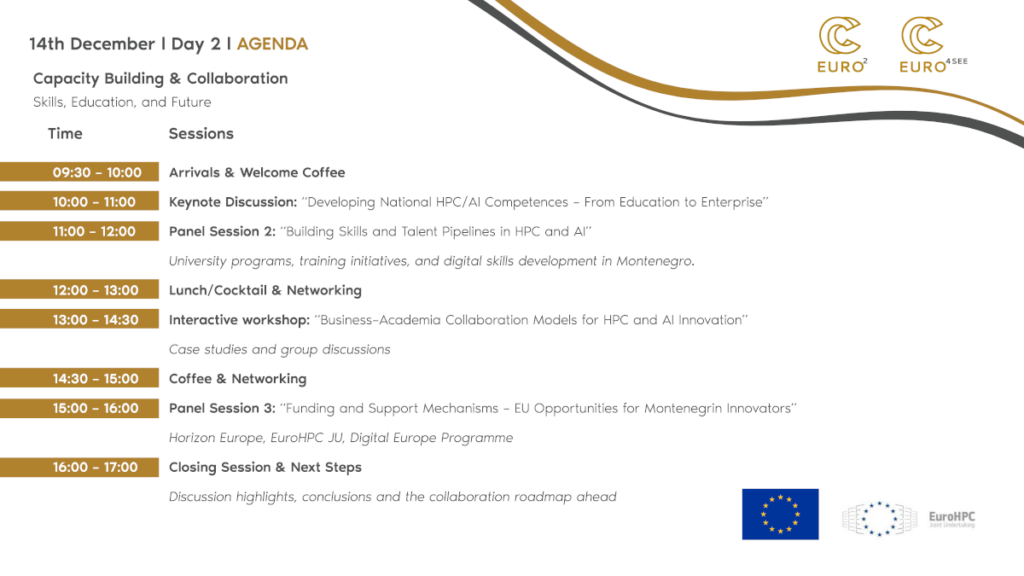
Day 2 will shift toward skills, education, and collaboration. Participants will explore national competence development in HPC/AI, talent pipeline building, and business–academia cooperation models through panels and an interactive workshop. The event will conclude with an overview of EU funding opportunities (Horizon Europe, EuroHPC JU, Digital Europe Programme) and a roadmap for further collaboration within the EuroCC4SEE network.
The forum aims to strengthen Montenegro’s position in the regional HPC/AI landscape and foster partnerships that empower innovation and research excellence.