NCC Montenegro Presented at the “CheckIn” Conference

At the CheckIn Conference, held in Bar, Montenegro on November 28th 2025, the activities, and results of the EUROCC / NCC Montenegro project were presented. The CheckIn conference brought together experts from the digital economy, technology and creative industries, with a mission to drive long-term impact on the environment –  from artificial intelligence and fintech to art, wellness and innovation.

The aim of this conference is to initiate a conversation on how smaller cities can become centers of innovation and how local potentials can be utilized in a modern, sustainable, and competitive manner. The large number of expert participants and visitors not only confirms that Bar is recognized as a city that brings together the scientific and professional community, but also as an environment that actively considers and adopts the latest practices and knowledge of the future.
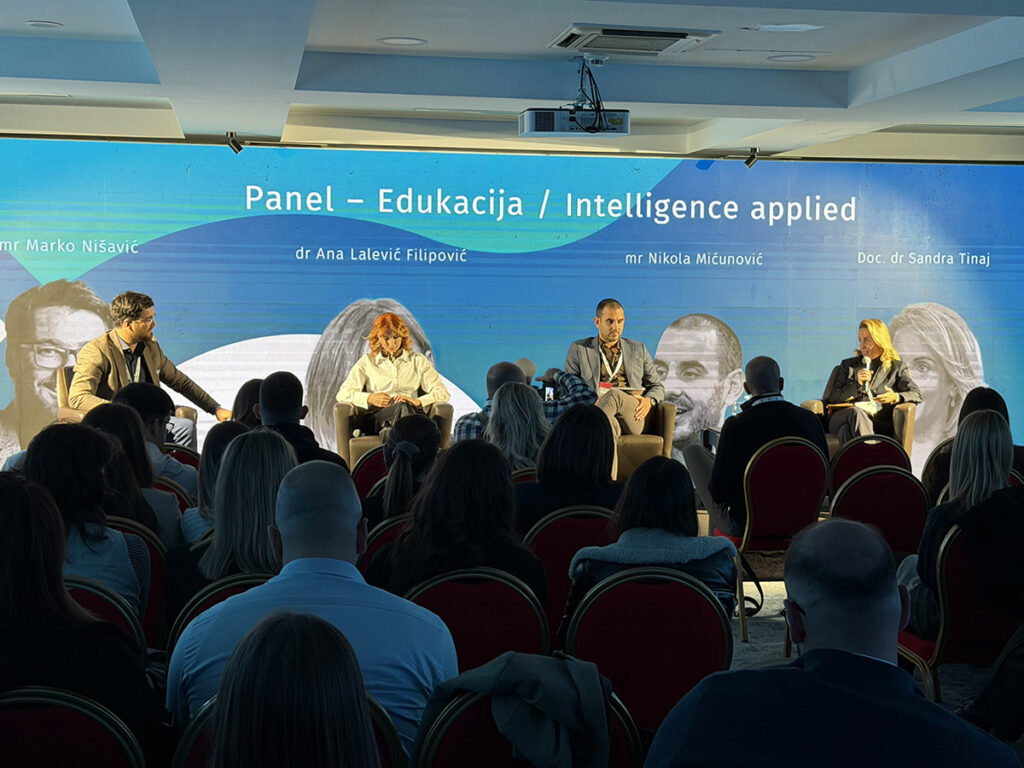
The Check In 2025 conference is designed and took place on two stages, featuring a total of eight panels covering the fields of information technology, investments and innovation, tourism, education and training, startup ecosystems, banking, the entertainment industry, and the FMCG sector.

During the panel “Intelligence applied”, the EUROCC / NCC Montenegro project was introduced by NCC Member, Ms. Sandra Tinaj as an initiative that actively supports digital transformation and the development of innovation and education capacities in Montenegro through a network of services and expertise in High-Performance Computing (HPC), Artificial Intelligence (AI), and Data Analytics.
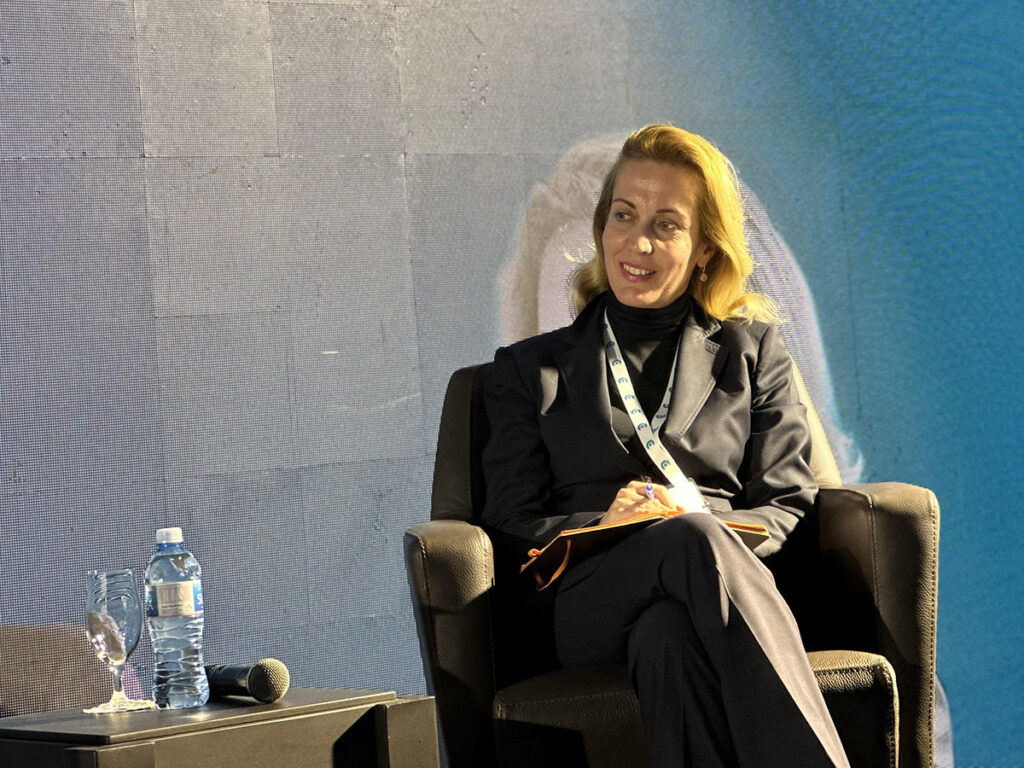
The panel opened an important discussion on Montenegro’s current position on the path of digital development and the key steps in education needed to build a modern, connected, and technologically advanced society. Special emphasis was placed on the role of NCC Montenegro in strengthening cooperation between between the academic sector and the economy, tourism, and the investment environment as a foundation for sustainable economic growth.

Furthermore, within the EXPO zone of the conference, the Municipality of Bar has also ensured the presentation of businesses supported by the local government through programs aimed at promoting entrepreneurship and women’s entrepreneurship. This is intended for additional promotion, networking, and sharing experiences with other participants and connecting with NCC Montenegro.

The participation of NCC Montenegro at the conference reaffirmed its strategic role in connecting research, education, and industry, and in fostering digital and innovation competitiveness in Montenegro
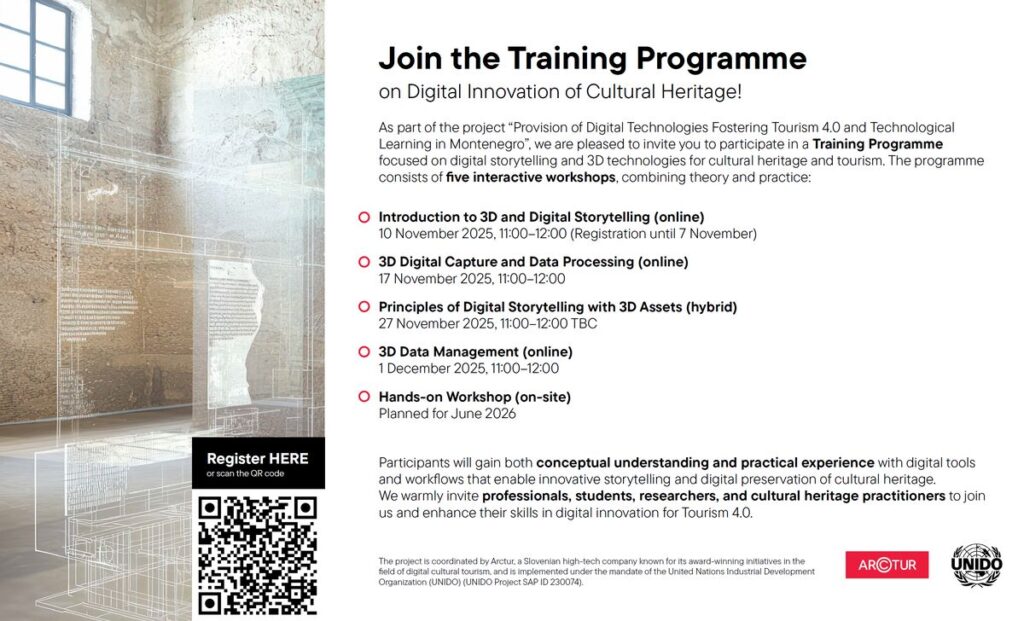
NCC Montenegro Advances Skills through Digital Innovation of Cultural Heritage Training

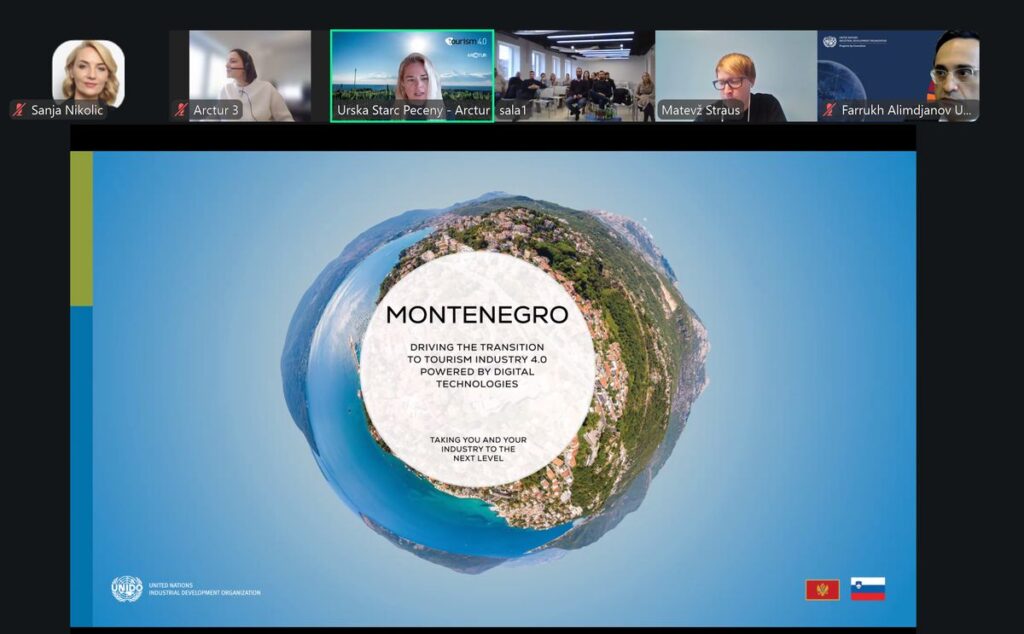
The Training Programme on Digital Innovation of Cultural Heritage, launched by Arctur (NCC Slovenia), aims to bring advanced digital heritage and Tourism 4.0 capabilities to Montenegro. Under this initiative (part of a project coordinated by UNIDO and the Montenegrin Ministry of Tourism), NCC Montenegro joined as a participant, seeking to build capacity in digital storytelling, 3D technologies, and modern approaches to cultural heritage digitisation and preservation.

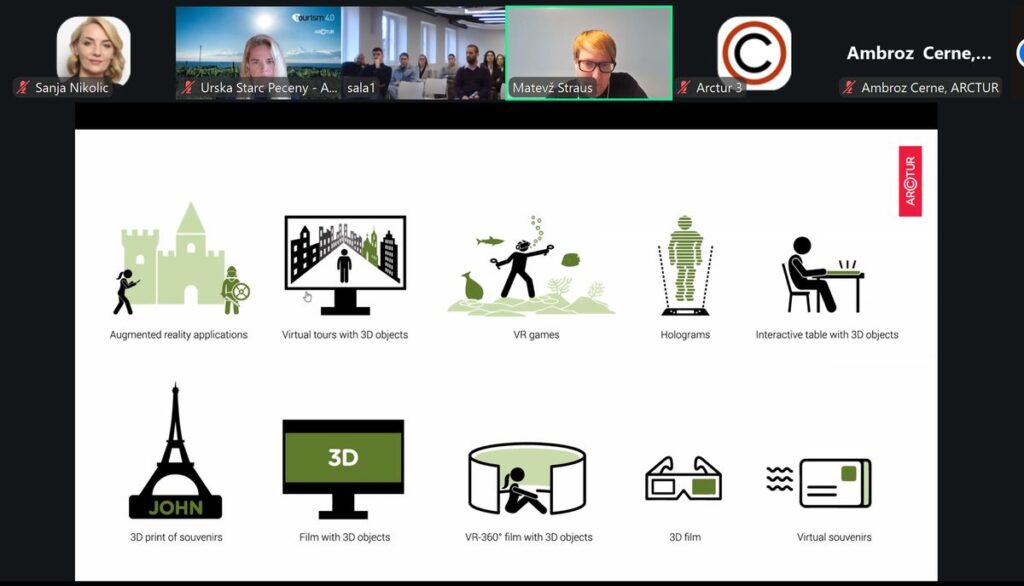
The training aligns with the broader mission of Tourism 4.0: leveraging Industry 4.0 technologies (e.g., 3D modelling, photogrammetry, AR/VR, digital storytelling) to create enriched tourist experiences, boost competitiveness, and support sustainable cultural-heritage-based tourism.

Through participation, NCC Montenegro and other attendees have gained both conceptual and practical knowledge of digital tools, workflows, and methodologies—from 3D capture to storytelling and asset management—enabling them to support digital heritage preservation, immersive storytelling, and innovative tourism products.
For NCC Montenegro, this engagement offers an opportunity to strengthen its role in regional Tourism 4.0 initiatives, cultural heritage digitisation, and digital innovation services, which complements its existing HPC/AI and digital acceleration expertise.

https://www.arctur.si/en/news/training-programme-on-digital-innovation-of-cultural-heritage-launched-in-montenegro

Meeting Between Business Centre Bar and NCC Montenegro

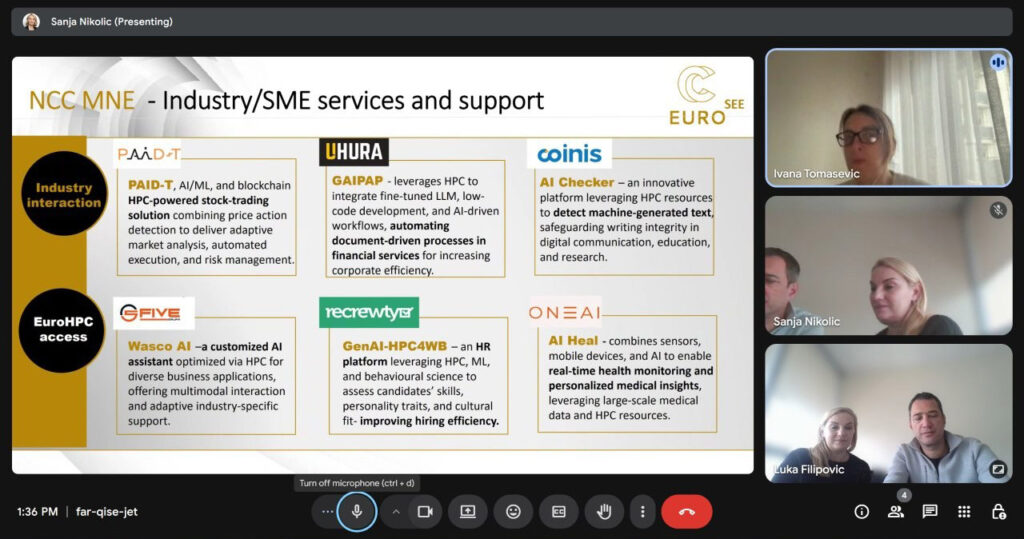
The National Competence Centre for HPC and AI held an initial meeting with the Director of the Business Center Bar, Ivana Tomašević to explore opportunities for supporting local digital entrepreneurship, in line with the growing importance of advanced data analytics and HPC/AI services for competitiveness, innovation, and sustainable business growth.

Business Center Bar is a key regional institution fostering entrepreneurship, innovation, and the growth of start-ups and SMEs by providing business incubator facilities, advisory and mentoring services, training and education, as well as facilitating access to institutional support and financial capital, coordinating local development initiatives, and supporting project development with national and international partners.

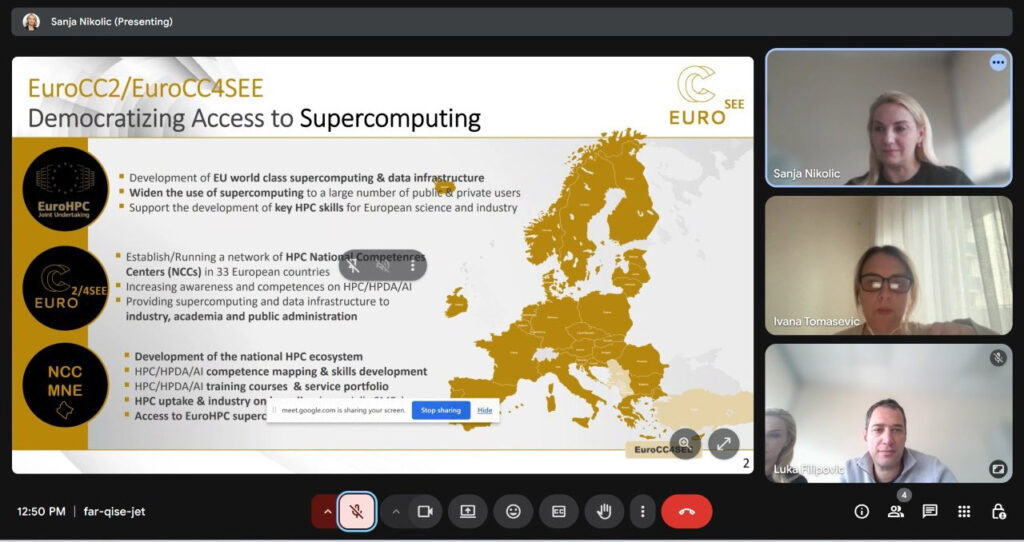
NCC Montenegro presented its portfolio of services, including tailored training programs, industry workshops, technical expertise, and access to supercomputing resources through the EuroCC2/EuroCC4SEE project. The discussion also highlighted HPC and AI success stories of Montenegrin companies, alongside inspirational use cases such as AI-powered tourism prediction models, data analytics for smart destinations, data-driven optimisation in agriculture, and asset-light simulations for SME products.

Both sides discussed local industry needs—including tourism, agriculture, maritime logistics, and creative industries—and opportunities for collaboration. They agreed to pursue joint activities such as sector-focused industry workshops, training support for SMEs, and project cooperation aimed at strengthening regional innovation capacities and R&D initiatives.

HPC in Europe Portal – Europe’s Unified Gateway to Supercomputing

EuroCC is pleased to share the launch of the new HPC in Europe Portal, developed under the CASTIEL2 project and the EuroCC network, in collaboration with the EuroHPC Joint Undertaking. The Portal serves as a centralized platform that unites EU-funded high-performance computing (HPC) resources, services, and expertise in one place. Starting with the first key projects, the portal will progressively expand to encompass the full breadth of Europe’s HPC ecosystem, making supercomputing more accessible and connected than ever before. Portal brings together the National Competence Centres (NCCs), European Centres of Excellence (CoEs) etc. and a comprehensive catalogue of training, events, and service offerings.

One central access point for beginners and experts alike – from researchers to industry – to find:

  • Success Stories & Use Cases
  • Training courses & Events
  • Codes & Best Practices
  • Competences: Expert support and consultancy
  • Specialised HPC software
  • Boosting the Supercomputing ecosystem: Designed to increase visibility, accessibility, and interaction across all of Europe’s HPC community.

The HPC in Europe Portal unites EU-funded supercomputing resources in one hub, making projects more visible, training more accessible, and collaboration across Europe’s HPC community stronger than ever.

“This portal will make Europe’s HPC knowledge, services, and training more accessible than ever,” said Anders Jensen, Executive Director of the EuroHPC Joint Undertaking. “It will empower users of all levels to engage with Europe’s growing supercomputing ecosystem.”

Explore the portal and discover how HPC is transforming research and innovation across Europe here.

Read more here.

Subscribe to the newsletter here

Short course: Building a Neural Network, Code Preparing for Multi-GPU HPC and Running Large-Scale Training

University of Montenegro, a member of NCC Montenegro team, is organizing a short training dedicated to students, young researchers and professionals from industry, willing to learn about using HPC in their work, through a practical example. After learning how to create a simple neural network, training participants will be trained to prepare local environment for the development and then to copy and run the code on HPC, thus enabling model training on multi-GPU HPC.

  • Date: 12.12.2025 at 12:00h
  • Venue: Faculty of Science and Mathematics, University of Montenegro, Room 210
  • Title: Training on Building a Neural Network, Code Preparing for Multi-GPU HPC and Running Large-Scale Training
  • Designed for: students, researchers, and professionals with basic Python knowledge
Short course on Neural networks using Multi-GPU HPC and Running Large-Scale Training

Training content overview

  • Creating simple neural network for defect detection in manufacturing (1h)
  • Explaining docker containerization tool, and preparing local environment for development (2h)
  • Copying local environment to HPC (0.3h)
  • Running model training on multi-GPU HPC (1.2h)

Modern Conversational AI – From Classic NLU to LLMs

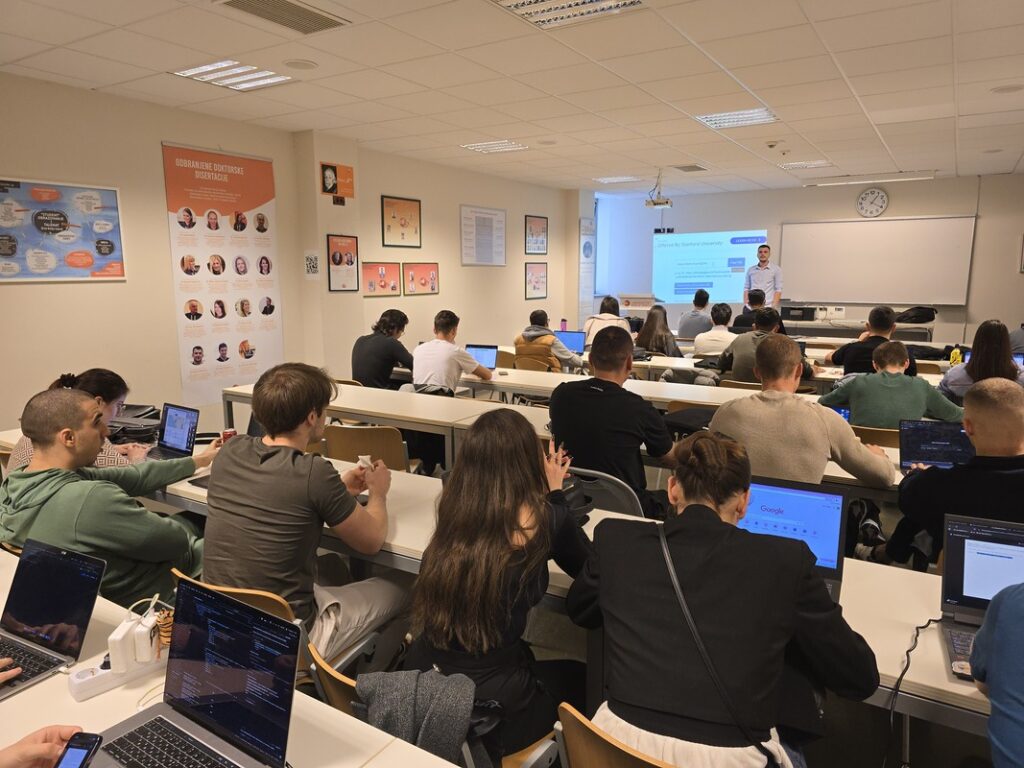
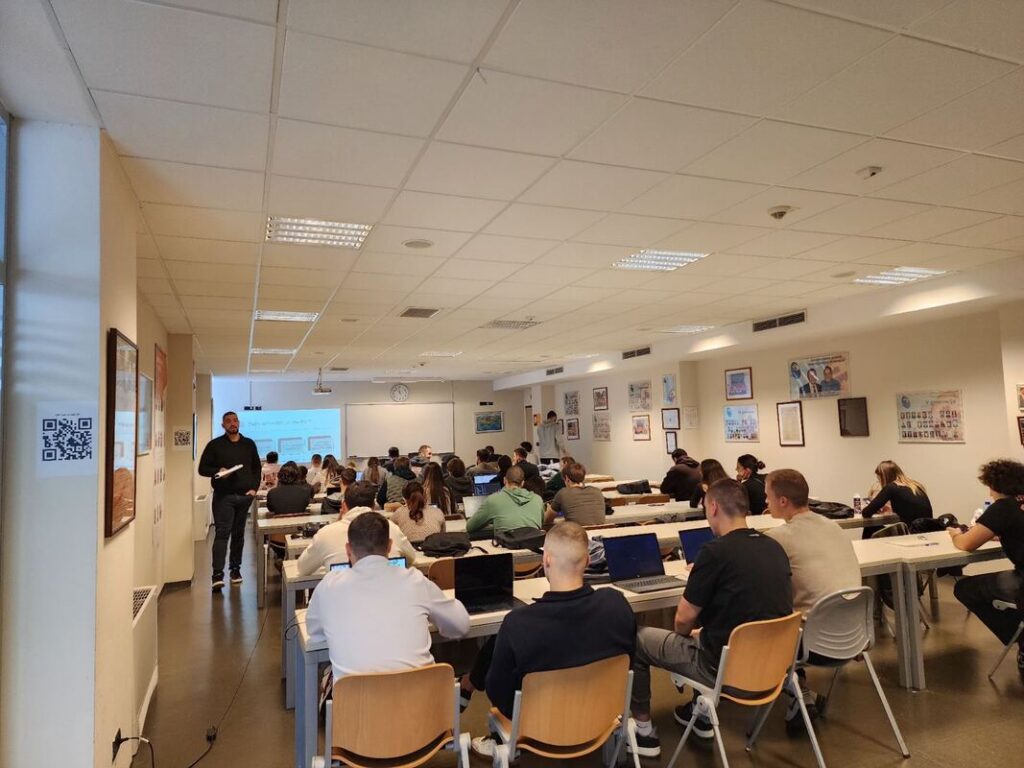
On 21.11.2025, NCC Montenegro successfully delivered a short course as part of the EUROCC 2 and EUROCC4SEE initiatives. The program brought together an excellent cohort of students, researchers, and industry professionals who demonstrated remarkable curiosity, teamwork, and practical problem-solving skills throughout the training.

The course was delivere by mr Dejan Babic and mr Ivan Jovovic

The course explored the evolution of conversational AI, beginning with traditional natural language understanding (NLU) approaches based on intents and entities, and progressing toward modern Large Language Model (LLM) architectures and Retrieval-Augmented Generation (RAG) systems. Participants were introduced to prompt design, tool and function calling, and essential aspects of safety, privacy, and guardrails in AI systems. The curriculum also covered embeddings, vector indexes, hybrid search techniques combining BM25 with dense vectors, and re-ranking strategies for improving retrieval quality.

A significant component of the course was a hands-on laboratory session where participants built a small RAG-based chatbot using domain-specific documents. The HPC perspective was also highlighted, including batch embedding generation, large-scale indexing considerations, and methods for stress testing AI pipelines. The course concluded with live demonstrations using Azure AI Foundry, showcasing Prompt Flow, Evaluate, and AI Search capabilities.

There was around 20 participants in the event

Participants quickly absorbed the theoretical concepts, engaged with thoughtful and challenging questions, and worked independently during practical sessions. By the end of the course, they delivered functional prototype systems featuring grounded answers and clear evaluation reports—demonstrating both strong technical understanding and applied competence.

Short course: Modern Conversational AI — From Classic NLU to LLMs

This short course covers the foundations of conversational systems—classic NLU (intents, entities, slot filling, dialogue design) and modern LLM workflows (prompt engineering, function calling, RAG). Participants build a practical chatbot grounded in their own documents, evaluate quality and safety, and deploy a lightweight interface. An HPC module is included for large-scale embeddings and offline evaluation/load testing.

  • Date: 21.11.2025 at 11:45
  • Venue: PS, UDG
  • Registration required: https://forms.gle/SRW6GYiRAbi8pFBe8
  • Designed for: students, researchers, and professionals with basic Python and web/API skills.
Short course on NLP and LLMs

Course content overview

Session 1 (90 min) – theoretical framework

  • From classic NLU (intents/entities/slots) to LLM “agents”
  • Dialogue design: state machines vs. tools/functions
  • RAG essentials: indexing, chunking, hybrid search, source citations
  • Evaluation & safety: relevance/groundedness, moderation, PII
  • HPC view: when batch embeddings and batch evaluation matter

Session 2 (90 min)- hands-on lab

  • Project setup and starter RAG pipeline
  • Document import/index, prompt + function calling
  • Quick evaluation and guardrails
  • Deploy a web chat

Learning outcomes

  • Contrast intent-based vs. LLM-based chatbots.
  • Design dialogue and implement a grounded RAG pipeline with citations.
  • Ship a lightweight production chatbot with evaluation and safety.
  • Apply HPC techniques to scale embeddings and offline performance testing.