HPC resources to continue research in the field of AI segmentation and inspection by 3D scanning

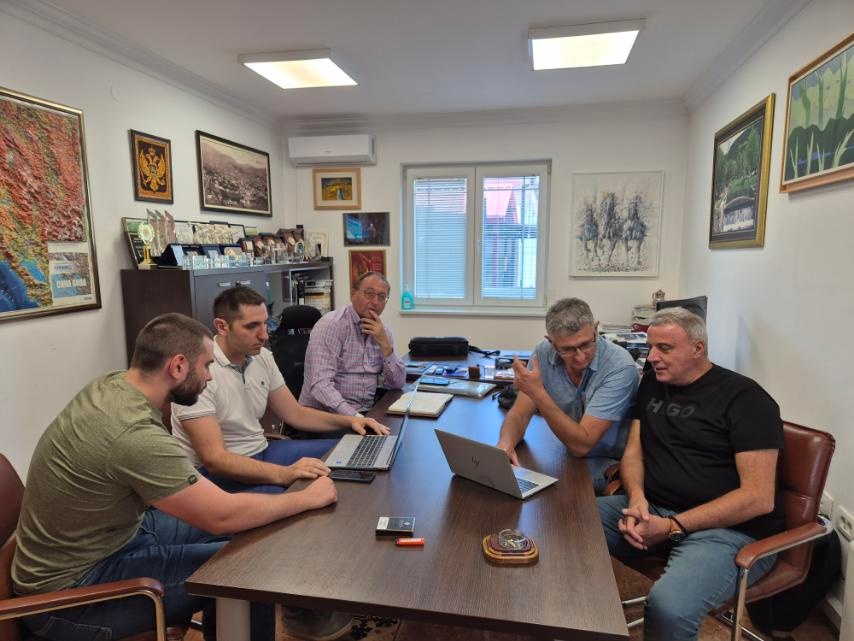
In order to successfully conduct new research directions within the project “AI Segmentation and Inspection by 3D Scanning,” researchers from the Center for Computer Sciences at the Faculty of Science and Mathematics have developed another successful application for utilizing HPC resources provided by EuroHPC Joint Undertaking. After completing the report for previous resource usage under the Benchmark call, and with the support of the NCC Montenegro team from the University of Montenegro, an application was prepared to access the Leonardo supercomputing center under the Development call.
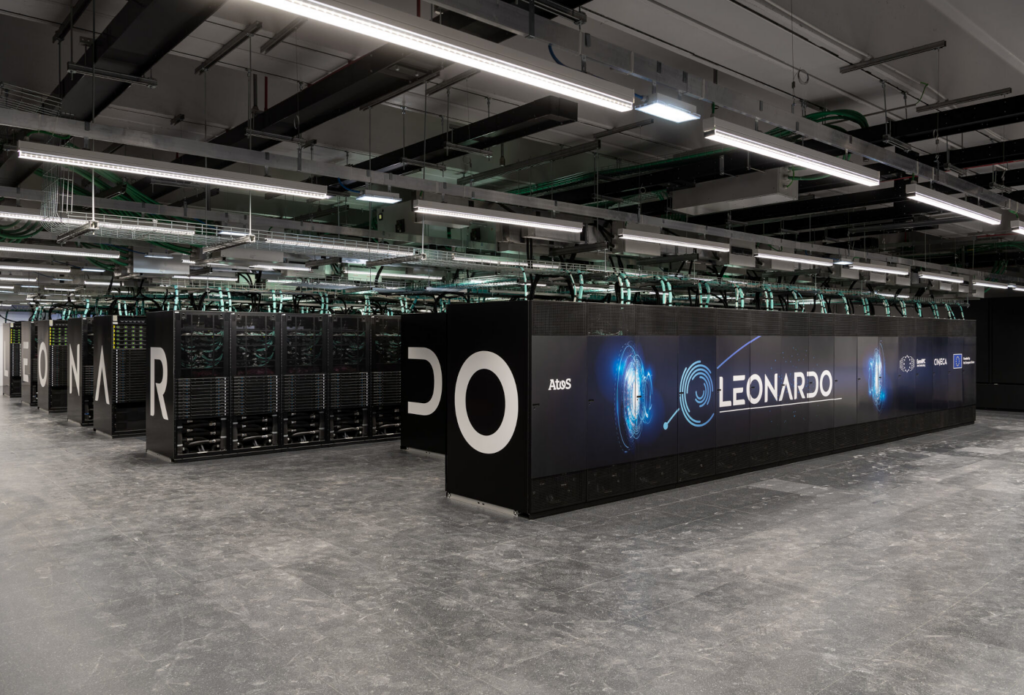
As a result of this project, it is anticipated that the system for automatic segmentation of 3D representations of mechanical assemblies obtained through 3D scanning will be expanded. This opens up possibilities for applications in fields such as reverse engineering, quality control, augmented reality (AR), virtual reality (VR), and more. Additionally, the project is expected to culminate in the defense of a doctoral dissertation in this area.
Another successful application for HPC resources for Five Group

After completing the experiment on the Leonardo booster partition, obtained through the Benchmark Call, Five Group successfully applied for HPC resources again — this time through the Development Call. In consultation with the NCC Montenegro team, it was recognized that their new project idea, stemming from the ongoing “Wasco AI – Custom AI Assistant Optimization via HPC” project, aligns better with the conditions of the Development Call for EuroHPC JU resources. Consequently, Five Group prepared another application with the support of the NCC Montenegro team, and since mid-August, they have once again gained access to the Leonardo Booster partition, this time for a period of one year.

Wasco AI – Custom AI Assistant Optimization via HPC

Conference Paper: Real-time Image Generation on ARM-based Edge Devices

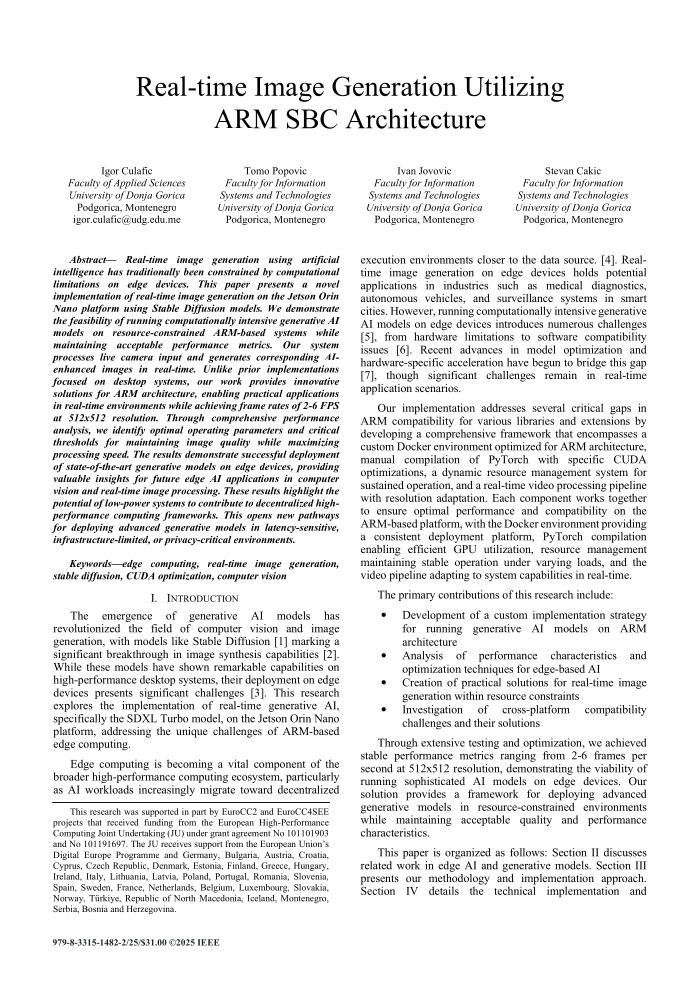
We are pleased to share that researchers from the University of Donja Gorica (UDG) presented their latest work at the 2025 IEEE International Symposium on Applied Sciences (ISAS). The paper, titled “Real-time Image Generation Utilizing ARM SBC Architecture”, is now published by IEEE and available at the following [link].

Click on image to open

The paper, authored by Igor Ćulafić, Tomo Popović, Ivan Jovović, and Stevan Ćakić, explores the deployment of advanced generative AI models on ARM-based edge devices, specifically the NVIDIA Jetson Orin Nano platform. Traditionally, real-time image generation with models such as Stable Diffusion has required powerful desktop GPUs or HPC clusters. This research demonstrates that, through careful CUDA optimization, ARM compatibility adjustments, and dynamic resource management, real-time performance of 2–6 FPS at 512×512 resolution can be achieved directly on low-power edge hardware.

The work addresses thermal management, memory constraints, and software compatibility challenges, proposing a custom ARM-optimized Docker environment and adaptive workload balancing. The results show how decentralized, low-power edge devices can complement high-performance computing ecosystems, opening new opportunities in fields such as healthcare, automotive, and smart city applications.

This publication also reflects the mission of NCC Montenegro to support academia and young researchers in advancing AI and HPC knowledge. By providing expertise, resources, and collaboration opportunities, NCC Montenegro helps integrate cutting-edge research with the broader European HPC ecosystem.

Consultations and Support for ITAS in Preparing the FFplus Application

In June 2025, the NCC Montenegro team from UoM visited ITAS. During the visit, they presented details about FFplus Project Call 2 – Type 1, which focuses on Business Experiments. ITAS, an SME specializing in IT and realizing several innovative projects, recognized this opportunity and decided to prepare a project proposal related to their ongoing fintech project.

NCC Montenegro visiting ITAS

As part of the support services provided by the NCC Montenegro team, professor Božo Krstajić visited ITAS on Thursday, July 31, while professor Enis Kočan participated online in the meeting. During the session, all necessary information about the FFplus project call was shared with the ITAS team. The meeting also discussed the potential involvement of the NCC Montenegro team as a supporting partner, mainly providing technical support for the use of HPC resources.

Next steps for drafting the project proposal and identifying potential partners were agreed upon.