

HPC4S3ME: Building Montenegro’s HPC and AI Research Foundation — From Lab Infrastructure to Live Research
THE PROBLEM / CHALLENGE
High-performance computing and artificial intelligence are increasingly central to research and innovation in virtually every sector — from agriculture and healthcare to energy and tourism. Yet for a university in a small country still on its EU accession path, the gap between ambition and infrastructure can be significant. Before the HPC4S3ME project, young researchers at the University of Donja Gorica (UDG) lacked access to hands-on HPC infrastructure, structured pathways into advanced AI and HPC methods, and the institutional connections needed to tap into European research networks. Conducting computationally intensive research — training deep learning models, running large-scale experiments, or working on data-heavy pilot applications — required improvisation rather than a reliable, managed computing environment.
At the same time, Montenegro’s Smart Specialisation Strategy (S3), adopted in 2019 as the first such strategy by a non-EU country, had identified clear priority domains for innovation, agriculture and food value chains, health, tourism, and energy, but the research base capable of delivering HPC- and AI-driven solutions in these domains still needed to be built. There was a structural need not just for equipment, but for a new generation of researchers trained in HPC and AI methods, embedded in a functioning ecosystem of national and European project collaboration.

SOLUTION
The HPC4S3ME project — “Building scientific and innovation potential to utilize HPC and AI for S3 Smart Specialisation in Montenegro” — was implemented at the University of Donja Gorica, funded through the EU IPA II programme (call reference EuropeAid/172-351/ID/ACT/ME), and carried out in close coordination with NCC Montenegro and the broader EuroCC2/EuroCC4SEE initiative. The project established a dedicated HPC Lab at UDG, initially deploying two computing nodes equipped with NVIDIA T4 GPUs and the SLURM workload management platform. The infrastructure was subsequently upgraded — through cross-project collaboration with the AI-AGE project — with a powerful rack server featuring 48 CPU cores, 128 GB RAM, an NVIDIA L40 48 GB GPU, and a dedicated 24 TB NAS storage system. Researchers were also supported in accessing EuroHPC resources through NCC Montenegro, complementing the in-house lab with European-scale computing capacity.
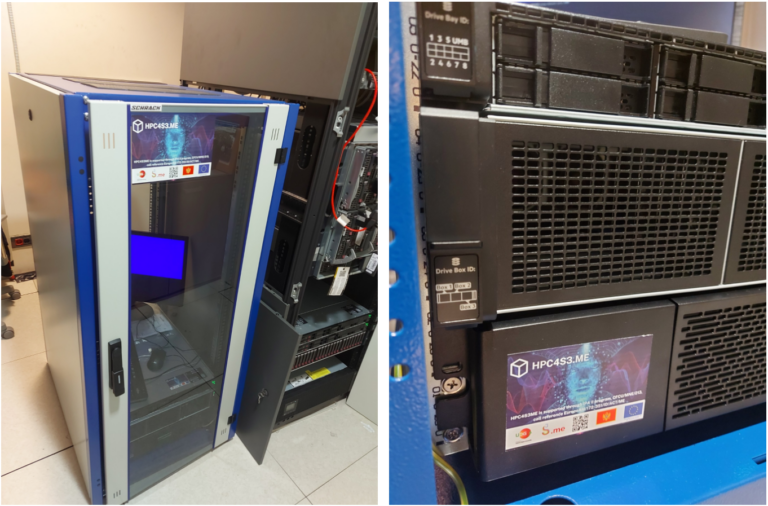
Beyond hardware, the project built human capacity through researcher mobilities, internships, and international partnerships. Pilot research was conducted across all S3 priority domains, with published results in agriculture (AI-based poultry farming and livestock detection), energy (solar panel optimisation), and health (AI-driven biomarker analysis). The project concluded with an HPC/AI Workshop and Student Conference in December 2024, attended by over 50 participants and featuring 19 student project presentations.
BENEFITS
- Permanent HPC infrastructure at UDG: The project established and equipped the first dedicated HPC lab at the University of Donja Gorica — a lasting institutional asset that continues to support research and teaching beyond the project’s lifetime, with hardware further strengthened through cross-project collaboration with AI-AGE.
- New generation of HPC-ready researchers: Through structured mentoring, internships, researcher mobilities, and hands-on project work, HPC4S3ME produced a cohort of young Montenegrin researchers with practical competencies in HPC, machine learning, and deep learning — directly aligned with the country’s S3 innovation priorities.
- Research outputs across S3 priority domains: The project generated peer-reviewed publications and conference papers in agriculture (generative AI for poultry monitoring, livestock detection on edge devices), sustainable energy (solar yield prediction), and health — demonstrating HPC and AI’s practical value across Montenegro’s key innovation sectors.
- Cross-project synergy as a multiplier: HPC4S3ME deliberately connected with complementary initiatives — EuroCC2/EuroCC4SEE, AI-AGE, AIFusion (Innovation Fund of Montenegro), and TRACEWINDU (MSCA H2020) — creating a network of shared infrastructure, expertise, and funding that multiplied the impact of each individual project and modelled a sustainable approach to research capacity building.
- Gateway to European HPC networks: Working in coordination with NCC Montenegro, the project provided researchers with access to EuroHPC resources and embedded UDG within the broader European HPC ecosystem — including outreach to leading international AI research institutions in China.
- A model for HPC adoption aligned with national strategy: By tying HPC and AI capacity directly to Montenegro’s Smart Specialisation Strategy, HPC4S3ME demonstrated how European-funded infrastructure and capacity building projects can be structurally anchored to national innovation priorities, maximising their relevance and long-term impact.
NCC Montenegro provided continuous coordination support throughout the HPC4S3ME project — connecting researchers to EuroHPC infrastructure, contributing to training and capacity building activities, and ensuring that the project’s outcomes fed directly into the broader national HPC ecosystem being developed under EuroCC2 and EuroCC4SEE