

AI-AGE: Using AI and HPC to Discover Non-Invasive Biomarkers of Ageing and Chronic Disease
THE PROBLEM / CHALLENGE
Ageing is the single greatest risk factor for a wide range of chronic diseases — from diabetes and cardiovascular conditions to cognitive decline and cancer. Early identification of individuals at elevated risk, before disease becomes clinically manifest, is one of the most important open challenges in preventive medicine. Yet non-invasive, scalable approaches to early risk assessment remain underdeveloped, particularly in smaller healthcare systems with limited diagnostic infrastructure. In Montenegro, as in much of the region, population-level data on frailty, prefrailty, and multimorbidity in middle-aged adults has until recently simply not existed — making it impossible to design evidence-based early intervention strategies for the most critical window of prevention.

At the same time, advances in medical imaging and machine learning have opened a remarkable scientific opportunity: the retina, accessible non-invasively through standard imaging equipment, serves as a window into vascular and neural tissue health across the entire body. Changes in retinal morphology are associated with the onset and progression of numerous age-related conditions, making retinal image analysis a potentially powerful, low-cost tool for early biomarker discovery. However, training accurate deep learning models on large annotated medical imaging datasets — and validating them across diverse clinical populations — demands significant computational resources, well beyond what standard academic infrastructure can provide.
SOLUTION
The AI-AGE project — “Artificial Intelligence Supported Identification of Novel Non-invasive Biomarkers of Aging” — is a research partnership between the Faculty for Information Systems and Technologies (UDG) and the Faculty of Medicine (University of Montenegro), funded by the Ministry of Education, Science and Innovation of Montenegro (grant no. 04-082/23-2528/1). The project applies machine learning and deep learning techniques — including CNNs (U-Net, ResNet), transformer architectures, ensemble methods, and LLMs for annotation and interpretation support — to large annotated retinal imaging datasets from the UK Biobank, with the goal of identifying novel non-invasive biomarkers of ageing and age-related risk.
Through cross-project collaboration with HPC4S3ME and NCC Montenegro, AI-AGE co-funded a major upgrade to the UDG HPC Lab — deploying a rack server with 48 CPU cores, 128 GB RAM, an NVIDIA L40 48 GB GPU, and a dedicated 24 TB NAS storage system — providing the in-house computational capacity needed to conduct large-scale AI model training and medical data analysis. The project has expanded its clinical scope beyond retinal imaging to include frailty and multimorbidity modelling from primary care data, diabetes and prediabetes screening using self-reported health indicators, and colorectal cancer detection. Results have been published in leading international journals and presented at regional and international conferences, with all primary datasets released publicly on Zenodo in line with open science principles.
BENEFITS
- HPC-enabled medical AI research: The project’s co-investment in the UDG HPC Lab — a dedicated rack server with an NVIDIA L40 GPU and 24 TB of storage — created the in-house computational capacity needed to train and validate deep learning models on large medical imaging and clinical datasets, establishing a lasting infrastructure asset for healthcare AI research in Montenegro.
- Multi-domain AI toolbox for ageing and chronic disease: Beyond retinal analysis, the project has developed and validated interpretable ML models for frailty risk, diabetes and prediabetes screening (using LightGBM with SHAP-based explanations), and colorectal cancer detection — building a versatile portfolio of AI-assisted clinical decision support tools grounded in rigorous evidence.
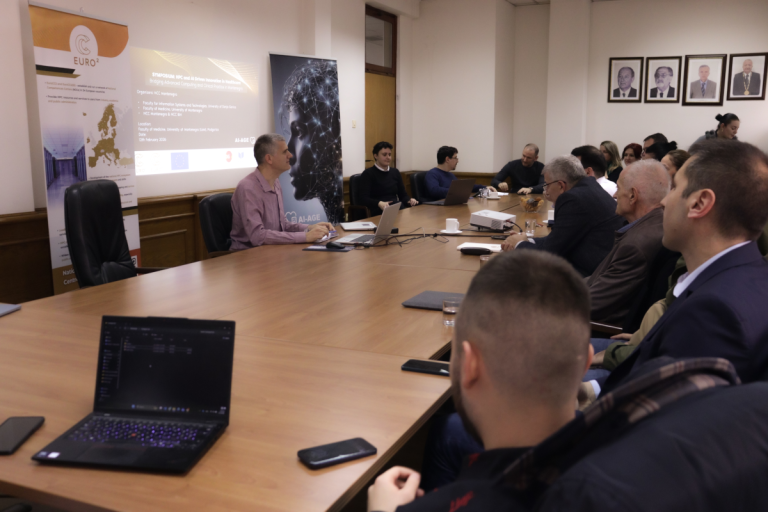
- Cross-project synergy as an accelerator: AI-AGE deliberately connected with HPC4S3ME, EuroCC2/EuroCC4SEE, and NCC Montenegro, co-investing in shared infrastructure, co-organising the regional Symposium on HPC and AI in Healthcare, and creating a collaborative ecosystem where expertise, data, and computing resources flow across projects — multiplying the impact of each individual initiative.
- Regional platform for HPC and AI in healthcare: Through co-organisation of the HPC and AI in Healthcare Symposium — a joint initiative with NCC Montenegro and NCC Bosnia and Herzegovina — AI-AGE helped establish Montenegro as a visible contributor to the regional conversation on responsible, clinically relevant AI adoption in medicine.
NCC Montenegro coordinated closely with the AI-AGE team throughout the project — supporting HPC infrastructure planning, connecting the project to EuroHPC resources and the broader EuroCC ecosystem, and co-organising the regional healthcare symposium that positioned AI-AGE’s results within the wider South-Eastern European HPC and AI landscape.