
Exams 4.0
2025/06 – 2026/12
The Exams 4.0 project – AI-based exam generation and evaluation is an innovative initiative aimed at modernising knowledge assessment processes in higher education through the application of artificial intelligence (AI) and high-performance computing (HPC). The project is implemented in collaboration between University of Donja Gorica and the company DigitalSmart, with support from the EuroHPC JU Development Call and the Innovation Fund of Montenegro, and aims to develop and validate a proof-of-concept (PoC) solution that demonstrates how advanced AI models can enhance the quality, fairness, and efficiency of academic assessment.

Within the project, a specialised large language model (LLM) tailored to the needs of university education is being developed, capable of automatically generating exam questions and evaluating student answers based on course materials, historical exam archives, and anonymised student submissions. Training and optimisation of the model require the processing of large, multimodal datasets (text, images, and video), which is achieved through the use of advanced supercomputing resources, primarily LUMI-G, with an alternative option of utilising the local HPC cluster at the University of Donja Gorica.

The PoC phase focuses on validating the technical feasibility, scalability, and reliability of the solution, as well as assessing its potential to reduce the workload of academic staff, standardise assessment criteria, and mitigate subjectivity in grading. In the longer term, Exams 4.0 illustrates how the integration of HPC and AI can transform higher education processes and business models, enable more personalised learning pathways, and contribute to the development of sustainable, digitally supported academic environments across Europe.
Međujezičko učenje LLM modela sa finim podešavanjem
2025/07 – 2026/07
The Cross-Lingual Training with Parameter-Efficient Fine-Tuning in Large Language Models project is a research initiative focused on the development and validation of advanced cross-lingual transfer learning methods in large language models (LLMs), with particular emphasis on low-resource languages. The project is carried out with support from EuroHPC JU through a Development Call providing access to high-performance GPU resources, and aims to demonstrate a proof-of-concept (PoC) approach that bridges theoretical insights on model scaling laws with practical constraints of computational resources.
Within the project, a systematic evaluation of state-of-the-art LLM architectures—such as LLaMA, Mistral, and DeepSeek—is conducted across a wide range of model scales, from smaller configurations to very large models with tens of billions of parameters. By applying parameter-efficient fine-tuning techniques, the project investigates how knowledge learned from high-resource languages can be effectively transferred to underrepresented languages, while preserving model stability, controlling training costs, and avoiding catastrophic forgetting. The use of EuroHPC supercomputing infrastructure, primarily the LEONARDO Booster GPU system, enables the training, optimisation, and comparative analysis of large-scale language models that are not accessible in standard academic or local HPC environments. This provides an experimental foundation for validating methods that are directly relevant to realistic, resource-constrained research scenarios.
The PoC phase focuses on validating the technical feasibility, scalability, and efficiency of the proposed approach, while the resulting findings offer practical guidelines for selecting appropriate model architectures, model sizes, and fine-tuning strategies under limited computational budgets. In the longer term, the project contributes to strengthening digital sovereignty, linguistic inclusiveness, and the accessibility of advanced AI technologies for European academic and research institutions, laying the groundwork for broader adoption of large language models in multilingual educational, administrative, and societal contexts.
PollenTrace
2025/04 – 2026/04
PollenTrace introduces a cutting-edge, data-driven platform designed to verify honey authenticity through AI-powered pollen analysis. Leveraging advanced machine learning and computer vision models, the platform analyzes pollen content to accurately determine the geographical and botanical origins of honey. By developing and training predictive models using established datasets such as MedExLab, PollenTrace offers an innovative solution to combat honey fraud while enhancing consumer trust. The project is implemented by the Faculty for Food Technology, Food Safety and Ecology and it is supported by the Innovation Fund of Montenegro.
The platform prototype will validate the accuracy and reliability of the AI models, ensuring high performance in identifying pollen types and verifying honey authenticity. It will also provide significant support to laboratory personnel by automating analyses, accelerating testing processes, and improving result accuracy.
The primary goal of the project is to develop, refine, and implement tools for honey authenticity verification, offering essential support to both honey producers and laboratory professionals, while increasing transparency across the supply chain. Through the application of data-driven technologies, PollenTrace aims to boost consumer confidence, protect the integrity of honey products, and contribute to the long-term sustainability of the honey production industry.
GenAI-HPC4WB
2025/02 – 2026/06
The GenAI-HPC4WB project combines generative AI, machine learning, and high-performance computing (HPC) to optimize hiring processes and enhance business culture in the Balkan region. It analyzes psychometric data, CVs, and interviews using AI models tailored to Montenegrin, Serbian, Bosnian, and Croatian. The project evaluates over 10,000 CVs with models like LLaMA 3.0 and Mistral, analyzes voice recordings to detect traits like confidence, and studies video interviews to identify emotions and micro-expressions. HPC resources enable efficient processing of large datasets, improving the accuracy and scalability of these AI-driven assessments.

Aimed at transforming recruitment for organizations of all sizes, the project enhances candidate evaluations by integrating psychometric data with multimodal AI analysis. It streamlines hiring by reducing bias and offering deeper insights into candidates’ skills and cultural fit. By leveraging HPC, GenAI-HPC4WB delivers scalable and efficient hiring solutions, setting new standards in AI-driven recruitment. The project is implemented through partnership with Recrewty DOO as a FFPlus Open Call #1 Experiment. FFPlus receives funding received funding from the European High-Performance Computing Joint Undertaking (JU) under grant agreement No 101163317. The JU receives support from the Digital Europe Programme. More info at [link].
AI-AGE
2024/01 – 2026/12
The eye serves as a window for non-invasive assessment of retinal vascular and neural tissue, offering valuable insight into our health. Extensive research has established the association between changes in retinal morphology and the increased risk for many age-related chronic diseases. These changes are also linked to healthy aging, albeit more pronounced in the presence of age-related chronic conditions. This project is implemented as collaboration between Faculty for informations systems and technologies at University of Donja Gorica and Faculty of medicine at University of Montenegro. The prokject is funded as scientific research grant by the Ministry of Education, Science and Innovation.

The AI-AGE project proposes the use of machine learning (ML) algorithms and evaluation of state-of-the-art AI tools to train and create prediction models to identify novel non-invasive biomarkers of aging, and increased risk for development of age-related conditions. The idea is to utilize a large dataset of annotated retinal images from the UK Biobank, to explore deep learning (DL) techniques, most commonly based on convolutional neural networks (CNNs), such as U-Net and Res-Net, and transformers, but also to expand the research on the use of ensemble methods that combine ML techniques to improve performance and accuracy. More info at [link].

HPC4S3ME
2023/01 – 2024/12
The full title of this new project is “Building scientific and innovation potential to utilize HPC and AI for S3 Smart Specialisation in Montenegro – HPC4S3ME” and it is funded by the IPA II program, call reference EuropeAid/172-351/ID/ACT/ME.
The overall objective of HPC4S3ME project is to contribute to straightening research excellence by building scientific and innovation potential based on the use of high performance computing and artificial intelligence (AI) for applications in industrial domains proposed by the Smart Specialisation Strategy (2019-2024) for Montenegro. The implementation of this project will provide a state-of-the-art environment for young researchers to gain experience in research and development in computer science, more specifically to apply machine learning and deep learning algorithms supported by HPC in order to create innovative information-communication technology solutions for applications in agriculture and food value chain, health and tourism, energy and sustainable environment, namely the priority domains identified by the smart specialisation strategy. More info at [link]

AI Fusion
2024/09 – 2024/12
Artificial intelligence in agriculture, medicine and energy (AI Fusion) supported by the Innovation Fund of Montenegro
The University of Donja Gorica, with the support of the Innovation Fund of Montenegro, as part of the program for the organization of education in the areas of smart specialization of Montenegro, organizes a three-month training called “AIFUSION – Artificial intelligence in agriculture, medicine and energy.” The course will be held in the period from the end of September (September 21) to the end of December (December 21) 2024. Leanr more about the conference at [link].
AI4S3
2023/09 – 2023/12
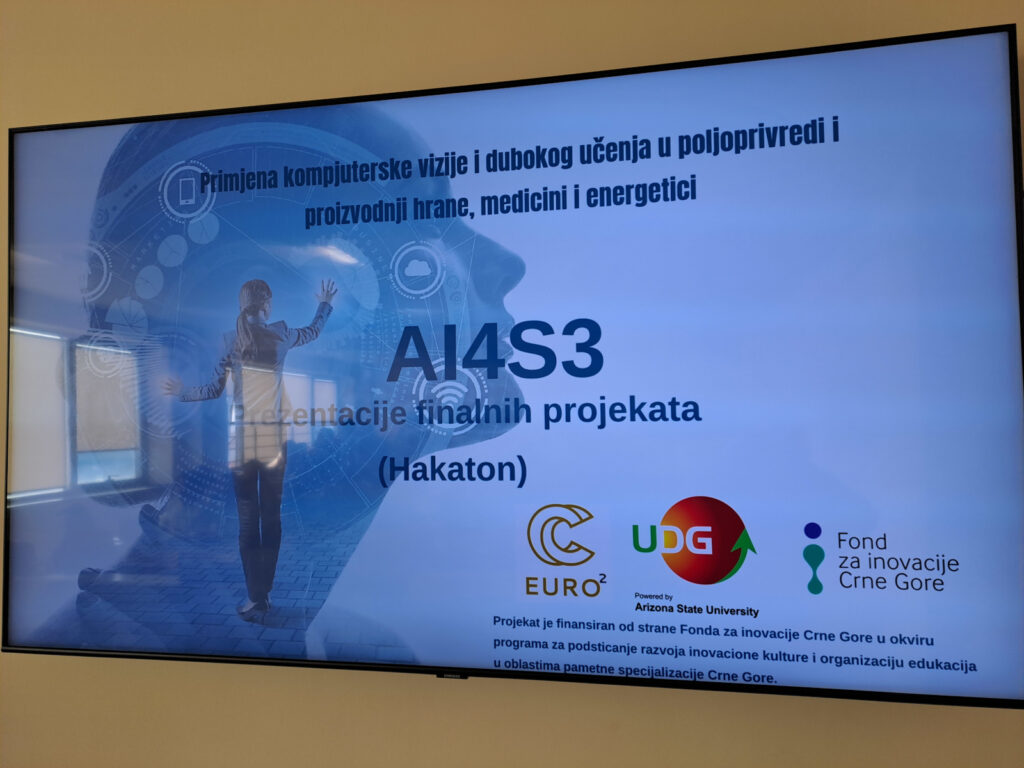
Application of computer vision and deep learning in agriculture and food production, medicine and energy (AI4S3) co-funded by the Innovation Fund of Montenegro.
NCC Montenegro team members and the Faculty of Information Systems and Technologies (UDG), with the support of the Innovation Fund of Montenegro as part of the program to encourage the development of innovation culture and the organization of education in the areas of expertise in Montenegro, organizes a three-month training called “AI4S3 – Application of computer vision and deep learning in agriculture and food production, medicine and energy” which will be held in the period from the beginning of October to the end of December 2023. More about the project at [link].
AIMIGH (FF4EuroHPC experiment)
2021/05 – 2022/08
AI/ML Enabled by HPC for Edge Camera Devices for the Next Generation Hen Farms and it is funded as an application experiment within Horizon 2020 FF4EuroHPC project.
The AIMHiGH project proposes the use of HPC and deep learning AI to create prediction models that can be deployed on the edge devices equipped with camera sensors for the use in IoT/AI solutions in the poultry sector. UDG will be providing HPC and domain expertise through NCC Montenegro and FoodHub Centre of Excellence. The AIMHiGH project proposes the use of HPC and deep learning AI to create prediction models that can be deployed on the edge devices equipped with camera sensors for the use in IoT/AI solutions in the poultry sector. DunavNET provides an expertise in AI/ML, IOT and software development, while University of Donja Gorica will be providing HPC and domain expertise through NCC Montenegro and FoodHub Centre of Excellence. Montenegrin companies Meso-promet Franca and Radinović Company will be taking part in the evaluation and piloting process. The project is fully aligned with the priorities of S3 Smart Specialisation strategy for Montenegro. More information at [link].

FoodDecide
2021-2024
Digital Technologies for Food Safety Decision Support
This project focused on developing efficient decision-support guidelines for Montenegrin food business operators and government agencies involved in food safety and disease outbreak investigations. It leveraged the research, expertise, and resources established at BfR and KLU in open-source software development, algorithm design, and food supply chain modeling. Key topics included data analytics and machine learning algorithms, which were simulated and applied to large datasets within food supply chains. The project is implemented by The German Federal Institute for Risk Assessment (BfR), Kühne Logistics University (KLU) and University of Donja Gorica (UDG) – Centre of Excellence for Digitalisation of Microbial Food Safety Risk Assessment and Quality Parameters for Accurate Food Authenticity Certification (FoodHub). Funding for the project was provided through the program “Stärkung Deutschlands im Europäischen Forschungs- und Bildungsraum” to support research and development initiatives between Germany and the Western Balkan countries (WBC2019).