

Combining Computer Vision and Clinical Data Analysis
Artificial intelligence can support medical diagnostics in very different ways, from analysing complex medical images to identifying patterns in structured clinical and laboratory data. This proof of concept explored both directions through two complementary use cases: detection of ovarian tumour changes in histopathology images and prediction of pneumonia from clinical data. The work was carried out by Anesa Abazović as part of her MSc research at the University of Donja Gorica within the MSc programme in Artificial Intelligence. The research was supported in part through the EuroCC2 and EuroCC4SEE projects and through the broader training, mentoring, and AI capacity-building activities of NCC Montenegro.
CHALLENGE
Medical decision-making increasingly relies on large volumes of heterogeneous data. Histopathology images require careful visual interpretation, while clinical assessment may depend on combining many laboratory, demographic and physiological variables. In both cases, AI can help identify relevant patterns and provide an additional analytical layer, but any proposed system must be evaluated carefully before it can be considered for clinical use.
SOLUTION
The proof of concept combined two AI workflows. The first used YOLOv8 computer vision to detect and localize ovarian tumour changes in histopathology images. The second compared machine-learning and deep-learning approaches for pneumonia prediction using structured clinical data, including XGBoost, Random Forest, logistic regression and a fully connected neural network.
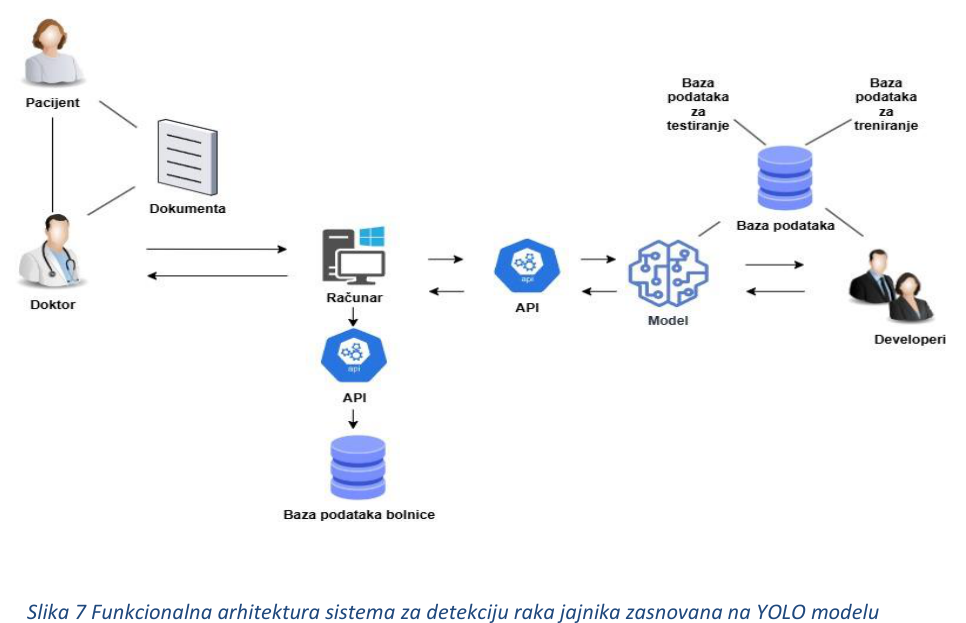
For the ovarian-cancer use case, a functional prototype was also developed using a simple web interface that allows a medical image to be uploaded and analysed by the trained YOLO model. The proposed system architecture considers the wider workflow around the model, including the clinician, application interface, API, data storage and model maintenance.
For pneumonia prediction, the workflow covered data collection and cleaning, target-variable preparation, dataset splitting, model training, performance evaluation and interpretation of results. The study considered a broad set of evaluation metrics rather than relying on accuracy alone.
RESULTS
The YOLOv8 model achieved an overall mAP50 of 0.922 and mAP50–95 of 0.688. For the tumour class, mAP50 reached 0.963, indicating promising performance for the experimental dataset. The results also showed that performance did not improve automatically with more epochs or class balancing, underlining the importance of empirical model tuning rather than assuming that a more complex training setup will always produce better results.
For pneumonia prediction, XGBoost was selected as the most balanced model for further analysis. It achieved precision of 0.97, sensitivity of 0.84, accuracy of 0.85, specificity of 0.71, F1-score of 0.84, ROC-AUC of 0.86 and MCC of 0.71. Other models achieved competitive values on some metrics, but showed stronger class-specific behaviour and signs of overfitting, making XGBoost a more stable compromise within the scope of the experiment.
The work should be considered a proof of concept rather than a clinically validated diagnostic solution. The study used limited datasets, did not apply cross-validation, and identified overfitting in part of the modelling pipeline. Larger and more diverse datasets, external validation and clinical evaluation would therefore be necessary before real-world deployment.
BENEFITS
- Two complementary AI approaches: computer vision for image-based detection and machine learning for structured clinical data.
- A functional proof-of-concept workflow for AI-assisted analysis of ovarian histopathology images.
- Promising tumour-detection performance, with YOLOv8 reaching mAP50 = 0.922 overall and 0.963 for the tumour class.
- A structured comparison of several models for pneumonia prediction, with XGBoost offering a strong balance between precision and prediction stability.
- A reusable development methodology covering data preparation, model training, evaluation, visualization and interpretation.
- Practical experience in responsible AI for health, including consideration of interpretability, data privacy, bias and system integration.
The project illustrates how AI education, mentoring, and applied research within the HPC Montenegro ecosystem can support concrete experimental solutions in high-impact domains such as healthcare.