

GenAI-HPC4WB FFplus Project
THE PROBLEM / CHALLENGE
HR and recruitment technology has advanced rapidly in recent years, but these advances have largely been built around major world languages — above all English. The languages of the Western Balkans — Montenegrin, Serbian, Bosnian, and Croatian — share a common linguistic root but carry distinct vocabulary, professional register, and regional context that general-purpose AI models handle poorly. When applied to tasks such as parsing CVs, understanding job descriptions, or matching candidates to roles in these languages, off-the-shelf LLMs produce results that are too imprecise for practical use, limiting the ability of regional companies to benefit from modern AI-assisted recruitment tools.
Addressing this gap requires fine-tuning powerful pre-trained language models on domain-specific, regionally relevant datasets — a process that is computationally far beyond the reach of standard hardware. Training and adapting large language models such as BERTić (a BERT-based model developed specifically for South Slavic languages), LLaMA 3.0, and Mistral to perform well in the Western Balkans professional context demands access to large-scale GPU compute. Without that, the linguistic quality of regional AI tools remains stuck well behind what is available in larger language markets.

SOLUTION
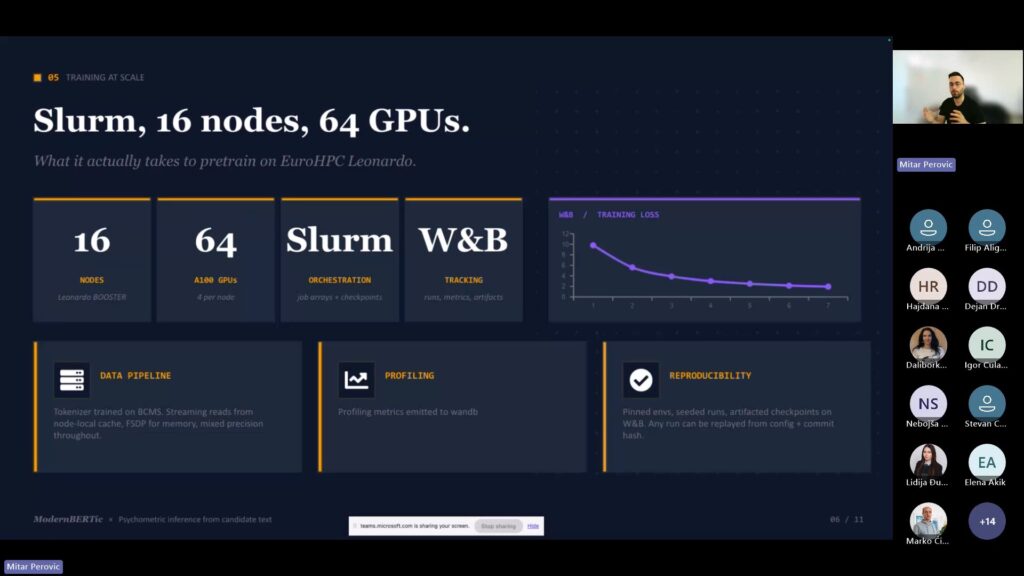
The two Montenegrin SMEs — Recrewty (an AI-assisted recruitment platform) and DigitalSmart — collaborated on the GenAI-HPC4WB project under FFPlus Open Call #1, receiving funding from the European High-Performance Computing Joint Undertaking (EuroHPC JU) under grant agreement No. 101163317 (Digital Europe Programme). With the guidance and support of the University of Donja Gorica (UDG) and NCC Montenegro, the project secured access to the Leonardo Booster supercomputer (EuroHPC JU, CINECA, Italy) through the Development Access Call. The primary use of HPC resources was the fine-tuning of BERTić and other open-source LLMs on anonymised, domain-specific textual datasets in Montenegrin, Serbian, Bosnian, and Croatian — with no personal data transferred to the HPC infrastructure at any stage. The result is a set of regionally adapted language models that significantly improve the platform’s ability to process professional text in these languages. The broader GenAI-HPC4WB platform uses these improved models to support CV analysis and job-description matching, providing recruiters with better-quality language understanding tools for the Western Balkans market. The project is now in its final stage.
BENEFITS
- Improved regional language AI: Fine-tuning BERTić and other LLMs on the Leonardo Booster supercomputer produced language models with substantially better understanding of Montenegrin, Serbian, Bosnian, and Croatian in professional and recruitment contexts — a capability gap that previously hindered the adoption of AI tools across the region.
- HPC-enabled scale and speed: The GPU resources of the Leonardo Booster allowed large-scale model training and iterative experimentation that would have been impractical on standard hardware, significantly shortening the development cycle for regionally adapted AI models.
- Privacy-by-design approach: No personal or candidate data was sent to the HPC infrastructure. All fine-tuning was performed on anonymised textual datasets, ensuring full compliance with GDPR and alignment with the EU AI Act framework from the outset.
- Accessible AI tools for regional SMEs: The improved language models support recruitment platforms in processing CVs and job descriptions in local languages with greater accuracy, helping companies of all sizes benefit from AI-assisted hiring workflows without replacing human judgement in the process.
- A replicable model for Western Balkans HPC uptake: This project demonstrates that Montenegrin SMEs, supported by NCC Montenegro and UDG, can successfully access and leverage top-tier European HPC infrastructure to build commercially relevant AI products for underserved regional language markets.
NCC Montenegro and the University of Donja Gorica supported the project, primarily for the initial FFPlus application and Leonardo Booster access request.