

AIHeal: Personalised AI Models for Every Patient
THE PROBLEM / CHALLENGE
Cardiovascular diseases remain the leading cause of death worldwide, and electrocardiogram (ECG) analysis is one of the most widely used tools for their early detection. However, conventional AI models developed for ECG interpretation are typically trained on large general-purpose datasets and applied uniformly across patients — a one-size-fits-all approach that fails to account for the significant physiological variation between individuals. What is normal for one patient may be a warning sign for another, and generic models are often too imprecise to capture such subtle, patient-specific anomalies reliably. This fundamental limitation reduces the clinical value of AI-assisted cardiac monitoring and leaves a significant gap in the personalisation of digital health solutions.
Building truly personalised AI models — one for each patient, continuously updated as new data becomes available — is computationally far beyond the reach of standard infrastructure. Training and retraining hundreds or thousands of individual models simultaneously, running large numbers of experiments in parallel, and integrating the results back into a live production environment demands the kind of massive GPU compute capacity that only a world-class supercomputer can provide. Without access to such resources, the vision of a genuine “digital twin” for every patient remains out of reach for an SME operating with conventional hardware.
SOLUTION
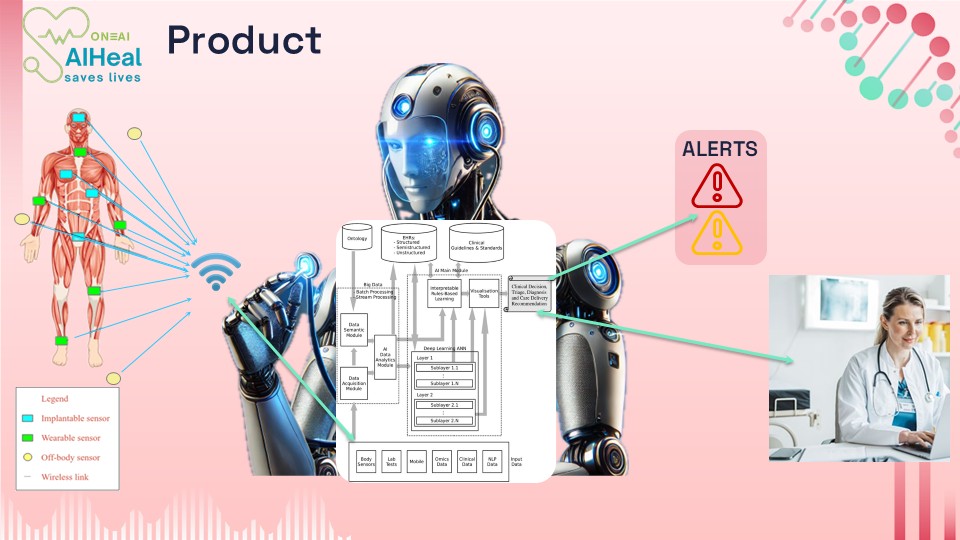
The Montenegrin company ONEAI, through its AIHeal project, addressed this challenge by building a dynamic HPC pipeline on the LUMI-G supercomputer — one of the most powerful EuroHPC JU systems in Europe, hosted in Finland — accessed through the EuroHPC access programme with the support of NCC Montenegro. The pipeline automates the full model lifecycle: patient data is collected from the AIHeal platform, transmitted to LUMI for GPU-accelerated training, and the resulting personalised models are returned to the production environment and registered in the MLflow model management system. This architecture creates a true “digital twin” for each patient — an AI model calibrated to that individual’s unique physiological profile — with the capability for continuous retraining as new ECG data accumulates. LUMI’s multi-GPU parallelisation enabled the simultaneous execution of a large number of training experiments, significantly accelerating the identification of optimal models and improving overall solution quality.
BENEFITS
- Clinically superior anomaly detection: Personalised patient models substantially outperform generic AI approaches in detecting ECG anomalies, since each model is tailored to the individual’s own physiological baseline rather than a population average.
- Scalable “digital twin” architecture: The automated pipeline — from data ingestion to model deployment and registration — makes it operationally feasible to maintain and continuously retrain a unique AI model for every patient, at scale.
- Massive acceleration through EuroHPC resources: Parallel training across multiple GPU units on the LUMI-G supercomputer drastically reduced the time needed to explore model configurations and identify optimal solutions, enabling rapid iteration that would be impossible on conventional hardware.
- Seamless integration into production: The end-to-end connection between the AIHeal clinical system, the LUMI supercomputer, and the MLflow registry ensures that improved models flow automatically into the live environment without manual intervention.
- Proven results and renewed access: Following the successful completion of the first project cycle, the AIHeal project was granted renewed access to EuroHPC computational resources — a direct recognition of the quality and impact of the results achieved.
- Pathway to broader healthcare impact: The next phase will use continued EuroHPC access to expand the system to a wider range of cardiovascular and other health-related indications, amplifying the clinical and commercial reach of the platform.
NCC Montenegro supported ONEAI in applying for and securing access to the LUMI-G EuroHPC supercomputer, providing the gateway through which this Montenegrin SME was able to compete and innovate at a European scale.